




Spot Market Freight Availability Stable, Rates Generally Slip
The amount of freight available on the spot market remained stable over the past week, while rates have improved little if any, according to freight matching service provider DAT -- but things could turn around soon.

The amount of freight available on the spot market remained stable over the past week, while rates have improved little if any, according to freight matching service provider DAT -- but things could turn around soon.
Available loads fell 1% August 3 through August 9 compared to the previous seven days, while spot market truck capacity increased just 0.2%
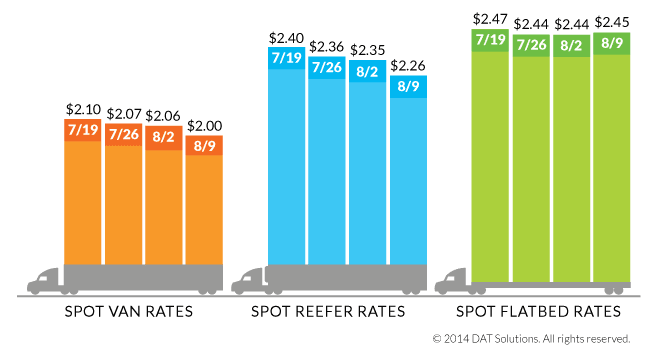
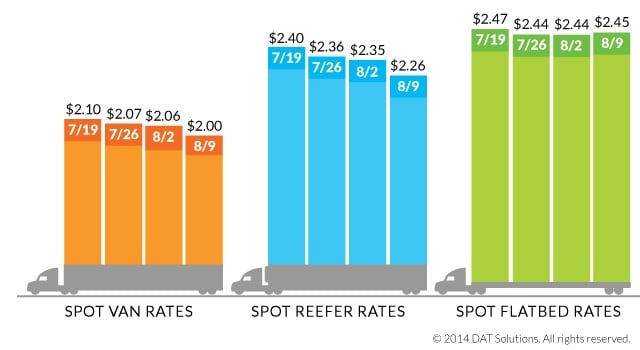
The average flatbed rate gained 0.4% to $2.45 due to continued high demand and limited capacity. In contrast, vans fell 2.9% to $2.00 per mile. Compared to three weeks ago, van rates are down 10 cents. Also down were reefers, by 3.8% to $2.26 per mile, marking a 14-cent decline over the past three weeks. However, reefer rates are still 11 cents higher than the August 2013 average.
Load-to-truck ratios were mixed, with reefers posting a 3.1% increase to 9.2 to 1, while vans added 0.7% hitting at 3.1 to 1. Flatbeds had the only decline, sinking 4.9%, but ratios are still high at 34.6 to 1.
Despite rates and freight generally declining this week and just the former the week before, this was expected, said DAT in late July in its Freight Talk Blog. However, the trend may not last for long, due to harvests in the late summer to near Winter and recent indications of a slowly improving American economy.
Now there is an added expectation for higher rates, tighter capacity due to new regulations, according to a blog post earlier this week. It points out since new hours-of-service regulations went into effect just over a year ago, trucking productivity has fallen. At the same time, expected new rules covering increased insurance requirements, electronic logging devices, enforcement by the California Air Resources Board, among other regulatory matters, could further constrain trucking’s already tight capacity.
More Fleet Management

Give Your Trucking Fleet a Cybersecurity Walkaround
Your fleet's cybersecurity policies may look good on paper. These seven checks can help you find out whether they’re working.
Read More →
Kodiak Lines Up Fleets for Driverless Trucking
An agreement for 75 trucks, a new Texas freight lane, and progress on safety validation move Kodiak closer to its planned driverless highway launch.
Read More →
ITS Logistics Settles Religious Harassment Case
The Nevada-based logistics firm agreed to pay more than $396,000 to settle a religious harassment charge involving an employee's Jewish identity.
Read More →
Your Trucks Are Busy. That Doesn’t Mean They’re Winning.
High utilization doesn’t always mean strong margins. Looking beyond the current load can help fleets make better dispatch decisions and get more value from each truck’s time.
Read More →
Why This Trucking Recovery Is Different
Freight demand remains sluggish, but rising costs and tougher enforcement have taken enough capacity out of the market to change the outlook for motor carriers.
Read More →
Platform Science Adds Dispatch and Safety Tools
Four additions to PS Fleet help fleets monitor loads, manage driver coaching, share truck locations and adjust video system settings.
Read More →
PrePass Intelligence Mines Fleet Bypass, Toll and Safety Data
PrePass Intelligence helps fleets measure bypass savings, flag potential toll overcharges, and spot suspicious transactions by combining data from separate systems.
Read More →
Motive Adds AI Agents for Fleet Operations
New tools automate follow-up on fleet data, from maintenance work orders to driver alerts, with two-way voice conversations planned for later this year.
Read More →
Can You Beat Our Trucking Trivia Challenge?
Test your truck knowledge with 19 trivia questions from Heavy Duty Trucking Exchange. Can you keep up with the fleet pros?
Read More →
BeyondTrucks Adds Rules Checks to Dispatch
New Compatibility Engine checks driver qualifications, equipment requirements and fleet policies before loads are dispatched.
Read More →