




Spot Freight Index Shows Unusual Strength in January
Reaching the highest-ever volume for the month of January, the DAT North American Freight Index increased 42% last month compared to January 2012. Freight volume was unusually robust for the season, exceeding December levels by 24%

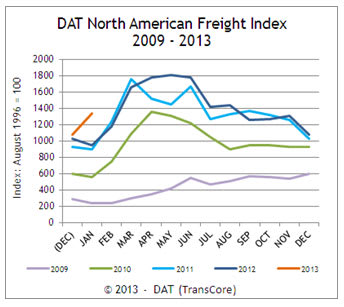
This is the first time DAT's Spot Freight Index has shown an increase in freight availability from December to January.
This is the first time DAT's Spot Freight Index has shown an increase in freight availability from December to January.
Reaching the highest-ever volume for the month of January, the DAT North American Freight Index increased 42% last month compared to January 2012.
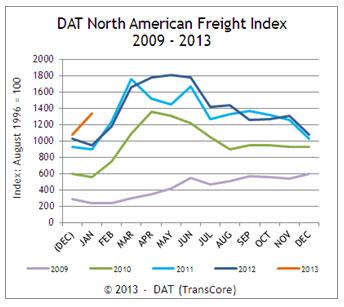
Freight volume was unusually robust for the season, exceeding December levels by 24%. This is the first time the Freight Index has shown an increase in freight availability from December to January. Over the past 10 years, there has been a 13% average decline in freight levels between those two months.
The DAT North American Freight Index is a measure of spot market freight availability in the U.S. and Canada.
Seemingly Contradictory Market Activity
Several things contributed to the seemingly contradictory market activity reflected in the DAT North American Freight Index in January — that is, a big increase in the volume of freight without a corresponding rise in rates.
"According to Mark Montague, DAT's industry pricing analyst and chief market-watcher, extraordinary things are happening with higher levels of exports to Brazil, China, and Mexico," explains David Schrader, senior vice-president of DAT's freight-matching business in Portland, Ore. "Much of this export freight is industrial freight, which tends to be spot-market freight.
"Also, according to industry reports, the 'contract marketplace' — i.e., freight shippers directly contracting loads out to carriers — shrank by 2.5% in January. This would have forced capacity into the spot market, which, while robust, is smaller than the contract marketplace. The net-net of all this is that loads as well as trucks (capacity) greatly increased on the spot market in January."
The net impact on spot market rates through most of January was negative, as the excess capacity in the marketplace competed for available loads. When it comes to contract rates, shippers appeared to be cautious about committing to higher contract rate volumes due to conflicting signals about consumer demand, Shrader says. "Additionally, when fuel prices increased recently, carriers realized the need to adjust pricing. That is contributing to higher fuel surcharge numbers (calculated) in most regions of the U.S, with the result that the overall net rate rising."
Mismatched Demand and Capacity
It's no unheard of for the spot market to grow even while freight volume is contracting, Schrader says. "The spot market often absorbs the effect of a mismatch between demand and available capacity in the larger freight market," he explains. "This mismatch can occur because of unexpected or large-scale changes in the freight marketplace or even in the economy. Specific markets, regions, and/or equipment types may be affected disproportionately, or there may be a broad trend among shippers to respond to economic conditions in a certain way." On a month-over-month basis, the unusual trend in freight availability affected the three major trailer types to differing degrees: van loads increased 16%, refrigerated freight volume increased 14%, and flatbed freight availability rose 28%. Compared to January a year earlier, freight volume increased 36% for vans, 32% for reefers and 7.9% for flatbeds.
Despite strong freight volumes, truckload capacity remained relatively loose in the spot market, so rates followed a somewhat typical seasonal pattern of a January decline that was most significant for vans and flatbeds. Van rates dropped 2.4% and flatbed rates slipped 2%, not including fuel surcharges. Reefer rates remained stable in January compared to December. On a year-over-year basis, van rates declined 2.4% and flatbeds lost 5.7%, while reefer rates rose 8.6%.
Meanwhile, Schrader says, February data is shaping up as you might expect in a dynamic market. DAT is seeing increased demand regarding spot freight plus tightened capacity, contributing to a rise in the line-haul rate.
Looking ahead to March, DAT believes the best combination of load volume and a favorable ratio of outbound loads should be found in Ohio, Illinois and Indiana in the Midwest, as well as in the Southeastern states of Georgia, North Carolina and Alabama.
More Drivers

From One Generation to the Next: How Mentorship Builds Safer Truck Drivers
After three decades in trucking, Harold Perry shares what he's learned about driver safety, mentorship, and helping the next generation build confidence behind the wheel.
Read More →
Truck Drivers Need More Than Another Alert
Fleets have more visibility into truck health, safety events, and driver activity than ever. The next challenge is turning all that information into useful guidance for the person who has to decide what to do next.
Read More →
FMCSA Removes 110 Truck Driver Training Schools from Certified ELDT List
Federal regulators also are targeting more than 160 additional training providers and launching a nationwide audit of third-party CDL skills testers as part of a broader crackdown on trucking fraud.
Read More →
Hours of Service Pilot Programs: FMCSA Readies for 2027 Rollout
Two pilot programs could eventually reshape hours-of-service rules, giving truck drivers options to pause their 14-hour clock or use longer split sleeper rest periods.
Read More →
Medical Cards, English Proficiency Reshape Roadcheck Violations
Medical-card violations jumped to the top of the driver out-of-service list during CVSA’s 2026 International Roadcheck, while English-language proficiency violations appeared among the leading violations for the first time.
Read More →
Driver Trust Can Make or Break the Success of Fleet Safety Technology
New Teletrac Navman research suggests that onboarding, transparency about driver data, and positive feedback can play a significant role in how commercial drivers respond to safety and coaching technology.
Read More →
EEOC Sues KLLM Over Alleged Sex Discrimination in Driver Training
KLLM is facing a federal sex-discrimination lawsuit over policies the EEOC alleges put female truck driver trainees at a disadvantage.
Read More →
FMCSA Moves to Codify English Language Requirements for Commercial Drivers
By changing regulations on English-language proficiency requirements for commercial drivers, rather than relying on a guidance memo, the FMCSA said future administrations won't be able to walk back the Trump administration's stricter enforcement with just a memo.
Read More →
Drivers Put Western Star Trucks to the Test at Star Nation Experience
Watch to get an inside look at the Western Star trucks, technology, and community behind the Star Nation Experience 2026!
Read More →
Trump Administration Looks to Put More Veterans Behind the Wheel
The Freedom Haulers program pulls together existing and expanded programs at several federal agencies to recruit veterans to drive commercial heavy-duty trucks and cut the red tape for them to get a CDL, training, and employment.
Read More →