





Related: California puts off GHG Trailer Regulations for Two Years
Southern California Gas to Deploy 30 Ultra-Low Emissions Trucks
Southern California Gas and Western Milling unveiled the first of a planned 30 new ultra-low emissions trucks the company will deploy at its operations in Goshen, California.
February 11, 2020
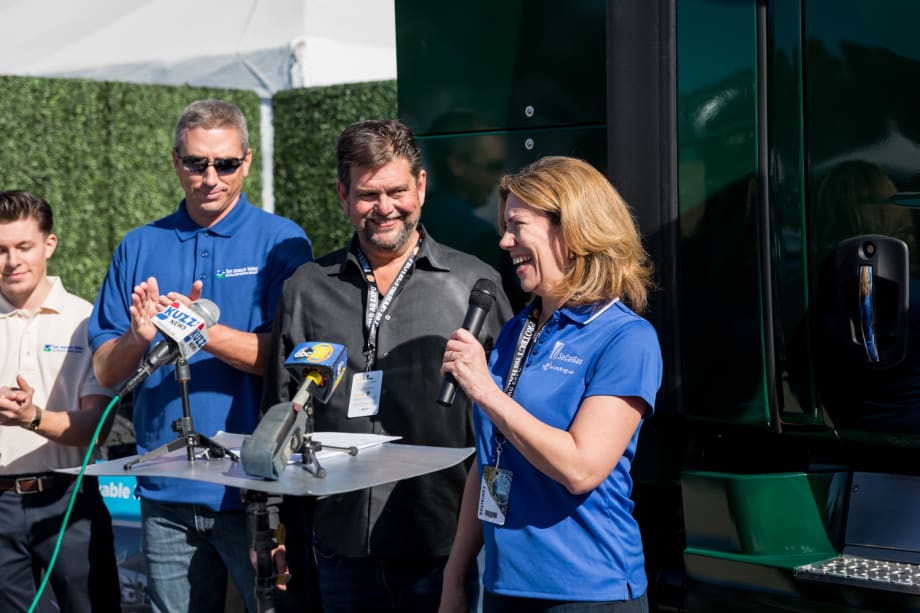
Executives from SoCalGas, Cummins Westport, the San Joaquin Air Pollution Control District, and Western Milling unveil new ultra-low emissions truck at World Ag Expo.
Photo: SoCalGas
4 min to read
Southern California Gas Co. (SoCalGas), officials from the San Joaquin Valley Air Pollution Control District and Western Milling unveiled the first of a planned 30 new ultra-low emissions trucks the company will deploy at its operation in Goshen, California.
Western Milling is one of the largest manufacturers and suppliers of nutrient solutions for plants, animals, and people in the U.S. According to the company, these new, near-zero emissions natural gas trucks will be fueled with renewable natural gas (RNG) that can virtually eliminate smog-forming pollutants and reduce greenhouse gas emissions linked to climate change by as much as 80%.
The trucks are powered by a 12-liter Cummins Westport engine, the first engine of its kind to meet the California Air Resources Board (CARB) optional low NOx standard. In addition, Western Milling revealed plans to open a new public fueling station supplying renewable natural gas in the city of Goshen later this year.
"Through the use of heavy-duty renewable CNG trucks, we're becoming more sustainable while simultaneously creating value for our employee owners," said Kevin Kruse, CEO at Western Milling. "It's good for everyone involved; us, our customers, and the communities in which we serve."
"The combination of new near zero emission natural gas engine technology and RNG provides the single best opportunity to achieve immediate and substantial NOx and GHG emission reductions in the on road heavy duty transportation sector," said Tom Swenson, business development manager at Cummins Westport. "We are proud to support a near-zero emissions strategy for our customers."
Western Milling's investment in its new natural gas trucks was supported by the San Joaquin Air Pollution Control District's Truck Replacement Program, an initiative to replace on-road diesel trucks with cleaner technology units or to expand fleets with the cleanest technology available – particularly in low income and disadvantaged communities experiencing greater air quality impacts. The program provides funding under its Standard Replacement, 2010 Compliant Replacement, and Fleet Expansion program options.
"As a public health agency serving the San Joaquin Valley, we are committed to improving the health and quality of life for all Valley residents through efficient, effective and entrepreneurial air quality management strategies. We are proud to support local companies investing in switching their diesel fueled trucks to clean natural gas trucks," said Samir Sheikh, executive director of Air Pollution Control Officer for the San Joaquin Valley Air Pollution Control District. "We applaud Western Milling's commitment to clean air and public health."
"At SoCalGas we are committed to raising awareness on how near-zero emissions natural gas trucks can help improve air quality and reduce greenhouse gas emissions," said Gillian Wright, senior vice president of customer relations at SoCalGas. "A huge congratulations to Western Milling as they invest in their future and cleaner air for the San Joaquin Valley."
In California, transportation accounts for more than 40% of greenhouse gas emissions and 80 percent of smog-forming pollution in the state, with heavy-duty trucks among the largest polluters. In the San Joaquin Valley, car and truck emissions make up about half of all measured airborne particulate matter, according to CARB.
Over the last five years, SoCalGas said, RNG use as a transportation fuel for heavy-duty trucks and buses has increased almost 600 percent, helping displace over seven million tons of carbon dioxide equivalent. That's equal to the emissions from more than a million homes' electricity use for one year.
The company notes that RNG is not a fossil fuel. It is a renewable form of energy produced from the methane emissions at dairy farms, wastewater treatment plants, landfills, and other waste streams. Depending on its source, RNG can be carbon negative, meaning it takes out more emissions from the atmosphere than it emits when used as a fuel. Capturing the methane from these waste sources and converting it into RNG keeps greenhouse gas emissions from entering the atmosphere and contributing to climate change and reduces the use of fossil fuels.
SoCalGas said it has worked with fleet owners to secure millions of dollars in incentive funding for the replacement of diesel trucks with cleaner, new near-zero emissions natural gas trucks. Since 2014, the utility has helped truckers and trucking companies replace more than 550 diesel trucks with clean natural gas trucks. That equates to taking about 30,000 cars off California's roads. Recently, SoCalGas supported a Los Angeles-Long Beach Port trucking company with their efforts to replace its entire 40 diesel truck fleet with near-zero emissions natural gas trucks.
Each new near-zero emissions natural gas truck that replaces a diesel truck is the equivalent of taking 57 passenger cars off the road.
Last month, SoCalGas opened a new RNG fueling station in Bakersfield. The new RNG station extends the network of clean natural gas stations across a key regional goods movement corridor in the San Joaquin Valley, which experiences the worst particulate matter pollution in the state, according to CARB. SoCalGas currently operates 15 public RNG fueling stations across its service territory.
More Fuel Smarts

How Volvo Updated Its D13 for EPA 2027 [Watch]
Volvo’s updated D13 promises lower emissions without sacrificing performance or fuel economy. Take a closer look at what changed inside the engine in this HDT Spotlight video.
Read More →
Diesel Price Spike Shortens Payback for Natural Gas Trucks, Report Says
Energy Vision estimates fleets could recover the higher purchase price of an RNG-fueled Class 8 tractor in 1.3 to 2.8 years under current fuel-price scenarios.
Read More →
Calstart Becomes Catalyst Mobility, Reflecting Broader Focus
Calstart is now Catalyst Mobility, reflecting the nonprofit’s growing national role in clean transportation, including zero-emission trucks, infrastructure and incentive programs.
Read More →

Record Diesel Prices Squeeze Trucking Fleets
Average U.S. diesel prices have climbed to nearly $6 a gallon, surpassing the 2022 record as tight refinery capacity and Middle East disruptions keep fuel costs elevated.
Read More →
Sponsored•September 9, 2026
How Fuel Delivery Shapes Engine Performance
Fuel delivery depends on more than what happens at the injector. For fleet, maintenance and technical professionals, looking at the full path from pump to injector can provide useful context for understanding engine performance.
Read More →
East Coast Port Launches $45M Electric Truck Push
The Port Authority of New York and New Jersey announced millions in incentives for zero-emission drayage trucks, yard tractors, and new charging hubs near the port.
Read More →
California Bill Could Shed Light on Electric Truck Prices
Why do battery-electric Class 8 trucks remain so expensive? A California bill headed to Gov. Gavin Newsom would give fleets and state agencies more visibility into what manufacturers charge.
Read More →
Detroit Opens Orders for EPA 2027 Engines
Detroit isn’t starting from scratch to meet EPA 2027 diesel emissions standards. Its Gen 6 DD13 and DD15 engines keep much of today’s platform while updating the fuel and aftertreatment systems.
Read More →
Zero-Emission Truck Corridor Planned for West Coast
California, Oregon, Washington, British Columbia and Baja California are coordinating plans for truck charging and hydrogen fueling from Canada to Mexico.
Read More →
A Closer Look at Kenworth’s Electric T880E Vocational Truck [Video]
Learn more about Kenworth's T880E battery-electric vocational truck at the Paccar Technical Center, including its range, applications, upfitting considerations, and PTO options, in this HDT Spotlight video.
Read More →