




Sneak Preview of the World’s Largest Truck Show
Connected and autonomous vehicle technology, as well as electric power, are three disruptive technologies that will highlight the IAA Commercial Vehicle Show in September in Germany.

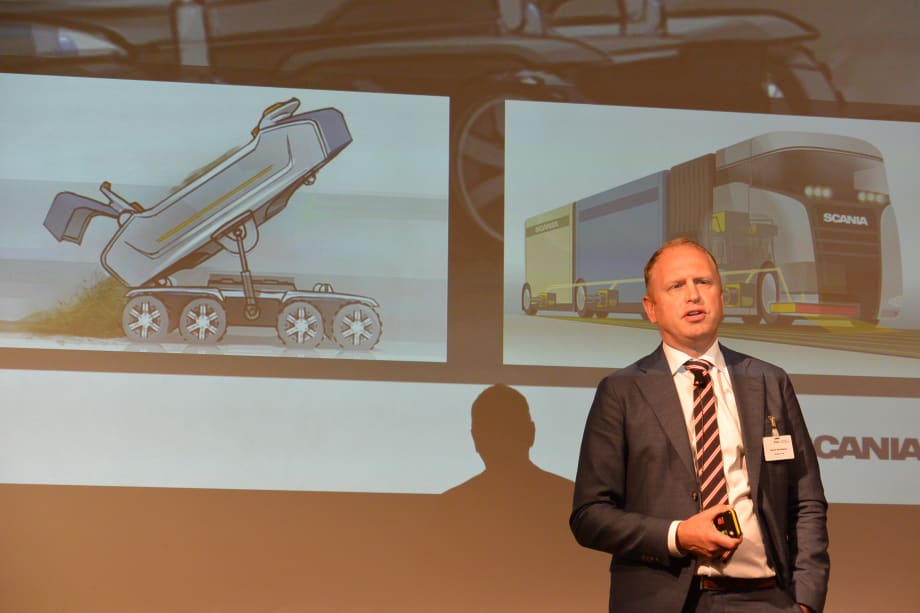
Henrik Henriksson, CEO of Scania, said autonomous trucks in the first round will go to the mining industry. Photo: Sven-Erik Lindstrand
Henrik Henriksson, CEO of Scania, said autonomous trucks in the first round will go to the mining industry.Photo: Sven-Erik Lindstrand
UPDATED -- More than 200 international automotive journalists recently got a preview of IAA, the world’s largest truck show, held every two years in Hannover, Germany.
This year’s event will be held Sept. 22-29, attracting about 1 700 exhibitors and some 250,000 to 300,000 visitors from all over the world.
Organized by VDA (Verband der Automobilindustrie), the powerful German Automobile Industry Association, the show this year has the motto “Driven by Ideas.”
A few years ago, the talk of this preview event was all about hybrid trucks. This time it's about three disruptive changes that will be reflected at the IAA:
1. Connected trucks
2. Electric power - battery and trolley
3. Autonomous, self-driving trucks
Matthias Wissmann, head of the VDA, noted
that the truck industry in Europe currently is experiencing tailwinds, as sales of new trucks continue to increase, ensuring a large exhibitor participation and expansive booths.
Top executives from the various truck makers spoke not not only about their respective brand excellence but also about future issues and challenges faced by the industry at large.
For instance, Dr. Wolfgang Bernhard, head of Daimler Trucks and Buses, pointed out his company’s absolute conviction that self-driving trucks are coming on strong. A must for this is stable Internet, he said, and will require massive investments in comprehensive mobile coverage along the German Autobahn highway system.
Also high on his wish list is the ability to use combination vehicles of up to 60 metric tons GCW and 25.25 meters (83 feet) long, as used in Sweden and Finland, throughout Europe.
Volkswagen Truck & Bus
Andreas Renschler is chief executive of Volkswagen Truck & Bus Group, which includes both MAN and Scania. They will make their first joint appearance at the IAA.
Until just over three years ago, Renschler held the job that Wolfgang Bernhard now possesses at Daimler, until he was moved sideways to lead the group's industrial production. In the spring of 2014 Renschler joined VW, succeeding former Scania CEO Leif Ostling as the president of the VW Truck & Bus Group.
At the pre-IAA briefing, Renschler presented a long series of examples on how we all will be affected by the Internet of Things in all areas of society, including revolutionary changes in transportation.
Volkswagen's truck group was massively represented on the list of speakers. In addition to Renschler it also included MAN boss Joachim Drees, CEO of Scania Henrik Henriksson, and Eckhard Scholz, who represented Volkswagen Light Commercial Vehicles.
None of VW Truck & Bus Group’s upcoming marketing plans was/were disclosed at the time.
Renschler, however, had shortly before announced that "savings of 1 million euros a year are possible" once the three brands have been integrated.
Looking ahead, he noted that in the next few years, transportation will undergo massive changes. "Most of you know how down to earth I am — but in this context, even I would say that we can speak of radical transformation," he said.
"Today, let me therefore take a look far ahead, into the year 2040. Will we still be transporting goods then? Yes, but the system will have changed. Will we still have haulers and carriers? Yes, but their roles will have changed. Will we still have trucks? Yes, but trucks other than what we see on the road today. In 2040, our transportation system will have reached a new level: fully connected; significantly more efficient and effective, above all."
Volvo and Scania
Hakan Karlsson, executive vice president of AB Volvo, along with Scania’s Henriksson, both agreed with previous speakers that in the future much will revolve around three key areas: connection, electric drive and autonomous vehicles. Volvo currently has 500 000 vehicles connected online, a prerequisite for increased productivity and preventive maintenance.
Large investments are imminent on the development of products that initially result in relatively small volumes. Governmental subsidiaries are necessary because it takes time to reach profitability.
Karlsson also talked quite a bit about Volvo's all-electric city buses, which will go into serial production next year.
Scania’s Henriksson said autonomous trucks in the first round will go to the mining industry -- and they won't even need a truck cab. Today Scania has 200,000 connected trucks, and for five years this has been standard equipment. These connections also form the base to make analyses and evaluations for vehicles that still have drivers. Fleets can see which drivers need training and on what. Are they idling too much, speeding, hard braking? Also for improved logistics, connectivity is the prerequisite for an optimized transport flow.
e-Highway and beyond
A maximum of 1,500 liters of diesel is what a long-distance truck in Europe is allowed to bring on a trip. According to Henriksson, this corresponds into an energy requirement of 60 tons of batteries. Not much payload there. So battery power is only for distribution trucks in urban areas, so far.
Henriksson proudly announced that the world's first electrified highway had been inaugurated the previous day close to the city of Gavle in Sweden. Its length is not very long, but a nice start. It’s a pilot project using trolley Scanias, which will run for two years with a number of partners.
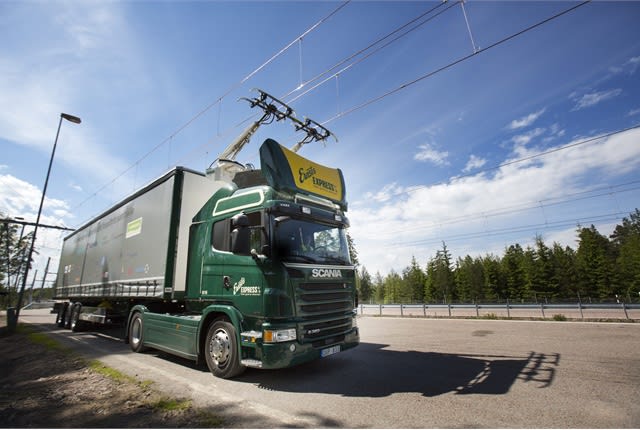
Electric power, such as this "trolley" electric system being tested by Scania, is seen as a key theme of this year's IAA.
Henriksson asked how transport companies will handle a future where autonomous technology could eliminate driver costs, which amount to 35% of the operating cost – and if running with permanent electrical power, a further 35% in energy costs.
In the meantime, connected vehicles from Scania will be getting individually customized service plans, Henriksson said. Depending on the application and driving style, the truck will be called to the workshop when it’s time and not according to mileage intervals. He promised to share more on this at IAA.
Finally, Henriksson warned that outsiders like a giant software company can enter from the side and offer a full hand of freight shipping services – without owning one single truck of its own.
Updated June 29, 10:15 EDT, to add additional Renschler remarks
More Fuel Smarts

How Volvo Updated Its D13 for EPA 2027 [Watch]
Volvo’s updated D13 promises lower emissions without sacrificing performance or fuel economy. Take a closer look at what changed inside the engine in this HDT Spotlight video.
Read More →
Diesel Price Spike Shortens Payback for Natural Gas Trucks, Report Says
Energy Vision estimates fleets could recover the higher purchase price of an RNG-fueled Class 8 tractor in 1.3 to 2.8 years under current fuel-price scenarios.
Read More →
Calstart Becomes Catalyst Mobility, Reflecting Broader Focus
Calstart is now Catalyst Mobility, reflecting the nonprofit’s growing national role in clean transportation, including zero-emission trucks, infrastructure and incentive programs.
Read More →

Record Diesel Prices Squeeze Trucking Fleets
Average U.S. diesel prices have climbed to nearly $6 a gallon, surpassing the 2022 record as tight refinery capacity and Middle East disruptions keep fuel costs elevated.
Read More →
How Fuel Delivery Shapes Engine Performance
Fuel delivery depends on more than what happens at the injector. For fleet, maintenance and technical professionals, looking at the full path from pump to injector can provide useful context for understanding engine performance.
Read More →
East Coast Port Launches $45M Electric Truck Push
The Port Authority of New York and New Jersey announced millions in incentives for zero-emission drayage trucks, yard tractors, and new charging hubs near the port.
Read More →
California Bill Could Shed Light on Electric Truck Prices
Why do battery-electric Class 8 trucks remain so expensive? A California bill headed to Gov. Gavin Newsom would give fleets and state agencies more visibility into what manufacturers charge.
Read More →
Detroit Opens Orders for EPA 2027 Engines
Detroit isn’t starting from scratch to meet EPA 2027 diesel emissions standards. Its Gen 6 DD13 and DD15 engines keep much of today’s platform while updating the fuel and aftertreatment systems.
Read More →
Zero-Emission Truck Corridor Planned for West Coast
California, Oregon, Washington, British Columbia and Baja California are coordinating plans for truck charging and hydrogen fueling from Canada to Mexico.
Read More →
A Closer Look at Kenworth’s Electric T880E Vocational Truck [Video]
Learn more about Kenworth's T880E battery-electric vocational truck at the Paccar Technical Center, including its range, applications, upfitting considerations, and PTO options, in this HDT Spotlight video.
Read More →