




Senators Intrigued by Virginia Approach to Highway Funding
Could Congress save the Highway Trust Fund by getting rid of the federal fuel tax? Two members of the Senate Finance Committee expressed strong interest in how Virginia solved its infrastructure funding crisis by replacing its per-gallon tax with a wholesale levy on fuel.


Could Congress save the Highway Trust Fund by getting rid of the federal fuel tax?
Two members of the Senate Finance Committee expressed strong interest in how Virginia solved its infrastructure funding crisis by replacing its per-gallon tax with a wholesale levy on fuel.

Virginia’s solution was one of several the Committee discussed at a Tuesday hearing on how to pay for a long-term highway program.
Suggestions ranged from raising the fuel tax, keeping spending where it is or getting the federal government out of the highway business altogether. The only point on which there was general agreement among Senators and witnesses was that highways are important and that Congress needs to provide a multi-year program.
Sen. Barbara Boxer, D-Calif., said that the Environment and Public Works Committee, which she chairs, is drafting a multiyear highway policy bill that calls for maintaining current funding levels, plus inflation.
The program needs more but EPW is going for the bare minimum of $18 billion to keep the Highway Trust Fund solvent in 2015, Boxer told the Finance Committee.
She warned that a short-term extension will create major problems for state transportation departments. With the Highway Trust Fund teetering toward the red by late August, the states already are cancelling long-term projects, she said.
The official word on the issue came from Joseph Kile, assistant director for microeconomic studies at the Congressional Budget Office.
CBO estimates that by October the balance in the Fund will fall to $3 billion for highways and transit. Spending for both will be $53 billion while income will be $38 billion.
“If nothing changes, the trust fund’s balance will be insufficient to meet all of its obligations in fiscal year 2015, and it will incur steadily accumulating shortfalls in subsequent years,” Kile said.
Absent any changes, the $18 billion in 2015 will have to be followed by $13 and $18 billion each year through 2024 to maintain spending averages, Kile said.
Senators Johnny Isakson, R-Ga., and Bill Nelson, D-Fla., questioned Virginia Transportation Secretary Aubrey Layne about that state’s funding solution.
The key element of Virginia’s solution was to replace its 17.5-cent gas and diesel tax with a 3.5% wholesale tax on gas and a 6% wholesale tax on diesel. Revenues from the tax move up with economic activity, although there is a floor to protect against falling revenues.
“It really solves some big problems,” Isakson said. “It was a good solution.”
Nelson said he is “quite intrigued” by this approach. He asked the Congressional Budget Office and the Joint Committee on Taxation to find the percentage sales tax that would be needed to replace the current federal fuel taxes.
“Anything that has anything to do with taxes [makes] people apoplectic around here,” he said. “It’s very interesting that the commonwealth of Virginia decided to get visionary.”
An additional nod to the Virginia approach came from Boxer, who described it as “an easy solution” in light of the resistance in Congress to increasing the fuel tax.
The other options discussed at the hearing included bonding, public private partnerships and devolving the responsibility for highway funding and management to the states.
Sen. Ron Wyden, D-Ore., the chairman of the Finance Committee, asked the witnesses for their best near-term and long-term solutions.
Layne of Virginia said public-private partnerships are helpful but not a complete solution. The immediate solution is to find a sustainable revenue source for the Highway Trust Fund. Longer-term, the highway program needs to emphasize multimodal programs.
Jayha Dhru, senior managing director for Standard & Poor’s Ratings Services, said the most important thing is to come up with a long-term solution, period.
Samara Barend, senior vice president of AECOM Capital, urged the committee to include tax-exempt private activity bonds.
Chris Edwards of the Cato Institute, a libertarian think tank, said the near-term answer is to use general funds to float the Highway Trust Fund, but in the long term to let the states take over highway funding.
Sen. John Rockefeller, D-W.Va., blamed the situation on a lack of will in Congress.
“It’s an American characteristic that you don’t do anything which displeases the voters because you always have to get re-elected here,” he said.
Rockefeller is retiring from Congress at the end of this year and spoke openly about his frustration.
“It has to do with, for some, we don’t want anything good to happen under this president because he’s the wrong color, for some it’s Tea Party, for some it’s fear of their reelection prospects.”
Congress will misrepresent its constituents if it allows the Highway Trust Fund to run out of money, he said. “It infuriates me that I have not been more upfront.”
Senate activity on highway issues will continue tomorrow with a Commerce Committee hearing on safety. Boxer plans to introduce the Environment and Public Works Committee bill shortly and mark it up next week.
More Fleet Management

Meet HDT's Truck Fleet Innovators at Heavy Duty Trucking Exchange
Heavy Duty Trucking Exchange brings fleet managers and suppliers together for the deeper conversations that lead to ideas, partnerships, and solutions. Time is running out to apply for HDTX, September 23-25.
Read More →
Enhance Fleet Performance with High-Efficiency Auxiliary Power Units
Drive sustainable cost savings while increasing driver comfort during short- and long-haul logistics operations.
Read More →
Is Your Parts Procurement Process Reactive or Proactive?
Ready to revamp your parts procurement process? Learn how now with “Strategic Parts Purchasing: A Process Checklist”
Read More →

What Trucking Events are Happening in 2026?
Looking for trucking-related conventions, expos, and other events? Heavy Duty Trucking has developed this list of national and larger regional trucking shows and events.
Read More →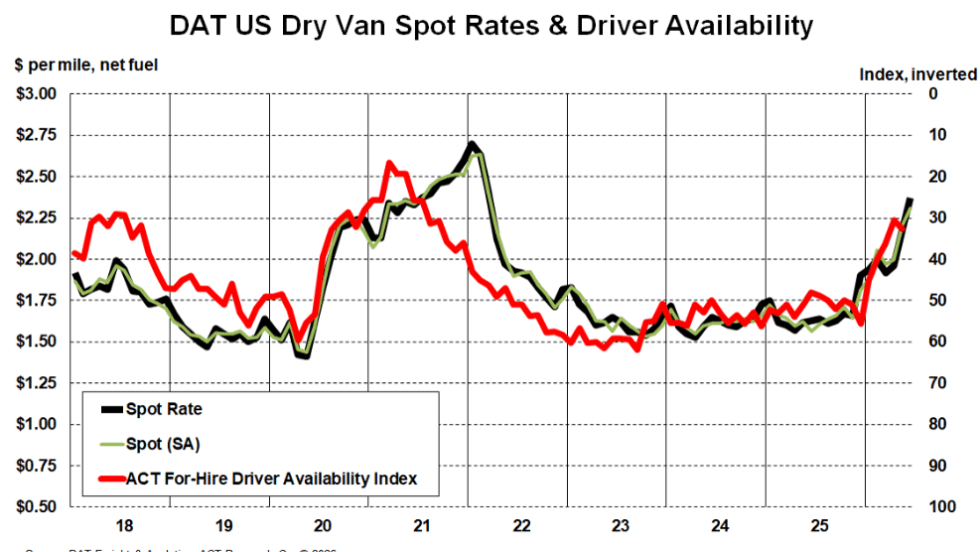
Truckload Rates Keep Rising as Tight Capacity Fuels Freight Market Recovery
Spot and contract rates continued climbing in May and June, not because freight demand is surging, but because fewer trucks and drivers are available.
Read More →
What Geotab's New AI Connector Means for Fleets
Fleets can now ask their usual AI assistants questions about maintenance, safety, fuel use, and vehicle performance, using their live Geotab data, and take action on the answers without leaving their preferred AI tool.
Read More →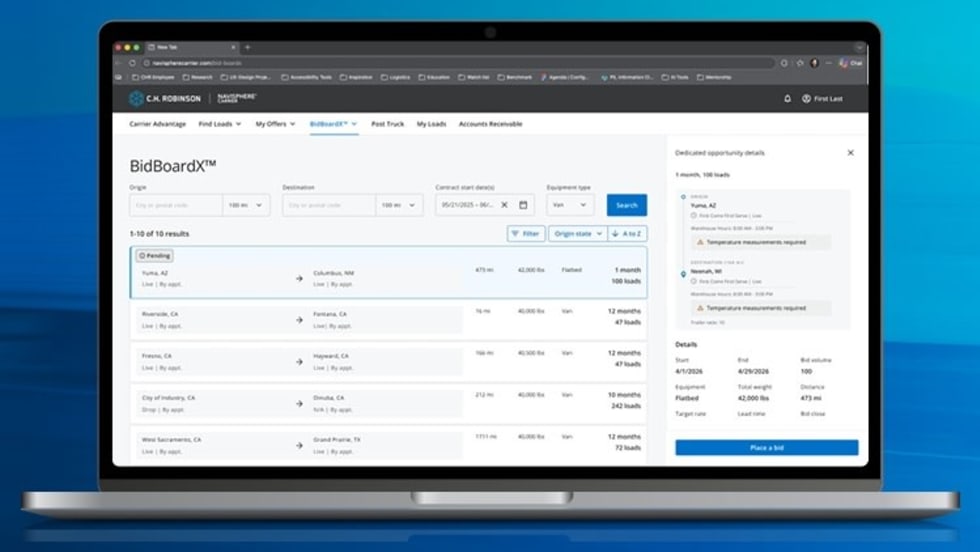
New C.H. Robinson Tool Opens Door to More Predictable Freight
BidBoardX lets carriers search, bid on, and secure committed freight opportunities through a single digital marketplace.
Read More →
New York City's Microhub Project is Delivering Results
Trucking, last-mile delivery companies, and environmental advocates like what they are seeing so far with New York's microhub program.
Read More →
Why Truck Detention Keeps Costing Fleets Time and Money
A 2024 ATRI study found detention affects nearly 40% of truckload stops and costs the industry more than $15 billion annually. Despite the toll on drivers, fleets, and supply chains, the problem remains stubbornly persistent.
Read More →
Amazon Launches Less-Than-Truckload Freight Offering for All Businesses
This launch is the latest addition to Amazon Supply Chain Services, a portfolio of supply chain capabilities from Amazon, including freight, distribution, fulfillment, and parcel shipping.
Read More →