




SAF-Holland Invests $4 Million in Manufacturing Expansion
SAF-Holland has announced that is expanding its operations in Dumas, Ark., opening a new facility to accommodate increased demand from current customers.
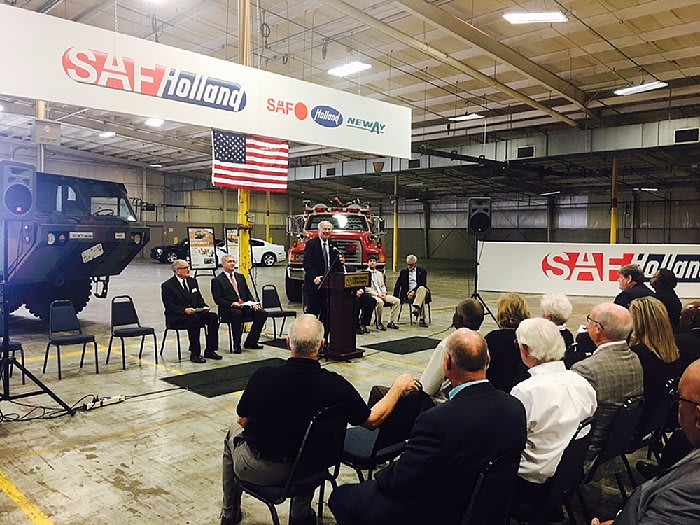
Arkansas Governor Asa Hutchinson speaking about the SAF-Holland Dumas facility expansion.
Photo: SAF Holland
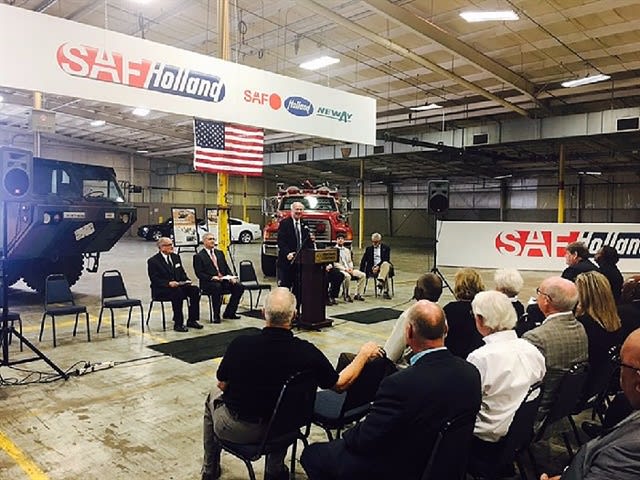
Arkansas Governor Asa Hutchinson speaking about the SAF-Holland Dumas facility expansion.
Photo: SAF Holland
SAF-Holland has announced that is expanding its operations in Dumas, Ark., opening a new facility to accommodate increased demand from current customers.
The expansion takes place as part of an ongoing restructuring of SAF-Holland’s North American plant network. The network is currently being centralized and placed closer to the customer base of the trailer and truck industry to strengthen long-term competitiveness. Internal logistics processes are also being streamlined to improve lead-time responsiveness.
“Our investment in Dumas will enable SAF-Holland to expand the North American business as we prepare for increasing market demand also in the mid-term,” said Bjoern Meyer, vice president of operations, Americas. “It allows SAF-Holland closer proximity to our OEM customers and enhances our level of service to our distributors and fleet customers. Ultimately, the location provides a means to expand our distribution network to not only support existing customers but result in additional customers.”
SAF-Holland has increased its Dumas staff by over 40%, creating 60 new jobs to date with plans to end up at approximately 65 total new positions, according to the company. As budgeted, it will invest approximately $4 million in the facility for additional manufacturing and warehousing space, paint line, robotic welding cells, and other new technology and equipment to step up the group’s capacities in axle and suspension systems in the Americas region.
SAF-Holland currently employs 143 in Dumas where it manufactures trailer suspension and axle systems for commercial vehicles including Wabash National and Great Dane trailers.
“We appreciate the continued confidence SAF-Holland has in our workforce that led to this expansion,” said Arkansas Governor Asa Hutchinson. “The jobs being created are the advanced manufacturing jobs that spur economic development and raise the quality of life for employees and their families.”
More Equipment

How Volvo Updated Its D13 for EPA 2027 [Watch]
Volvo’s updated D13 promises lower emissions without sacrificing performance or fuel economy. Take a closer look at what changed inside the engine in this HDT Spotlight video.
Read More →
Michelin Tire Improves Efficiency and Durability for Regional Fleets
The Michelin X Multi Energy D2 is a regional haul drive tire engineered to help fleets improve fuel efficiency, durability and traction in demanding stop-and-go operations.
Read More →
ZF Expands Commercial Vehicle Push in North America
ZF is expanding its North American commercial-vehicle presence with new transmission applications, electrification, trailer technology and autonomous-driving systems.
Read More →
Tesla Wants a Self-Driving Semi. Are Cameras Enough?
Could Tesla’s camera-only autonomous driving technology work on an 80,000-pound Semi? In this commentary, HDT's Deborah Lockridge takes a look at Tesla, Cybercab, and how autonomous trucks see the road.
Read More →
Kodiak: Driverless Long-Haul Truck Launch on Track for 2026
Kodiak AI says its driverless long-haul safety case is 93% complete and it remains on track to begin commercial operations by year-end 2026.
Read More →
What DOT’s Automated Vehicle Strategy Means for Trucking
The U.S. Department of Transportation issued a new automated-vehicle strategy that outlines plans for driverless-truck regulations, cross-state freight corridors, and federal safety standards.
Read More →
East Coast Port Launches $45M Electric Truck Push
The Port Authority of New York and New Jersey announced millions in incentives for zero-emission drayage trucks, yard tractors, and new charging hubs near the port.
Read More →
PlusAI Going Public to Fund Autonomous Truck Launch
A SPAC deal could provide PlusAI with up to $300 million as it works toward a 2027 commercial launch of factory-built autonomous trucks.
Read More →
NHTSA Moves to Rewrite Truck Fuel-Economy Rules
The National Highway Traffic Safety Administration says it lacks authority to regulate medium- and heavy-duty truck engines separately from complete vehicles, but the existing standards have not yet been eliminated.
Read More →
Detroit Opens Orders for EPA 2027 Engines
Detroit isn’t starting from scratch to meet EPA 2027 diesel emissions standards. Its Gen 6 DD13 and DD15 engines keep much of today’s platform while updating the fuel and aftertreatment systems.
Read More →