




Rush Switching from Expansion to Integration Following Dealer Purchases
Rush Enterprises must integrate its new Navistar dealerships into the company's operations and "culture" in the coming year, Chairman and CEO Rusty Rush says.

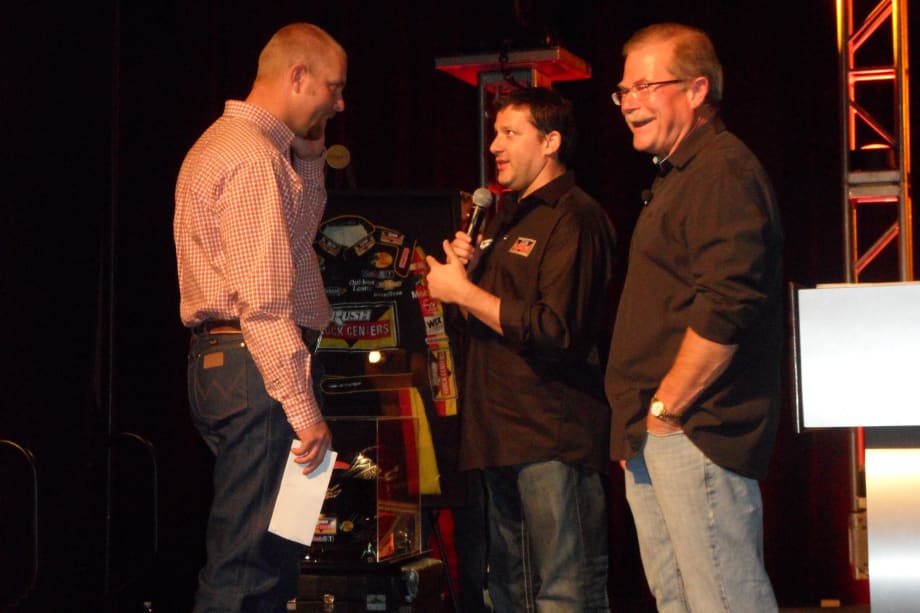
From left, All-Around Grand Champion Jason Swann is congratulated by NASCAR driver Tony Stewart and company Chairman Rusty Rush at the Tech Skills Rodeo banquet on Tuesday night. Building team spirit is part of the Rush culture.
Truck dealership Rush Enterprises spent 2013 in an expansion mode as it arranged the acquisition of 34 Navistar International “stores” in six states, and it’s now preparing to fold the new properties and their employees into the company’s ways of doing business – its “culture” – according to Rusty Rush, chairman and CEO.
“This year was an acquisition stage,” he said. “Next year and after will be integration,” and it will be a big job. He’s already flying around the country in the company jet meeting with new employees as well as current ones.
The company is accelerating the buying of a $50 million business system that includes new computer hardware and software, and contractors will install equipment in existing and new stores – Rush’s term for locations – and expects to have the project completed in March of 2015.
“We have to get it done,” he told reporters during a pause in his observations of the eighth annual Rush Truck Centers Tech Skills Rodeo, held earlier this week in San Antonio, which brought 106 technicians to for three days of test competition. Thirty winners in 13 truck-equipment categories were named at a banquet on Tuesday night.
“If it had been my choice, I would I have bought all these stores more gradually, but the opportunities came up” and he had to act on them, Rush said. They are in six states, four of them in the Midwest. By the time all the deals are closed early in the New Year, as hoped, there will be 108 Rush Truck Center locations in 20 states.
Rush will add about 1,500 employees to its current roster of 5,400 who work in sales, parts, service, body repair, management and clerical pursuits. Parts and service are especially important in supporting customers’ trucks, Rush said.
“It’s all about uptime,” he told technicians gathered at the awards banquet on Tuesday night. “The way we get there is through the guys in this room.
"If we keep a customer’s truck up and running 29.3 days in a month and the competition does it so it’s running 28.5 days, that’s three-quarters of a day more that it’s running and hauling freight and earning revenue. That’s how we differentiate ourselves.”
Parts and service are vital in keeping customers loyal, he told reporters, and “parts and service margins are six times better than truck sales margins, in gross profit. But parts and service takes investment – shop space, tools, people. You don’t need investment to sell a truck.”
Rush Enterprises had 35 to 40 locations in southern and western states just before the recession started. Most were Peterbilt stores but also included Hino, Isuzu and Ford medium-truck franchises. Paccar, Peterbilt’s parent, won’t allow Rush to buy more dealerships, so he and his father, founder Marvin Rush, chose to grow by acquiring a Navistar International franchise in Utah, then in North Carolina.
The others are in Georgia, Idaho, Virginia, Illinois, Missouri, Indiana and Ohio. The Midwestern locations for International are philosophically proper, Rusty Rush believes, because “Navistar is a Midwestern truck” while “Peterbilt is a West Coast truck,” and many of those stores are in the West.
Sellers of the Navistar International franchises were typically people looking toward retirement, though some have stayed on to manage the stores, he said.
Asked if he obtained the properties at good prices because of Navistar’s recent engine problems, he replied, “I didn’t steal ‘em. I got ‘em at a fair price.”
Though its sales are still lagging, Navistar is recovering since it switched away from trying to make its all-EGR approach work, he said.
“I think it’s on the right path with SCR. In the interim, we’ve got to deal with what we have. There’s more [engine] problems than we’d like. We’ve been doing campaigns… but some people have been hurting too much over it. We’re doing all we can, but perception is reality.
“The vast majority, based on what Navistar tells us, 80% of the trucks have had the campaigns done on them. It’s an overhang from the EGR engines that we have to work our way through. It’s not something that’s like you can turn on a light switch. You have to work your way through.”
Hard work is part of the Rush culture, but so are good times and the building of team spirit. Sponsorship of NASCAR driver Tony Stewart and his Number 14 car is among the ways Rush builds morale.
Stewart, dressed in a black Rush Truck Centers shirt and blue jeans, appeared at the Tech Skills Rodeo and sat with contestants, including the tech who turned out to be the All-Around Grand Champion, Jason Swann, at the banquet.
From left, All-Around Grand Champion Jason Swann is congratulated by NASCAR driver Tony Stewart and company Chairman Rusty Rush at the Tech Skills Rodeo banquet on Tuesday night. Building team spirit is part of the Rush culture.
In presenting the award, Stewart joked that “Jason and his wife are buying the drinks afterwards. I can’t. I’m unemployed” after breaking a leg in a dirt-track race earlier this year. For fun, he raced in scores of dirt-track events between NASCAR contests.
Rusty Rush looks for a return on investment in his property improvements and expansions, but says the NASCAR sponsorship “isn’t something you can put numbers to. There’s been surveys that say truck drivers’ favorite sports are football and NASCAR. It’s a branding kind of thing… It creates loyalty.
“And it’s with customers, too. Customers get to go meet the man, get to go into the pits” because the company invites them to races. “Tony Stewart is a real guy. He’s like me,” Rush said, pointing to his own jeans.
In promotional and advertising exposure, the company triples the dollars spent on NASCAR because the Rush Truck Centers name is seen so often at race tracks and on television, said Karen Konecny, the company’s vice president for marketing and communications.
In actual business, in 2012 Rush Truck Centers sold 23,171 trucks and, with parts, service and other activities, earned $3.1 billion in revenue. Sales growth this year is well above a target of 10% as the economy and improves and trucking gets healthier.
Further growth might come through more midrange-truck stores with the same nameplates, Rush said. But “now we have to digest all of this.”
More Equipment

How Volvo Updated Its D13 for EPA 2027 [Watch]
Volvo’s updated D13 promises lower emissions without sacrificing performance or fuel economy. Take a closer look at what changed inside the engine in this HDT Spotlight video.
Read More →
Michelin Tire Improves Efficiency and Durability for Regional Fleets
The Michelin X Multi Energy D2 is a regional haul drive tire engineered to help fleets improve fuel efficiency, durability and traction in demanding stop-and-go operations.
Read More →
ZF Expands Commercial Vehicle Push in North America
ZF is expanding its North American commercial-vehicle presence with new transmission applications, electrification, trailer technology and autonomous-driving systems.
Read More →
Tesla Wants a Self-Driving Semi. Are Cameras Enough?
Could Tesla’s camera-only autonomous driving technology work on an 80,000-pound Semi? In this commentary, HDT's Deborah Lockridge takes a look at Tesla, Cybercab, and how autonomous trucks see the road.
Read More →
Kodiak: Driverless Long-Haul Truck Launch on Track for 2026
Kodiak AI says its driverless long-haul safety case is 93% complete and it remains on track to begin commercial operations by year-end 2026.
Read More →
What DOT’s Automated Vehicle Strategy Means for Trucking
The U.S. Department of Transportation issued a new automated-vehicle strategy that outlines plans for driverless-truck regulations, cross-state freight corridors, and federal safety standards.
Read More →
East Coast Port Launches $45M Electric Truck Push
The Port Authority of New York and New Jersey announced millions in incentives for zero-emission drayage trucks, yard tractors, and new charging hubs near the port.
Read More →
PlusAI Going Public to Fund Autonomous Truck Launch
A SPAC deal could provide PlusAI with up to $300 million as it works toward a 2027 commercial launch of factory-built autonomous trucks.
Read More →
NHTSA Moves to Rewrite Truck Fuel-Economy Rules
The National Highway Traffic Safety Administration says it lacks authority to regulate medium- and heavy-duty truck engines separately from complete vehicles, but the existing standards have not yet been eliminated.
Read More →
Detroit Opens Orders for EPA 2027 Engines
Detroit isn’t starting from scratch to meet EPA 2027 diesel emissions standards. Its Gen 6 DD13 and DD15 engines keep much of today’s platform while updating the fuel and aftertreatment systems.
Read More →