




Reyes Beverage Group Takes Delivery of 29 Freightliner eCascadias
The new eCascadias mark the first phase of the California beverage fleet’s transition to a fully zero-emission fleet by 2039.

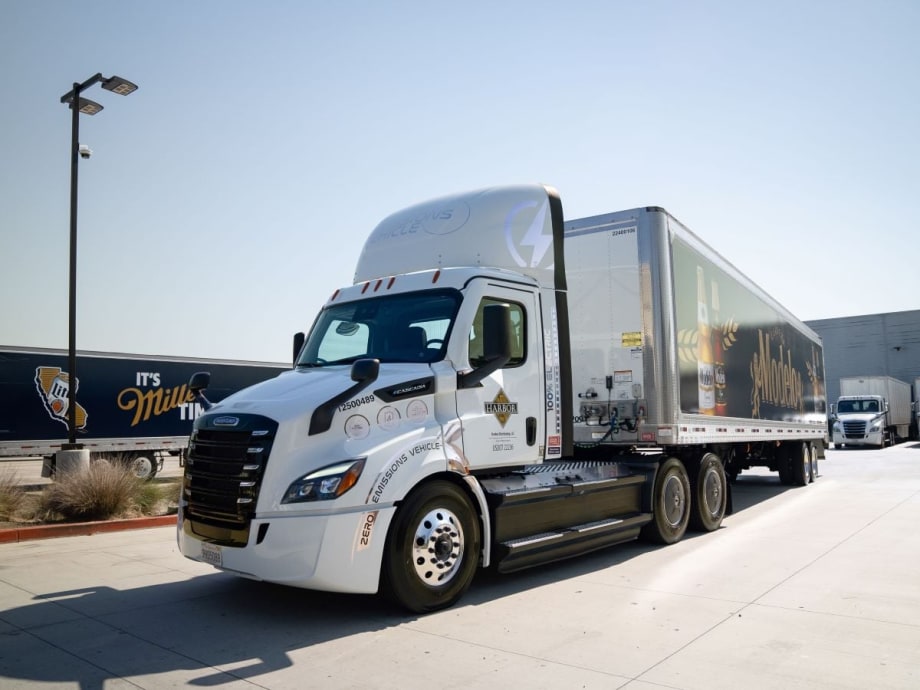
Reyes Beverage Group has a goal of reducing carbon emissions by 60 percent by 2030.
Photo: DTNA
Daimler Truck North America has delivered 20 zero-emission, battery-electric Freightliner eCascadia Class 8 tractors to Reyes Beverage Group (RBG), a total bev-alc (alcoholic beverages) distributor.
The vehicles, deployed at RBG’s Golden Brands – East Bay and Harbor Distributing – Huntington Beach warehouses, mark the first phase in RBG’s transition to a fully zero-emission fleet in the state by 2039.
An additional nine vehicles are scheduled for delivery to RBG’s Gate City Beverage – San Bernardino warehouse later this year.
Built with Productivity in Mind
With the customer at the center of its strategy, DTNA is focused on leading the transformation to zero-emission transportation by developing vehicles that meet the evolving needs of fleet operators.
“The Freightliner eCascadia is built with maximum productivity in mind for fleets switching to efficient, zero-emission vehicles,” said David Carson, senior vice president, sales and marketing for DTNA. “As the leading manufacturer of medium- and heavy-duty trucks in the U.S., we are fully committed to reducing emissions with our vehicles and working with partners like RBG who share our vision to continue moving the commercial transportation industry toward a more sustainable future.”
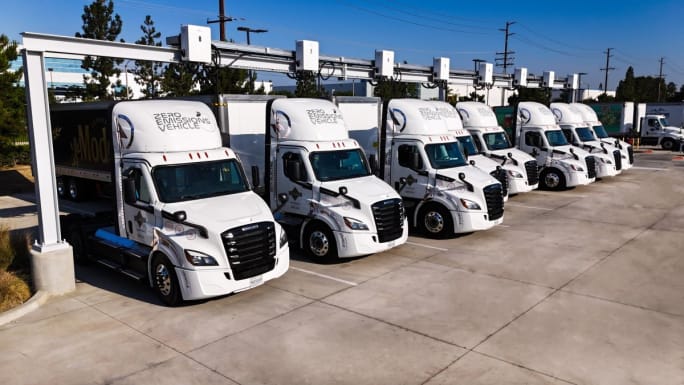
RBG’s decision to adopt the Freightliner eCascadia builds on its recent transition to renewable diesel and its ongoing idle-time reduction program
Photo: DTNA
RBG’s decision to adopt the Freightliner eCascadia builds on its recent transition to renewable diesel and its ongoing idle-time reduction program.
These electric vehicles (EVs) will contribute significantly toward RBG's goal of reducing carbon emissions by 60 percent by 2030, saving over 98,000 gallons of diesel annually and avoiding nearly 700 metric tons of carbon dioxide emissions each year.
“We are excited to be among the first in our industry to adopt these electric vehicles,” said Tom Reyes, President of RBG West. “This is a significant step toward our sustainability goals and ensuring compliance with state regulation as we transition our fleet to EV.”
90-Minute Charging Times
RBG’s Freightliner eCascadia tractors will rely on electric charging stations installed at each facility, allowing them to recharge to 80% capacity in as little as 90 minutes.
With a typical driving range of 220 miles as equipped, these trucks are well-suited for RBG's distribution needs, the OEM said.
The Freightliner eCascadia offers multiple battery and drive axle configurations with ranges between 155 and 230 miles, depending on the truck specification.
Developed with the Detroit proprietary ePowertrain, the eCascadia ensures high levels of power, efficiency, and reliability, according to DTNA.
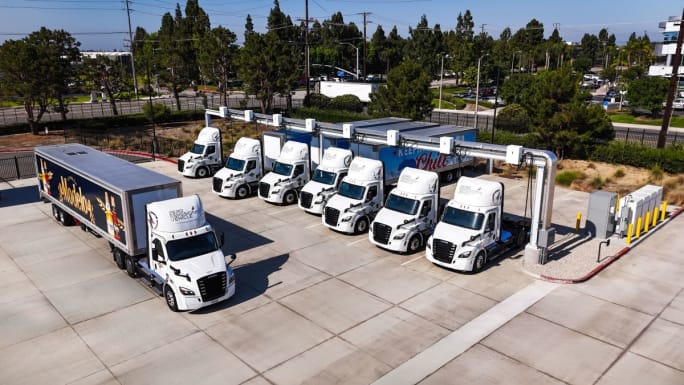
Freightliner eCascadias have a typical single charge driving range of around 220 miles and can reach an 80% state of charge in 90 minutes.
Photo: DTNA
For enhanced road safety, the trucks come standard with Detroit Assurance with Active Brake Assist 5 Suite of Safety Systems.
For customers currently transitioning to electric vehicles or interested in electrification, DTNA said it offers comprehensive fleet electrification solutions. From Detroit eFill commercial chargers to Detroit eConsulting services, DTNA can assist customers with charging infrastructure, energy optimization, and renewable energy integration, providing a seamless transition to zero-emission operations.
More Fuel Smarts

How Volvo Updated Its D13 for EPA 2027 [Watch]
Volvo’s updated D13 promises lower emissions without sacrificing performance or fuel economy. Take a closer look at what changed inside the engine in this HDT Spotlight video.
Read More →
Diesel Price Spike Shortens Payback for Natural Gas Trucks, Report Says
Energy Vision estimates fleets could recover the higher purchase price of an RNG-fueled Class 8 tractor in 1.3 to 2.8 years under current fuel-price scenarios.
Read More →
Calstart Becomes Catalyst Mobility, Reflecting Broader Focus
Calstart is now Catalyst Mobility, reflecting the nonprofit’s growing national role in clean transportation, including zero-emission trucks, infrastructure and incentive programs.
Read More →

Record Diesel Prices Squeeze Trucking Fleets
Average U.S. diesel prices have climbed to nearly $6 a gallon, surpassing the 2022 record as tight refinery capacity and Middle East disruptions keep fuel costs elevated.
Read More →
How Fuel Delivery Shapes Engine Performance
Fuel delivery depends on more than what happens at the injector. For fleet, maintenance and technical professionals, looking at the full path from pump to injector can provide useful context for understanding engine performance.
Read More →
East Coast Port Launches $45M Electric Truck Push
The Port Authority of New York and New Jersey announced millions in incentives for zero-emission drayage trucks, yard tractors, and new charging hubs near the port.
Read More →
California Bill Could Shed Light on Electric Truck Prices
Why do battery-electric Class 8 trucks remain so expensive? A California bill headed to Gov. Gavin Newsom would give fleets and state agencies more visibility into what manufacturers charge.
Read More →
Detroit Opens Orders for EPA 2027 Engines
Detroit isn’t starting from scratch to meet EPA 2027 diesel emissions standards. Its Gen 6 DD13 and DD15 engines keep much of today’s platform while updating the fuel and aftertreatment systems.
Read More →
Zero-Emission Truck Corridor Planned for West Coast
California, Oregon, Washington, British Columbia and Baja California are coordinating plans for truck charging and hydrogen fueling from Canada to Mexico.
Read More →
A Closer Look at Kenworth’s Electric T880E Vocational Truck [Video]
Learn more about Kenworth's T880E battery-electric vocational truck at the Paccar Technical Center, including its range, applications, upfitting considerations, and PTO options, in this HDT Spotlight video.
Read More →