




Reyco Granning Developing Suspensions for Electric Vehicles
Reyco Granning Electric Vehicle Solutions has developed a new high-capacity variant of its customizable suspension option for Class 5-8 electric trucks.

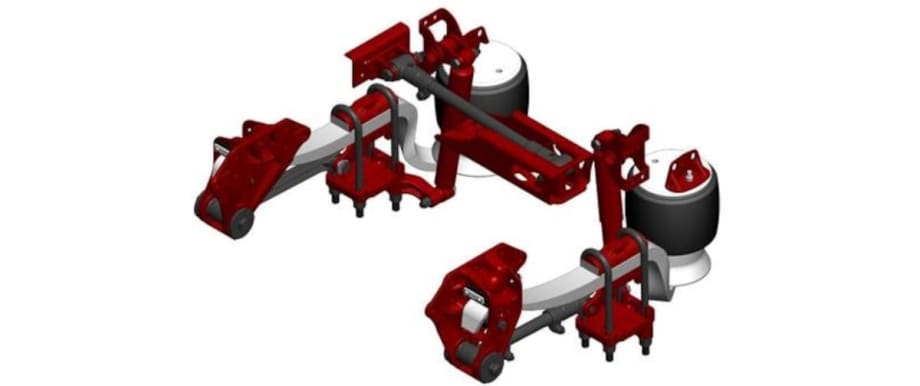
Reyco Granning’s 240AR-EV has a GAWR range of 17,000 lb. to 23,000 lb.
Photo: Reyco Granning
Reyco Granning Electric Vehicle Solutions has developed a new high-capacity variant of its customizable suspension option for Class 5-8 electric trucks.
The company said its 79KB is a very customizable suspension option available for Class 5 through 8 trucks. the new high-capacity, 35,000-lb. GAWR variant allows customers to configure a 4X2 with a GVW that would have required a 6X4 in the past, according to the company.
Reyco Granning Electric Vehicle Solutions reports the 79KB is widely used by a major truck OEM for EV applications today. The system is available in a variety of capacities with options that include a stabilizer bar, taper leaf springs, helper springs, shock absorbers, and disc brake compatibility.
The 240AR-EV has a GAWR range of 17,000 lb. to 23,000 lb. and is suitable for single or tandem-drive axle arrangements. Low profile frame brackets leave room for body mounts or fifth wheel angles.
The curved spring beam eliminates the traditional lower air spring mount to increase ground clearance and reduce weight. Design efficiencies were a focus to make room for a larger e-axle and higher un-sprung mass. The company said the system is ideally suited for on-highway truck, tractor, motorhome, or bus applications.
“Taking our place in the development of EV solutions further cements our commitment to the future of heavy and medium vehicle propulsion,” said John Stuart, president.
More Equipment

How Volvo Updated Its D13 for EPA 2027 [Watch]
Volvo’s updated D13 promises lower emissions without sacrificing performance or fuel economy. Take a closer look at what changed inside the engine in this HDT Spotlight video.
Read More →
Michelin Tire Improves Efficiency and Durability for Regional Fleets
The Michelin X Multi Energy D2 is a regional haul drive tire engineered to help fleets improve fuel efficiency, durability and traction in demanding stop-and-go operations.
Read More →
ZF Expands Commercial Vehicle Push in North America
ZF is expanding its North American commercial-vehicle presence with new transmission applications, electrification, trailer technology and autonomous-driving systems.
Read More →
Tesla Wants a Self-Driving Semi. Are Cameras Enough?
Could Tesla’s camera-only autonomous driving technology work on an 80,000-pound Semi? In this commentary, HDT's Deborah Lockridge takes a look at Tesla, Cybercab, and how autonomous trucks see the road.
Read More →
Kodiak: Driverless Long-Haul Truck Launch on Track for 2026
Kodiak AI says its driverless long-haul safety case is 93% complete and it remains on track to begin commercial operations by year-end 2026.
Read More →
What DOT’s Automated Vehicle Strategy Means for Trucking
The U.S. Department of Transportation issued a new automated-vehicle strategy that outlines plans for driverless-truck regulations, cross-state freight corridors, and federal safety standards.
Read More →
East Coast Port Launches $45M Electric Truck Push
The Port Authority of New York and New Jersey announced millions in incentives for zero-emission drayage trucks, yard tractors, and new charging hubs near the port.
Read More →
PlusAI Going Public to Fund Autonomous Truck Launch
A SPAC deal could provide PlusAI with up to $300 million as it works toward a 2027 commercial launch of factory-built autonomous trucks.
Read More →
NHTSA Moves to Rewrite Truck Fuel-Economy Rules
The National Highway Traffic Safety Administration says it lacks authority to regulate medium- and heavy-duty truck engines separately from complete vehicles, but the existing standards have not yet been eliminated.
Read More →
Detroit Opens Orders for EPA 2027 Engines
Detroit isn’t starting from scratch to meet EPA 2027 diesel emissions standards. Its Gen 6 DD13 and DD15 engines keep much of today’s platform while updating the fuel and aftertreatment systems.
Read More →