




Report: Lightweighting Trends Shift as Tractor Weights Increase
Trucking fleets can save 2,000 pounds by investing to a limited degree in lightweighting and as much as 4,000 pounds with an aggressive investment, according to the North American Council for Freight Efficiency.

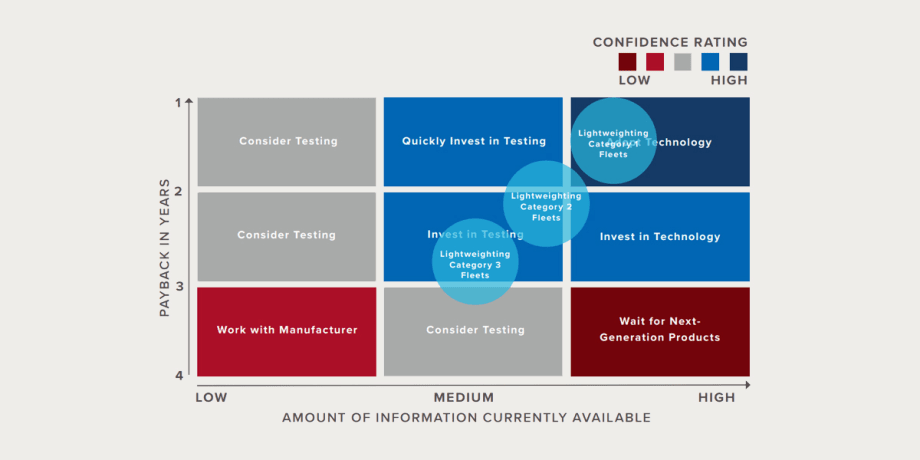
"Category 1" trucks are bulk carriers, which represent about 2% of the industry. The majority of bulk haulers have already invested in lightweight technologies.
Photo: NACFE
The North American Council for Freight Efficiency has issued an updated report on the changing trends of lightweighting technologies since the council last published a study on the topic in 2015, including strategies to deal with increased tractor weights.
The study team interviewed more than 50 companies, including fleets, tractor and trailer OEMs, suppliers and technology companies, and confirmed that the weight of tractors (and to some degree trailers) has increased, while freight is becoming denser, and shippers are loading more pallets per trailer.
Currently, the market can be divided into three categories with respect to weight sensitivity and the percent of time that fleets are requested to gross out.
Category 1: Trucks that currently travel at the 80,000-pound limit at some point along nearly 100% of their routes. This represents a small percentage of the industry (about 2%). This segment consists of bulk carriers.
Category 2: Trucks that are loaded to the maximum weight (gross out) on a minority, perhaps 10%, of their trips. This represents about 10% of the trucks on the road, mostly refrigerator units but also some dry van routes.
Category 3: Dry van units that rarely (2% of the time) or never travel at maximum weight, either because they are filled to maximum volume (cube out) before they gross out, or simply because their routes and cargo patterns are not conducive to traveling full. About 88% of the trucking industry falls into this category.
The study found that bulk carriers are willing to pay $6 to $11 up front cost per pound of weight saved, and that the majority of bulk haulers have already invested in lightweight technologies. Meanwhile, reefers and some dry van fleets are willing to pay $2 to $5 per pound of weight saved, and fleets with dry van units that rarely travel at maximum weight are willing to pay up to $2 per pound of weight saved.
NACFE found that over the next five to 10 years, shippers will request that Category 2 and Category 3 trucks double the percent of time they gross out, to 20% of the time for Category 2 and 4% of the time for Category 3.
In order to meet these trends head-on and accommodate the heavier, denser freight, Category 2 and 3 fleets will have two options — add more trucks to the road, or explore lightweighting so that at least some of their trucks will be able to carry more freight. Lightweighting is by far the better option, NACFE officials said. Along with improving the overall freight efficiency of a fleet, lightweighting is a good investment because it opens the door for the adoption of additional beneficial technologies that might otherwise make a truck unacceptably heavier than it currently is.
Emissions regulations, combined with fuel economy features and driver amenities on today’s commercial vehicles, have added 1,000 pounds to the typical Class 8 truck, according to NACFE officials.
Fleets can save 2,000 pounds by investing to a limited degree in lightweighting and as much as 4,000 pounds with an aggressive investment. Lightweighting can take place in various areas of the tractor and trailer, including the powertrain, axle suspensions, wheel ends, drive shaft, frame and fifth wheel.
The study team developed the following recommendations based on the trends officials recorded:
Category 2 and Category 3 fleets should begin to explore and spec lightweighting technologies in order to improve freight efficiency. By doing so, they may even produce economies of scale that bring down the upfront cost of these technologies, while perhaps opening up new options for Category 1 fleets to adopt technologies that are currently too expensive.
To bring down costs the industry should collaborate in order to address current redundancy in the development, testing, and product availability cycle among product developers, tractor-trailer integrators, and fleets.
The study also found that:
Aluminum frame rails that were looked at five years ago are no longer available.
Lightweight frame cross members are becoming more popular with new developments on the horizon.
Both steel and aluminum wheel manufacturers have reduced wheel weight by 5 pounds since 2015.
Electric trucks are 2,500 to 5,000 pounds heavier than their diesel counterparts for the same duty cycle.
There are a number of new products in development, from film to replace paint to new frame processing and composite cab structures.
More Equipment

How Volvo Updated Its D13 for EPA 2027 [Watch]
Volvo’s updated D13 promises lower emissions without sacrificing performance or fuel economy. Take a closer look at what changed inside the engine in this HDT Spotlight video.
Read More →
Michelin Tire Improves Efficiency and Durability for Regional Fleets
The Michelin X Multi Energy D2 is a regional haul drive tire engineered to help fleets improve fuel efficiency, durability and traction in demanding stop-and-go operations.
Read More →
ZF Expands Commercial Vehicle Push in North America
ZF is expanding its North American commercial-vehicle presence with new transmission applications, electrification, trailer technology and autonomous-driving systems.
Read More →
Tesla Wants a Self-Driving Semi. Are Cameras Enough?
Could Tesla’s camera-only autonomous driving technology work on an 80,000-pound Semi? In this commentary, HDT's Deborah Lockridge takes a look at Tesla, Cybercab, and how autonomous trucks see the road.
Read More →
Kodiak: Driverless Long-Haul Truck Launch on Track for 2026
Kodiak AI says its driverless long-haul safety case is 93% complete and it remains on track to begin commercial operations by year-end 2026.
Read More →
What DOT’s Automated Vehicle Strategy Means for Trucking
The U.S. Department of Transportation issued a new automated-vehicle strategy that outlines plans for driverless-truck regulations, cross-state freight corridors, and federal safety standards.
Read More →
East Coast Port Launches $45M Electric Truck Push
The Port Authority of New York and New Jersey announced millions in incentives for zero-emission drayage trucks, yard tractors, and new charging hubs near the port.
Read More →
PlusAI Going Public to Fund Autonomous Truck Launch
A SPAC deal could provide PlusAI with up to $300 million as it works toward a 2027 commercial launch of factory-built autonomous trucks.
Read More →
NHTSA Moves to Rewrite Truck Fuel-Economy Rules
The National Highway Traffic Safety Administration says it lacks authority to regulate medium- and heavy-duty truck engines separately from complete vehicles, but the existing standards have not yet been eliminated.
Read More →
Detroit Opens Orders for EPA 2027 Engines
Detroit isn’t starting from scratch to meet EPA 2027 diesel emissions standards. Its Gen 6 DD13 and DD15 engines keep much of today’s platform while updating the fuel and aftertreatment systems.
Read More →