




Report: Hybrid Truck Viability Hurt by Low Fuel Prices
A report from Indiana University's School of Public and Environmental Affairs finds challenges to the economic viability of medium-sized diesel-electric hybrid trucks. These hybrids have a significantly higher sticker price than conventional diesel-powered trucks. With volatile fuel
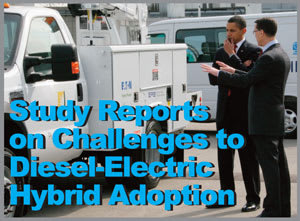
President Obama has supported tax incentives for hybrid vehicles.
A report from Indiana University's School of Public and Environmental Affairs finds challenges to the economic viability of medium-sized diesel-electric hybrid trucks.
These hybrids have a significantly higher sticker price than conventional diesel-powered trucks. With volatile fuel prices and uncertain technology and environmental trends, the fuel savings and environmental benefits from driving these hybrids may not be enough to recover their higher investment costs, say John D. Graham and Kerry Krutilla, the authors of the study.
At the same time, new federal fuel consumption regulations are improving the fuel economy of conventional diesel-powered vehicles, reducing the comparative advantage of hybrids.
"Looking over a 20-year period, there aren't many scenarios where the government would be justified in significantly subsidizing hybrid truck manufacturers or consumers," Graham says.
He cautioned that economic, environmental and regulatory conditions could change, which also would change that analysis.
Advances in hybrid technology also could affect that equation. Eaton last month announced it's increased the fuel economy of its hybrid power system by 5% to 10%, lowering the return-on-investment time while also improving vehicle performance. Changes include a new high-capacity battery, a new single-phase 115-volt AC auxiliary power generator, a higher capacity clutch and a remanufactured battery for aftermarket purchase. (See 6/5/2012 Eaton Enhances Hybrid Drive System for Faster Payback)
The study also examined the fiscal effects of using and promoting hybrids. States collect additional sales tax revenue when higher-priced hybrids are sold, and these revenues were found to be larger than the lost fuel tax revenue from driving more fuel-efficient vehicles. But at the federal level, the combined effect of corporate tax losses (from the deduction of the investment cost of the hybrid technology) and reduced fuel tax collections worsens the fiscal picture.
The report has been published as an article, "Are Green Vehicles Worth the Extra Cost? The Case of Diesel-Electric Hybrid Technology for Urban Delivery Vehicles," in a just-released symposium edition on science policy in the Journal of Policy Analysis and Management.
Graham, an expert in benefit-cost analysis and former administrator in the White House Office of Management and Budget, is dean of the School of Public and Environmental Affairs. Krutilla is an associate professor at IU and the author of a book and numerous articles on environmental and energy policy and benefit-cost analysis.
A grant from Navistar Corp. funded the research.
More Drivers

Truck Drivers Need More Than Another Alert
Fleets have more visibility into truck health, safety events, and driver activity than ever. The next challenge is turning all that information into useful guidance for the person who has to decide what to do next.
Read More →
FMCSA Removes 110 Truck Driver Training Schools from Certified ELDT List
Federal regulators also are targeting more than 160 additional training providers and launching a nationwide audit of third-party CDL skills testers as part of a broader crackdown on trucking fraud.
Read More →
Hours of Service Pilot Programs: FMCSA Readies for 2027 Rollout
Two pilot programs could eventually reshape hours-of-service rules, giving truck drivers options to pause their 14-hour clock or use longer split sleeper rest periods.
Read More →
Medical Cards, English Proficiency Reshape Roadcheck Violations
Medical-card violations jumped to the top of the driver out-of-service list during CVSA’s 2026 International Roadcheck, while English-language proficiency violations appeared among the leading violations for the first time.
Read More →
Driver Trust Can Make or Break the Success of Fleet Safety Technology
New Teletrac Navman research suggests that onboarding, transparency about driver data, and positive feedback can play a significant role in how commercial drivers respond to safety and coaching technology.
Read More →
EEOC Sues KLLM Over Alleged Sex Discrimination in Driver Training
KLLM is facing a federal sex-discrimination lawsuit over policies the EEOC alleges put female truck driver trainees at a disadvantage.
Read More →
FMCSA Moves to Codify English Language Requirements for Commercial Drivers
By changing regulations on English-language proficiency requirements for commercial drivers, rather than relying on a guidance memo, the FMCSA said future administrations won't be able to walk back the Trump administration's stricter enforcement with just a memo.
Read More →
Drivers Put Western Star Trucks to the Test at Star Nation Experience
Watch to get an inside look at the Western Star trucks, technology, and community behind the Star Nation Experience 2026!
Read More →
Trump Administration Looks to Put More Veterans Behind the Wheel
The Freedom Haulers program pulls together existing and expanded programs at several federal agencies to recruit veterans to drive commercial heavy-duty trucks and cut the red tape for them to get a CDL, training, and employment.
Read More →
Putting Mack’s Command Steer to the Test
A test drive of Mack’s Command Steer active steering system evaluates how it can make truck driving easier and less tiring.
Read More →