




Report: Fund Freight Infrastructure Beyond Highway Trust Fund
A new research report strongly advocates for greater funding of transportation infrastructure investments what is now covered by Highway Trust Fund allocations. It also stresses the value of projects designed to support multiple transportation modes.

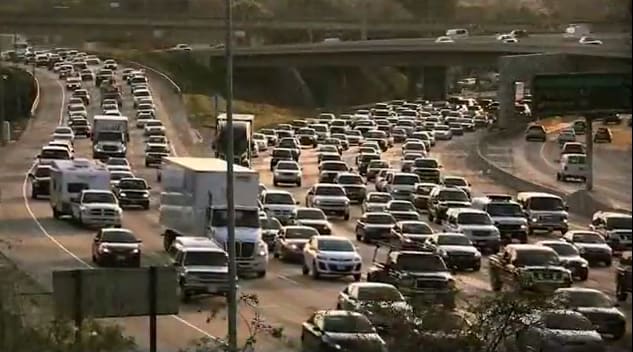
Image: U.S. DOT

Image: U.S. DOT
A new research report strongly advocates for greater funding of transportation infrastructure investments what is now covered by Highway Trust Fund allocations. It also stresses the value of projects designed to support multiple transportation modes.
Release of the “The State of Freight II—Implementing the FAST Act and Beyond” report, co-authored by the American Association of State Highway and Transportation Officials and the American Association of Port Authorities, marks the one-year anniversary of the passage of the Fixing America’s Surface Transportation (FAST) Act highway bill.
The report aims to be a “blueprint for state DOTs, Congress and the new [Trump] administration to address the critical freight infrastructure needs of our nation,” said AASHTO President and MaineDOT Commissioner David Bernhardt.
“One of my top priorities as AASHTO president is to focus on intermodal freight capacity constraints and work collectively to improve the vital connections between rail, ports, intermodal facilities and the national surface transportation system necessary to meet the projected demand in population growth and freight movement over the coming decades.”
Kurt Nagle, AAPA president and CEO, said the report gives a “comprehensive national overview of where states are collectively in developing state freight plans, one year after the FAST Act was passed.”
The two associations contend that while states are making progress, improvements to critical freight infrastructure have not kept pace with current and future demands. The report includes several recommendations to leverage private-sector investment and “move lawmakers to provide additional and ongoing funding resources outside of the Highway Trust Fund.”
Based on compiling and analyzing results from a combined AASHTO- AAPA survey completed in November, the report delves into how states fund freight-specific investments through state-dedicated or discretionary funding, and how these funding sources can potentially work with federal freight investments.
For example, the survey found that 71% of states have state freight plans that they are actively working to make compliant with the FAST Act compliant. Additionally, 57% of states have targeted more than 6,200 freight projects for inclusion in their state freight plans, while 35% have identified a combined $259 billion in costs for their state’s freight plan projects.
The associations also noted that of the 50 state departments of transportation and the District of Columbia’s, 12 have direct relationships with one or more ports in their state. What’s more, 38 states are connected by navigable waterways and/or marine highway routes, “which creates opportunities and obvious synergies for close DOT/port relationships.”
To help states plan sustainable investments in a national freight network, AAPA and AASHTO recommend in the report that these steps be taken:
Have the U.S. Department of Transportation continue providing Highway Trust Fund allocations to states for highway freight projects through the National Highway Freight program
Have the USDOT coordinate its Build America Bureau and freight advisory committees with state freight plans to better leverage private-sector investment
Request that Congress provide additional and ongoing funding resources outside of the HTF for the overall multimodal freight network in such a way it can supplement highway formula dollars and fund discretionary grant programs
Move the Harbor Maintenance Tax (HMT) from discretionary to mandatory spending to enable all the revenues from HMT collections to be used for maintenance of deep-draft navigation channels and providing more equity
During a Dec. 6 conference call with reporters, AASHTO Executive Director Bud Wright pointed out that while the FAST Act authorizes $11 billion to be spent on freight infrastructure over a five-year span, “a lot more will be needed just for the over 6,200 freight projects targeted by states. “That’s why we’re urging lawmakers to provide additional and ongoing resources outside of the Highway Trust Fund to fund freight programs.”
AAPA’s Nagle told reporters that a combination of federal, state, local and private-sector investments will be needed to bridge the funding gap. “President-elect Trump has talked very vocally about his desire to rebuild infrastructure – discussing an up to $1 trillion package with Congress,” he said. “I think there is a new recognition by Trump and Congress that we need to invest not just in overall infrastructure, but in transportation, specifically in freight transportation, if we are to compete internationally.”
More Fleet Management

Color Match Smarter: Tools That Restore & Perform
For fleet managers and collision repair professionals keeping heavy-duty trucks on the road, getting the color right the first time isn't just about appearance — it's about efficiency, turnaround time, and bottom-line results. Discover how today's digital color tools are transforming the repair process from guesswork to precision.
Read More →
FMCSA Pauses Biennial-Update Enforcement Amid Motus Transition
Carriers whose updates were due on or after June 1 have more time, while FMCSA works to stabilize its new registration system and warns of phishing sites impersonating its new carrier registration system, Motus.
Read More →
2026 Blueprint for Countering Smarter Supply Chain Theft
Cargo theft is no longer just the cost of doing business. It's a multi-billion-dollar criminal enterprise exploiting vulnerabilities across your fleet, drivers, and supply chain.
Read More →


How Telematics Improves Visibility, Control, and Performance in Refrigerated Fleets
Explore how telematics help refrigerated fleets improve visibility, uptime, efficiency, compliance, and cargo protection across connected cold chain operations.
Read More →
What the U.S.-Canada Trade War Means for Trucking
Escalating U.S.-Canada tariffs could disrupt cross-border freight, reduce truck volumes, raise costs, and create new uncertainty for carriers on both sides of the border.
Read More →
What Are Trucking’s Top Concerns for 2026?
The American Transportation Research Institute wants to know what's worrying trucking fleet managers, drivers, and other stakeholders in its annual Industry Issues survey.
Read More →
American Trucking Associations Looks for a New Leader
ATA President and CEO Chris Spear abruptly left his job at the association on August 21, at a pivotal time for the trucking industry.
Read More →
Public Wi-Fi Cybersecurity Risks: How Truck Drivers and Fleets Can Protect Their Data
Public Wi-Fi can expose truck drivers and fleets to credential theft, malware, and other cyber threats. Here’s how to reduce the risk on the road.
Read More →
For Nicky Cupp, Fleet Innovation Starts With Frustration
HDT Truck Fleet Innovator Nicky Cupp turns everyday pain points at Fraley & Schilling into opportunities for better technology and smarter processes.
Read More →
Adam Buttgenbach’s Approach to Electric Trucks: Start With Where They Fit
HDT Truck Fleet Innovator Adam Buttgenbach helped PepsiCo build one of North America’s largest EV fleets by focusing on where electric trucks make operational sense.
Read More →