




Renewable Natural Gas Gets a Bipartisan Boost on Capitol Hill
A bipartisan bill introduced in both the House and Senate would provide a tax credit for renewable natural gas used as fuel.

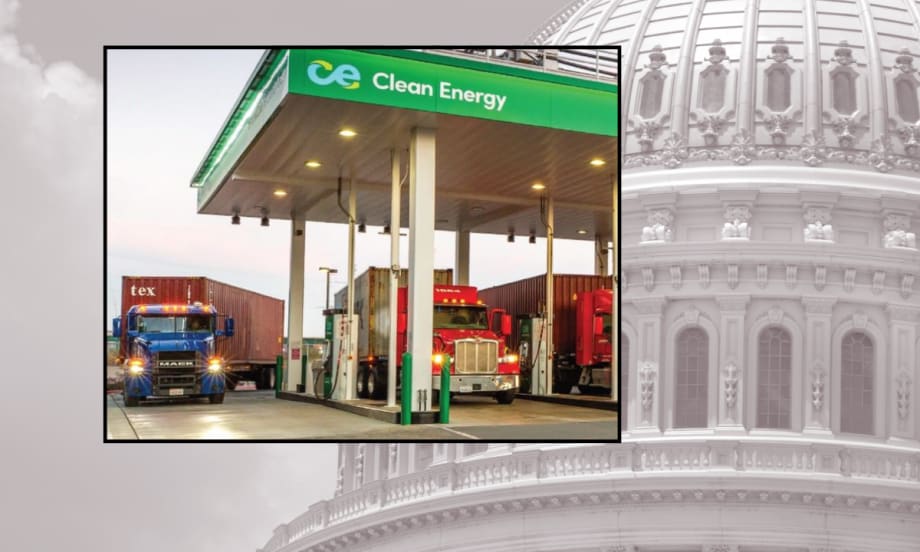
A bipartisan bill would provide a tax credt for renewable natural gas fuel.
Image: HDT Graphic, Clean Energy photo
A bipartisan bill introduced in both the House and Senate would provide a tax credit for renewable natural gas used as fuel.
Rep. Brian Fitzpatrick, a Republican congressman from Pennsylvania, and Rep. Linda Sánchez, a Democrat congresswoman from California, have joined forces with Senators Thom Tillis (R-NC) and Mark Warner (D-VA) to introduce the Renewable Natural Gas Incentive Act of 2025 to help drive the transition to cleaner fuels.
This legislation would create a $1-per-gallon tax credit for renewable natural gas used or sold as fuel.
The bill’s sponsors say it will help:
Reduce emissions and greenhouse gases.
Spur job creation
Strengthen domestic energy supply chains
Provide long-term certainty with the credit remaining in place through 2035.
The credit also would apply tocertified blended RNG.
RNG Bill Sponsors: Energy Independence, Pollution Reduction, Economic Growth
“Achieving American energy independence demands bold, forward-thinking solutions — and renewable natural gas is one of the most promising,” said Rep. Fitzpatrick in a news release.
“By cutting emissions and modernizing transportation across our supply chains, RNG delivers both environmental progress and economic growth."
Rep. Sanchez noted that heavy-duty trucks and buses are major contributors to pollution and the greenhouse gases that drive climate change.
“By transitioning to renewable natural gas, we can reduce these harmful impacts while providing a cleaner, more affordable fuel option,” she said.
“Our tax credit will incentivize replacing outdated fleets with more sustainable alternatives, ensuring a healthier environment and a stronger economy without disrupting operations or increasing costs.”
Daniel Gage, president of The Transport Project, a group promoting RNG, praised the bill.
“Transitioning to RNG-fueled vehicles can save money and reduce emissions, and deploys new, affordable, cleaner, and compliant technology without delay and without compromising business operations," Gage said.
“More and more commercial fleets are discovering how allocating RNG as transportation fuel can help achieve more sustainable results immediately. We are fortunate to have bipartisan, bicameral support in advancing the use of domestically produced RNG in commercial trucking.
"Getting this credit passed in this Congress will promote energy security, American jobs, and fuel cost savings for businesses.”

As of December 2024, the Renewable Natural Gas Coalition reports there were 442 active RNG facilities in the U.S. and Canada.
Source: Renewable Natural Gas Coalition
Why Renewable Natural Gas?
Captured above ground from organic material in agricultural, wastewater, landfill, or food waste, RNG can produce carbon-negative results when fueling on-road vehicles such as short- and long-haul trucks, transit buses, and refuse and recycling collection vehicles.
According to California Air Resources Board data, the weighted average carbon intensity (CI) value of California’s bio-CNG vehicle fuel portfolio in its Low Carbon Fuel Standard program is below zero — the only carbon negative clean transportation outcome in the program, according to TTP.
In 2023, 79% of all on-road fuel used nationwide in natural gas vehicles was from a renewable source.
However, TTP noted that RNG for fuel can cost two to three times more than fossil-based compressed natural gas.
“The dirtier the feedstock and lower CI RNG fuel is, the more production costs per gallon,” it explained. “Comparable fuels receive $1/gallon despite worse carbon intensity and emissions."
And natural-gas-powered trucks cost approximately $65,000 more per vehicle, according to TTP.
"This fuel credit helps to offset the cost of investing in new, clean vehicles and ensure the oldest, dirtiest diesel trucks are taken off of our roads.”
“Because RNG captures harmful greenhouse gases at the source — like dairies and other agriculture facilities — and at the vehicle, it is rated the cleanest fuel in the world, many times cleaner than electric vehicles,” said Andrew Littlefair, CEO and President of Clean Energy Fuels Corp.
“The bipartisan approach to this legislation demonstrates the win-win-win nature of RNG – reducing emissions with a very affordable U.S.-produced alternative fuel for fleets operating U.S.-made vehicles, while bring economic development to rural areas and helping our farmers.”
Major fleets using RNG, such as UPS and Waste Management, praised the bill.
Renewable natural gas has gained even more interest in trucking with the recent introduction of the Cummins X15N natural gas engine, which offers power and performance much closer to a diesel engine than previous natural gas engines.
More About the RNG Fuel Credit Bill
The Transport Project highlighted several facts about the bill.
This credit is modeled after the Alternative Fuels Tax Credit and provides an incentive for renewable natural gas when used as a motor vehicle fuel.
The incentive is provided to businesses, individuals, and tax-exempt entities that sell or, in some cases, use the fuel. The general rule is that the credit goes to the seller in the case of retail transactions. If the fuel is dispensed using a private fueling station, the credit may go to the user of the fuel.
For businesses and tax-exempt entities (e.g., federal, state and local governments), the credit must first be taken as an excise tax offset against taxes otherwise owed on alternative fuel they use or sell, and then it may be taken as a refundable credit. Many tax-exempt entities will not owe any excise taxes and can immediately apply for a payment that essentially amounts to a rebate.
Any gallon of fuel is eligible for either the Alternative Fuels Tax Credit or the Renewable Natural Gas Fueling Credit; not both.
To get the credit, the taxpayer must get certification from the producer of the renewable natural gas that identifies the product produced and the percentage of renewable natural gas in the product. This certification is modeled after existing biodiesel certification.
Watch to Learn More About RNG for Trucking:
More Fuel Smarts

How Volvo Updated Its D13 for EPA 2027 [Watch]
Volvo’s updated D13 promises lower emissions without sacrificing performance or fuel economy. Take a closer look at what changed inside the engine in this HDT Spotlight video.
Read More →
Diesel Price Spike Shortens Payback for Natural Gas Trucks, Report Says
Energy Vision estimates fleets could recover the higher purchase price of an RNG-fueled Class 8 tractor in 1.3 to 2.8 years under current fuel-price scenarios.
Read More →
Calstart Becomes Catalyst Mobility, Reflecting Broader Focus
Calstart is now Catalyst Mobility, reflecting the nonprofit’s growing national role in clean transportation, including zero-emission trucks, infrastructure and incentive programs.
Read More →

Record Diesel Prices Squeeze Trucking Fleets
Average U.S. diesel prices have climbed to nearly $6 a gallon, surpassing the 2022 record as tight refinery capacity and Middle East disruptions keep fuel costs elevated.
Read More →
How Fuel Delivery Shapes Engine Performance
Fuel delivery depends on more than what happens at the injector. For fleet, maintenance and technical professionals, looking at the full path from pump to injector can provide useful context for understanding engine performance.
Read More →
East Coast Port Launches $45M Electric Truck Push
The Port Authority of New York and New Jersey announced millions in incentives for zero-emission drayage trucks, yard tractors, and new charging hubs near the port.
Read More →
California Bill Could Shed Light on Electric Truck Prices
Why do battery-electric Class 8 trucks remain so expensive? A California bill headed to Gov. Gavin Newsom would give fleets and state agencies more visibility into what manufacturers charge.
Read More →
Detroit Opens Orders for EPA 2027 Engines
Detroit isn’t starting from scratch to meet EPA 2027 diesel emissions standards. Its Gen 6 DD13 and DD15 engines keep much of today’s platform while updating the fuel and aftertreatment systems.
Read More →
Zero-Emission Truck Corridor Planned for West Coast
California, Oregon, Washington, British Columbia and Baja California are coordinating plans for truck charging and hydrogen fueling from Canada to Mexico.
Read More →
A Closer Look at Kenworth’s Electric T880E Vocational Truck [Video]
Learn more about Kenworth's T880E battery-electric vocational truck at the Paccar Technical Center, including its range, applications, upfitting considerations, and PTO options, in this HDT Spotlight video.
Read More →