




Reason Foundation Plan Would Fix Chicago Infrastructure Through Toll Roads
A new study from the Reason Foundation finds Chicago has severely underinvested in expressways and urges the region to embark on an ambitious long-term road-building plan paid for entirely by tolls. It's a financing method that doesn't sit well with some Illinois truckers, while others say avoiding Chicago's notorious congestion might be worth it
A new study from the Reason Foundation finds Chicago has severely underinvested in expressways and urges the region to embark on an ambitious long-term road-building plan paid for entirely by tolls. It's a financing method that doesn't sit well with some Illinois truckers, while others say avoiding Chicago's notorious congestion might be worth it.
The plan calls for 11 major transportation projects that would add 2,401 new lane miles of expressways in the region.
"Expressways make up just 18% of the Chicago region's road network and yet they handle over 53% of the vehicle miles traveled," said Reason Foundation Vice President Adrian Moore, the study's project director, who served on Congress' National Surface Transportation Infrastructure Financing Commission. "Between 1982 and 2010, travel demand increased 126% on expressways but the number of lane miles increased by just 57%."
The plan's 11 projects, which would cost $52 billion to build, could be financed entirely by toll revenues from the new lanes and roads.
"The people who use these roads and tunnels will pay the costs to build and maintain them - as it should be," said Reason Foundation Senior Fellow Samuel Staley, author of the report and managing director or the DeVoe L. Moore Center at Florida State University. "By using variably-priced tolls, Chicago can guarantee both free-flowing traffic conditions and a sustainable revenue stream that ensures the long-term health of the road network. And many of these projects would be ideal candidates to be part of Mayor Rahm Emanuel's Chicago Infrastructure Trust."
Matt Hart, spokesman for the Illinois Trucking Association, said while he hadn't read the entire report, the association is leery of tolls after its experience with the Illinois Tollway, which has seen an increase in truck tolls of more than 500%.
Hart said the association is concerned that any initiative to create new toll lanes will put even more of a burden on the trucking industry.
The association has taken "a hard stance against any effort to take an existing public highway and turn it into a toll road," Hart said. "We are not opposed to new lanes of construction that are toll lanes. That being said, we still believe the best and most efficient way of funding infrastructure is through user fees, through traditional motor fuel taxes."
On the other hand, Don Schaefer with the Mid-West Truckers Association says in some cases, truckers may be happy to pay a premium to avoid the congestion. With the state's current woeful financial state, he says, it may be the only way to get things done.
With today's less-flexible hours of service regulations, time is money. Some truckers already go miles out of their way to avoid the Chicago metro area entirely, trading off the extra fuel cost for the time saved not sitting in a highway that's turned into a parking lot.
One of the projects Schaefer singles out is the Iliana Corridor, which will connect I-55 with I-65.
"It'll run parallel to I-80 up there, which is just a fiasco. The idea is for it to act as a reliever, take some of that traffic off of I-80. Especially when you get close to the Indiana state line, it's just a mess. Depending on what the toll is going to be, I'm sure a lot of truckers would be willing to pay a premium to avoid that traffic on I-80."
He also says several of these projects are already under way, at least in the planning process, including the Iliana Corridor; the Lake County Corridor, which will extend an expressway that currently "comes to a dead stop at the Cook County/Lake County line," and the Elgin O'Hare extension, which would alleviate traffic around O'Hare airport.
Others on the list are more "pie in the sky," Schaefer said, but called it a fun report to read.
The Reason Foundation transportation plan for Chicago includes:
- Regional High-Occupancy Toll Lanes Network: A 275-mile (1,100 lane miles), $12.0 billion network of high-occupancy toll (HOT) lanes that would add two priced lanes in each direction on I-294 (Tri-State Tollway), I-90 (Northwest Tollway), I-88 (East-West Tollway), and I-355 South of I-88. The toll rates in these lanes would vary, based on traffic conditions, to ensure they remain free flowing at all times.
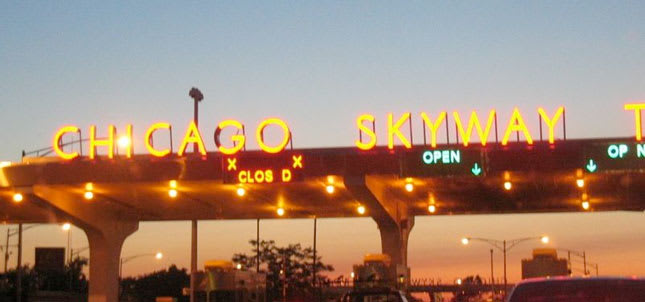
- Cross Town Tunnel: An 11-mile, $7.1 billion north-south tunnel in the alignment of Cicero Avenue and a nine-mile, $5.8 billion elevated Midway Extension running east along 63rd Street, connecting to the north endpoint of the Chicago Skyway (I-90). This project would allow through-traffic to bypass the downtown area and provide a connection between I-90/I-94, I-290 and I-55, alleviating problems around some of the most debilitating bottlenecks (the Circle and the I-90 Skyway Split).
- Outer Beltway: A 76.3-mile, $5.0 billion new outer expressway through Cook, DuPage and Will Counties with three toll lanes in each direction.
- Lake County Corridor: A 32.3-mile, $2.1 billion expressway extension connecting the proposed Outer Beltway with I-94.
- Northbrook-Palatine Connector: A new 25.3-mile, $1.6 billion freeway running between the I-94/I-294 interchange in Northbrook and the new Outer Beltway in Barrington.
- Elgin-O'Hare Extension: A 17.3-mile, $1.1 billion extension of the Elgin O'Hare Expressway east to O'Hare International Airport and west to the new Outer Beltway that is similar to a project in the Chicago Metropolitan Agency for Planning's Regional Transportation Plan.
- Illiana Corridor: A 40.5-mile, $2.6 billion extension of the southern end of I-355, connecting Chicago with the state of Indiana.
- Arterial Queue Jumpers: A $3.5 billion initiative to build more than 50 queue jumpers, special overpasses and tunnels that allow cars and buses to bypass traffic signals at major arterial intersections.
- Bus Rapid Transit Network: A system of bus routes that would utilize the new toll lanes network to provide express bus service to key locations.
- Kennedy Tunnel: A 9.8-mile, $6.4 billion tunnel paralleling the Kennedy Expressway that would provide a fast alternative to I-90/I-94.
- Eisenhower Tunnel: A 7.3-mile, $4.8 billion tunnel paralleling the Eisenhower Expressway (I-290) to alleviate one of the nation's biggest bottlenecks on the Eisenhower between exits 13 and 17.
"Chicago's population is going to continue to grow. And the current long-range plans acknowledge that traffic congestion will continue to worsen and take billions more out of the region's economy," Staley said. "The Reason Foundation plan will reduce congestion, shorten travel times and provide workers and businesses with options and flexibility that save time and money."
The full study is online here:
http://reason.org/studies/show/chicago-mobility-reduce-congestion
http://reason.org/files/chicago_transportation_plan.pdf
Reason Foundation's transportation research is here: http://reason.org/areas/topic/transportation
More Drivers
Trucker Path Expands Reserved Parking Network
Trucker Path has added close to 6,000 more truck parking spaces to its Trucker Path Reserved Parking Network with the addition of Safe Truck Parking.
Read More →
EEOC Sues Texas Trucking Company Over Driver Age Limits
The agency says Trancasa USA rejected applicants over 65 and applied tougher driving-record standards to those over 60.
Read More →
Nussbaum, Roehl Announce Second Driver Pay Increase This Year
This year has seen a swath of major truck driver pay increases as freight capacity has tightened.
Read More →
From One Generation to the Next: How Mentorship Builds Safer Truck Drivers
After three decades in trucking, Harold Perry shares what he's learned about driver safety, mentorship, and helping the next generation build confidence behind the wheel.
Read More →
Truck Drivers Need More Than Another Alert
Fleets have more visibility into truck health, safety events, and driver activity than ever. The next challenge is turning all that information into useful guidance for the person who has to decide what to do next.
Read More →
FMCSA Removes 110 Truck Driver Training Schools from Certified ELDT List
Federal regulators also are targeting more than 160 additional training providers and launching a nationwide audit of third-party CDL skills testers as part of a broader crackdown on trucking fraud.
Read More →
Hours of Service Pilot Programs: FMCSA Readies for 2027 Rollout
Two pilot programs could eventually reshape hours-of-service rules, giving truck drivers options to pause their 14-hour clock or use longer split sleeper rest periods.
Read More →
Medical Cards, English Proficiency Reshape Roadcheck Violations
Medical-card violations jumped to the top of the driver out-of-service list during CVSA’s 2026 International Roadcheck, while English-language proficiency violations appeared among the leading violations for the first time.
Read More →
Driver Trust Can Make or Break the Success of Fleet Safety Technology
New Teletrac Navman research suggests that onboarding, transparency about driver data, and positive feedback can play a significant role in how commercial drivers respond to safety and coaching technology.
Read More →
EEOC Sues KLLM Over Alleged Sex Discrimination in Driver Training
KLLM is facing a federal sex-discrimination lawsuit over policies the EEOC alleges put female truck driver trainees at a disadvantage.
Read More →