




Q&A: What Volvo Connect Updates Can Do for Trucking Fleets
How is a new Volvo truck like your smartphone? Learn about the latest enhancements to the Volvo Connect platform in this interview with Volvo's Johann Agebrand.

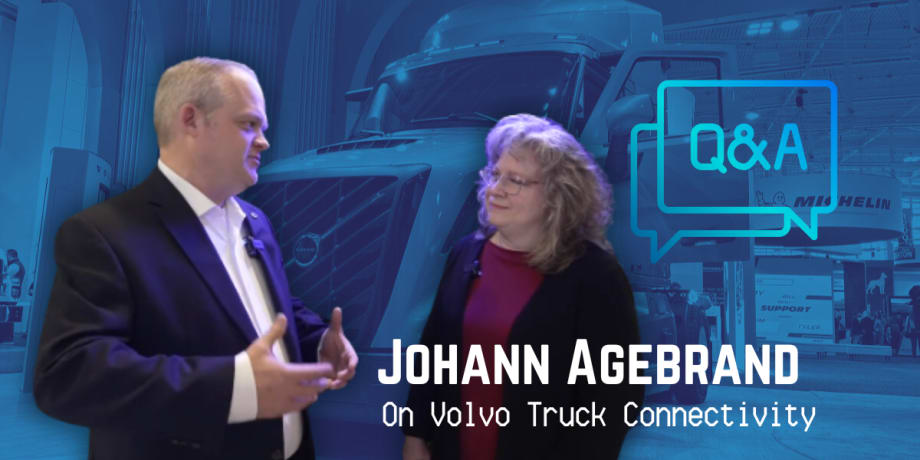
"Fleets might think the trucks are running one set of parameters, but the driver might have a friend at a tech workshop go in there and change it a little bit. Now we’re able to provide a portal interface to the fleets so they can go directly into Volvo Connect and see exactly the parameters."
Image: HDT graphic
How is a new Volvo truck like your smartphone?
After Volvo Trucks North America launched the all-new Volvo VNR regional truck, we chatted with Johann Agebrand, director of product marketing, about the newest Volvo Connect updates featured on both the VNR and the new Volvo VNL.
Volvo Connect, Volvo’s digital fleet management platform, has new capabilities, as does Volvo's remote programming offering. (These are available for legacy models as well.)
Volvo Trucks will now streamline over-the-air updates for customers, and changing vehicle parameter settings will be available in Volvo Connect. Customers can now modify and deploy commonly adjusted parameters, such as maximum road speed, pedal maximum, cruise maximum and idle shutdown settings.
These changes can be applied to specific trucks or across the entire fleet through the Volvo Connect portal. Customers can also create and save templates, receiving alerts if a truck deviates from the designated template.
This interview from the American Trucking Associations’ Technology & Maintenance Council 2025 meeting has been lightly interviewed for length and clarity.
Deborah Lockridge: One of the big developments is automatic software updates — kind of like what your iPhone does, right?
Johann Agebrand: Exactly like an iPhone — and that’s a big deal for the trucking industry. From the data we’ve gathered, we see up to 24% better uptime when software is kept up to date.
It’s not necessarily that the trucks are faulty, but with all the complexity, the systems, the sensors, you get little nuisances.
We’re constantly learning as customers drive these trucks. That helps us optimize and improve our products and algorithms and make everything work better constantly with continuous updates.
The trucks still work as they did before, but over time we discover better ways to use existing sensors or functions. Then we can push those improvements out via updates. It’s all about continuous improvement.

Volvo Trucks North America has made enhancements to Volvo Connect, its digital fleet management platform, and its remote programming offering.
Photo: Volvo Trucks North America
Lockridge: And the ability to update parameters is much easier and faster than it used to be.
Agebrand: it's a significant reduction in time. Before, if you had to do certain updates, we could initiate it through Volvo Action Service. Sometimes we could do them remotely, but in some cases the truck had to come into a shop.
That meant you had to plan that truck to come into your terminal, get the drivers out of it, get them into another truck or something, have the service workshop work on it, and then get it back. So you're probably looking at two, three days that the truck is out of your operational fleet.
Now, with automatic updates, no longer do we have to have the fleet manager or the owner say, ‘I want the update.’
We at Volvo say, ‘Here is a good update.’ What we give you as an option as a customer is that you decide when you want to initiate it. So we send out a notification — just like a smartphone — saying an update is available. You decide when to install it. They can initiate it on their schedule.
We’ve designed it so that programming can happen during appropriate windows. For example, some powertrain updates can be completed during a driver’s 30-minute hours of service break. If it’s something longer, it can be scheduled overnight.
The goal is to fit updates into the customer’s business, not the other way around.
Lockridge: And fleets now have direct access to parameters, right?
Agebrand: Now, using the Volvo Connect portal, they can manage this directly — see all their trucks, adjust parameters, and create templates for different applications.
They can create templates if they have, for example, two different applications or use cases. They can create two templates and make sure that all those trucks are updated to those templates and get them programmed over there.
Lockridge: What are the most common parameters fleets want to change?
Agebrand: The most common one is the road speed limit.
Say you’re running northern states and all of a sudden you pick up a contract route that goes into Canada. They might want to change the speed limits near the border, depending on the route. We give them the flexibility to do that.
Or, fleets might think the trucks are running one set of parameters, but the driver might have a friend at a tech workshop go in there and change it a little bit.
Now we’re able to provide a portal interface to the fleets so they can go directly into Volvo Connect and see exactly the parameters.
Lockridge: What kind of feedback have you been hearing from customers here at the show?
Agebrand: There’s definitely excitement. Fleets have so much on their plates already, with the economy, trying to make everything work, being able to provide profit, especially in today’s market. So many times, they don’t necessarily think that far ahead, and we can show them, ‘This is something that would really help you out.’
Lockridge: It’s easy to get caught up in the day-to-day that it’s sometimes hard to look at that bigger picture of things you could improve and things you could optimize.
Agebrand: Exactly. It’s hard to know what you’re missing if you’re not actively looking.
More Equipment

How Volvo Updated Its D13 for EPA 2027 [Watch]
Volvo’s updated D13 promises lower emissions without sacrificing performance or fuel economy. Take a closer look at what changed inside the engine in this HDT Spotlight video.
Read More →
Michelin Tire Improves Efficiency and Durability for Regional Fleets
The Michelin X Multi Energy D2 is a regional haul drive tire engineered to help fleets improve fuel efficiency, durability and traction in demanding stop-and-go operations.
Read More →
ZF Expands Commercial Vehicle Push in North America
ZF is expanding its North American commercial-vehicle presence with new transmission applications, electrification, trailer technology and autonomous-driving systems.
Read More →
Tesla Wants a Self-Driving Semi. Are Cameras Enough?
Could Tesla’s camera-only autonomous driving technology work on an 80,000-pound Semi? In this commentary, HDT's Deborah Lockridge takes a look at Tesla, Cybercab, and how autonomous trucks see the road.
Read More →
Kodiak: Driverless Long-Haul Truck Launch on Track for 2026
Kodiak AI says its driverless long-haul safety case is 93% complete and it remains on track to begin commercial operations by year-end 2026.
Read More →
What DOT’s Automated Vehicle Strategy Means for Trucking
The U.S. Department of Transportation issued a new automated-vehicle strategy that outlines plans for driverless-truck regulations, cross-state freight corridors, and federal safety standards.
Read More →
East Coast Port Launches $45M Electric Truck Push
The Port Authority of New York and New Jersey announced millions in incentives for zero-emission drayage trucks, yard tractors, and new charging hubs near the port.
Read More →
PlusAI Going Public to Fund Autonomous Truck Launch
A SPAC deal could provide PlusAI with up to $300 million as it works toward a 2027 commercial launch of factory-built autonomous trucks.
Read More →
NHTSA Moves to Rewrite Truck Fuel-Economy Rules
The National Highway Traffic Safety Administration says it lacks authority to regulate medium- and heavy-duty truck engines separately from complete vehicles, but the existing standards have not yet been eliminated.
Read More →
Detroit Opens Orders for EPA 2027 Engines
Detroit isn’t starting from scratch to meet EPA 2027 diesel emissions standards. Its Gen 6 DD13 and DD15 engines keep much of today’s platform while updating the fuel and aftertreatment systems.
Read More →