




Pumper Truck Market Revival Evident at World of Concrete
The economic recovery has revived construction activity, which was obvious at the World of Concrete show which took place from Feb. 2-6 in Las Vegas.

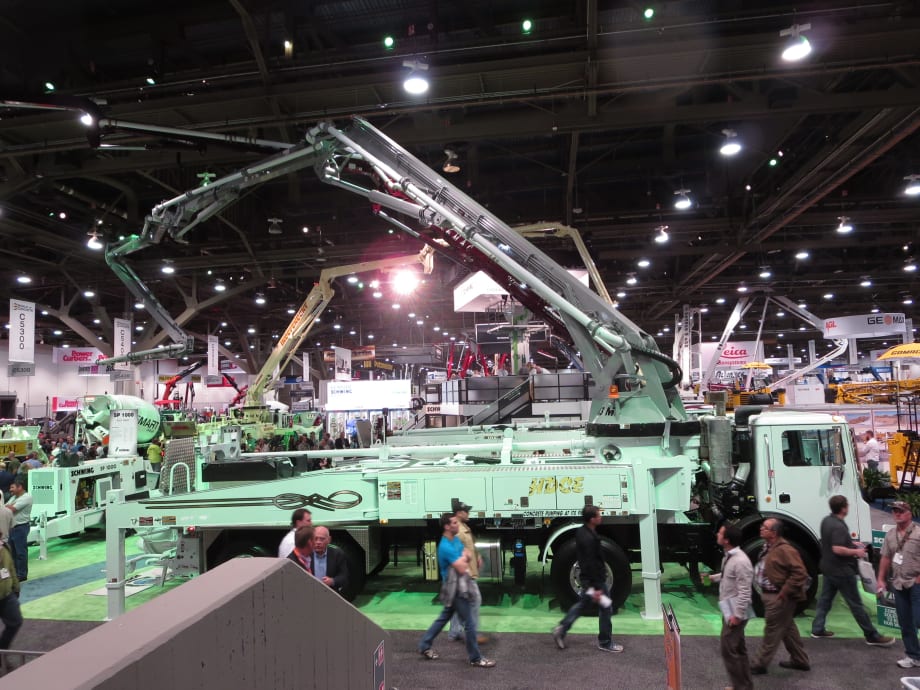
Schwing is displaying numerous wheel- and truck-mounted pumps. Equipment is painted white, but filters on overhead lights produced a green cast. Photo by Tom Berg
Schwing is displaying numerous wheel- and truck-mounted pumps. Equipment is painted white, but filters on overhead lights produced a green cast.Photo by Tom Berg
The economic recovery has revived construction activity, which was obvious at this week’s World of Concrete show at the Las Vegas Convention Center. It’s bigger than in previous years, with more trucks and concrete-handling equipment on display in several halls and outside lots. Among them were transporters of concrete pumping units, which are always eye-catching for their sheer size and massive weight.
As with mixer trucks, the market for pumps all but died during the Great Recession. Many of both types were on display at the show during those stagnant years, but representatives at manufacturers’ booths acknowledged that pumper chassis were a year or two or three old, as contractors with more time than work on their hands had ceased ordering them. Now the market has revived, and pumper trucks were all over the place at the World of Concrete.
Pumps are used to quickly lift the grey slurry to upper stories of buildings and place it across large pads. A large pump can move many hundreds of cubic yards of concrete in a shift. For reference, a typical load of concrete is 9 to 11 yards, so it takes a small fleet of mixer trucks to keep a pumper busy. Massive jobs can go on around the clock – occasions reported by local news media because of all the human and vehicular activity.
Pumper booms hydraulically fold out and extend to 30 to 60 meters, or roughly 100 to 200 feet. Displays have booms deployed horizontally, vertically and at various angles. Outside, some serve as expensive flag poles, flying fabric with a company’s name or the beloved Stars and Stripes.
While the American construction industry still measures almost everything in standard inch and foot terms, many pump manufacturers (like Putzmeister and Schwing) are headquartered overseas where metrics rule, so boom length is one thing described in meters (1 meter equals 39.37 inches).
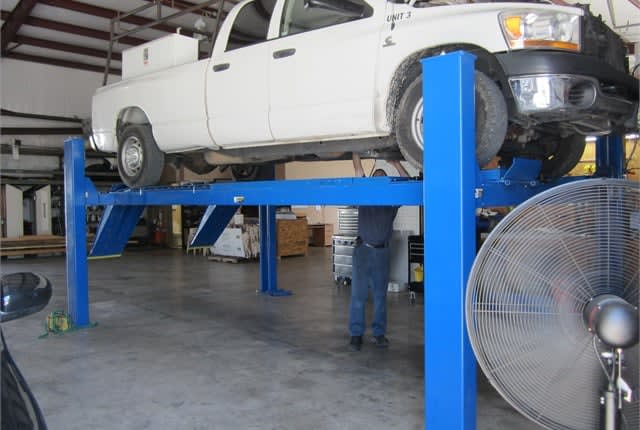
Mack MR TerraPro has seven axles, three powered and several actively steered.Photo by Tom Berg
Mack has long dominated the pumper-chassis business in North America with its MR (now called TerraPro), a heavy low-cab-forward model also employed by trash-collection fleets. Many multi-axle MRs are displayed in implement makers’ booths. Most have at least four axles and at least one had seven, with two or more axles actively steered.
The largest and heaviest trucks sit on big-single flotation tires to better carry the weight over soft dirt, and are stabilized by hefty outriggers while working on site. One of these trucks can weigh 40 or more tons just sitting there, and some must move under special permits.
Operators need high horsepower not just to move the truck to and from job sites, but also to spin the massive pumps that propel concrete through piping in the long booms. So MP7 and MP8 diesels with 400 to 500 hp are used in Macks. Because the trucks spend more time sitting than moving down highways, multi-speed manual transmissions rather than the Allison automatics used in trash trucks are the rule.
Heavy low-cabovers from other builders also compete in this segment. Peterbilt’s Model 320, also primarily a trash chassis, has long been in it, and the company has put new emphasis on the concrete pump market since it came alive.
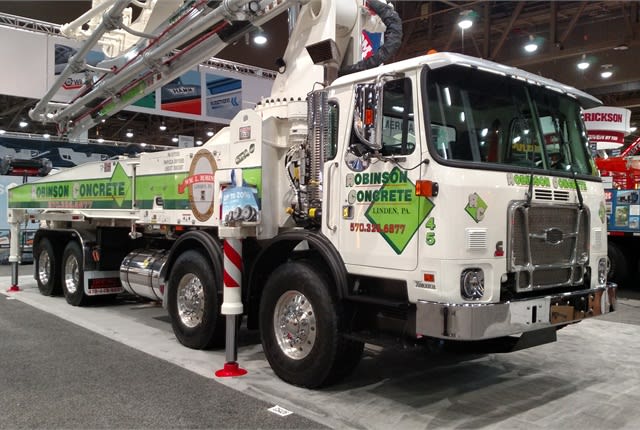
Now that the market's revived, Autocar expects more pump-chassis sales of its Xpeditor.Photo by Tom Berg
Autocar, a firm formed to take over the Volvo Xpeditor, is another. Over the years Autocar has built Xpeditor pumper chassis in ones and twos under special order, but it can expect more these days – at least as long as the economic recovery lasts.
Smaller pumps are toted by heavy or medium-duty conventional-cab chassis. Their comparative compactness and high maneuverability make them useful in tight urban areas. But they look less impressive than their big brothers, and we failed to photograph even one.
More Equipment

How Volvo Updated Its D13 for EPA 2027 [Watch]
Volvo’s updated D13 promises lower emissions without sacrificing performance or fuel economy. Take a closer look at what changed inside the engine in this HDT Spotlight video.
Read More →
Michelin Tire Improves Efficiency and Durability for Regional Fleets
The Michelin X Multi Energy D2 is a regional haul drive tire engineered to help fleets improve fuel efficiency, durability and traction in demanding stop-and-go operations.
Read More →
ZF Expands Commercial Vehicle Push in North America
ZF is expanding its North American commercial-vehicle presence with new transmission applications, electrification, trailer technology and autonomous-driving systems.
Read More →
Tesla Wants a Self-Driving Semi. Are Cameras Enough?
Could Tesla’s camera-only autonomous driving technology work on an 80,000-pound Semi? In this commentary, HDT's Deborah Lockridge takes a look at Tesla, Cybercab, and how autonomous trucks see the road.
Read More →
Kodiak: Driverless Long-Haul Truck Launch on Track for 2026
Kodiak AI says its driverless long-haul safety case is 93% complete and it remains on track to begin commercial operations by year-end 2026.
Read More →
What DOT’s Automated Vehicle Strategy Means for Trucking
The U.S. Department of Transportation issued a new automated-vehicle strategy that outlines plans for driverless-truck regulations, cross-state freight corridors, and federal safety standards.
Read More →
East Coast Port Launches $45M Electric Truck Push
The Port Authority of New York and New Jersey announced millions in incentives for zero-emission drayage trucks, yard tractors, and new charging hubs near the port.
Read More →
PlusAI Going Public to Fund Autonomous Truck Launch
A SPAC deal could provide PlusAI with up to $300 million as it works toward a 2027 commercial launch of factory-built autonomous trucks.
Read More →
NHTSA Moves to Rewrite Truck Fuel-Economy Rules
The National Highway Traffic Safety Administration says it lacks authority to regulate medium- and heavy-duty truck engines separately from complete vehicles, but the existing standards have not yet been eliminated.
Read More →
Detroit Opens Orders for EPA 2027 Engines
Detroit isn’t starting from scratch to meet EPA 2027 diesel emissions standards. Its Gen 6 DD13 and DD15 engines keep much of today’s platform while updating the fuel and aftertreatment systems.
Read More →