




Related: California Rules Seven Port Truckers Wrongly Classified as Independents
Port Drivers Reach $5 Million Settlement in Misclassification Suit
A class-action lawsuit representing nearly 400 Southern California port truck drivers has resulted in a $5 million settlement agreement with port trucking company group QTS, ending the three-year-long suit.
by Staff
July 15, 2016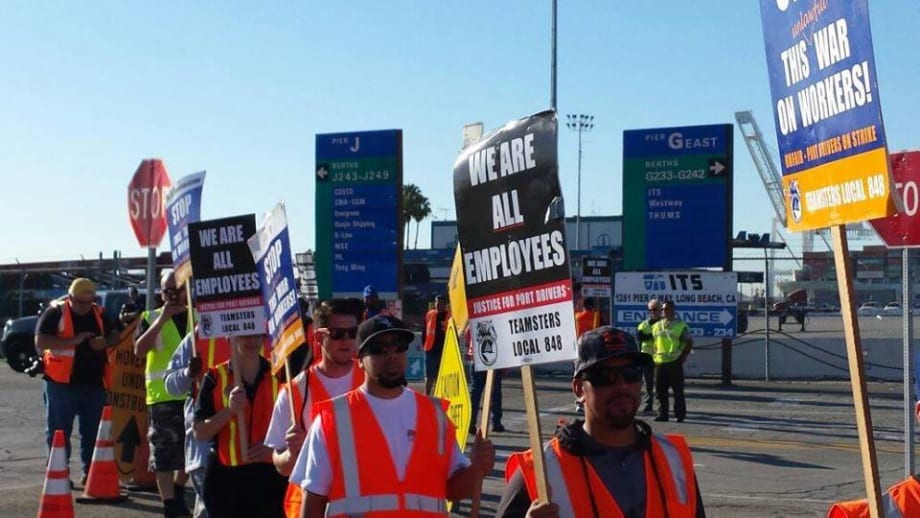
Photo: Justice for Port Drivers
2 min to read
Photo: Justice for Port Drivers
A class-action lawsuit representing nearly 400 Southern California port truck drivers has resulted in a $5 million settlement agreement with port trucking company group QTS, ending the three-year-long suit.
The lawsuit was brought by the Wage Justice Center and Asian Americans Advancing Justice–Los Angeles on behalf of Latino and Korean-American port truck drivers who claimed that they had been misclassified as contract workers in order to cheat them out of the wages and benefits granted to full employees.
This is the latest in a longstanding dispute between many port truck drivers serving the Ports of Los Angeles and Long Beach and the port trucking companies who classify drivers as independent contractors. Most recently, Premium Transportation Services filed for bankruptcy, blaming its financial troubles on driver misclassification lawsuits and legal costs. QTS was also in the midst of bankruptcy proceedings during the lawsuit.
Port drivers have also staged several strikes related to the issue. While few port truck driver are part of a union (as independent contractors they are forbidden from organizing by federal law), the Brotherhood of Teamsters has been active in staging strike demonstrations along with groups like Justice for Port Drivers.
“Unfortunately, misclassification is the port industry norm,” said Nicole Ochi, attorney from Advancing Justice-LA. "Nearly two-thirds of all port truck drivers nationally are misclassified as independent contractors, resulting in an impoverished, mostly immigrant workforce. We are proud that with this settlement, hundreds of drivers will be rightfully compensated, and we hope this case sends a strong signal to other drivers that they can win if they fight back.”
More Drivers

Truck Drivers Need More Than Another Alert
Fleets have more visibility into truck health, safety events, and driver activity than ever. The next challenge is turning all that information into useful guidance for the person who has to decide what to do next.
Read More →
FMCSA Removes 110 Truck Driver Training Schools from Certified ELDT List
Federal regulators also are targeting more than 160 additional training providers and launching a nationwide audit of third-party CDL skills testers as part of a broader crackdown on trucking fraud.
Read More →
Hours of Service Pilot Programs: FMCSA Readies for 2027 Rollout
Two pilot programs could eventually reshape hours-of-service rules, giving truck drivers options to pause their 14-hour clock or use longer split sleeper rest periods.
Read More →
Medical Cards, English Proficiency Reshape Roadcheck Violations
Medical-card violations jumped to the top of the driver out-of-service list during CVSA’s 2026 International Roadcheck, while English-language proficiency violations appeared among the leading violations for the first time.
Read More →
Driver Trust Can Make or Break the Success of Fleet Safety Technology
New Teletrac Navman research suggests that onboarding, transparency about driver data, and positive feedback can play a significant role in how commercial drivers respond to safety and coaching technology.
Read More →
EEOC Sues KLLM Over Alleged Sex Discrimination in Driver Training
KLLM is facing a federal sex-discrimination lawsuit over policies the EEOC alleges put female truck driver trainees at a disadvantage.
Read More →
FMCSA Moves to Codify English Language Requirements for Commercial Drivers
By changing regulations on English-language proficiency requirements for commercial drivers, rather than relying on a guidance memo, the FMCSA said future administrations won't be able to walk back the Trump administration's stricter enforcement with just a memo.
Read More →
Drivers Put Western Star Trucks to the Test at Star Nation Experience
Watch to get an inside look at the Western Star trucks, technology, and community behind the Star Nation Experience 2026!
Read More →
Trump Administration Looks to Put More Veterans Behind the Wheel
The Freedom Haulers program pulls together existing and expanded programs at several federal agencies to recruit veterans to drive commercial heavy-duty trucks and cut the red tape for them to get a CDL, training, and employment.
Read More →
Putting Mack’s Command Steer to the Test
A test drive of Mack’s Command Steer active steering system evaluates how it can make truck driving easier and less tiring.
Read More →