




Plus Debuts AI-Powered Vehicle Safety System
PlusProtect is AI-based software that enhances next-generation safety systems for all vehicle types

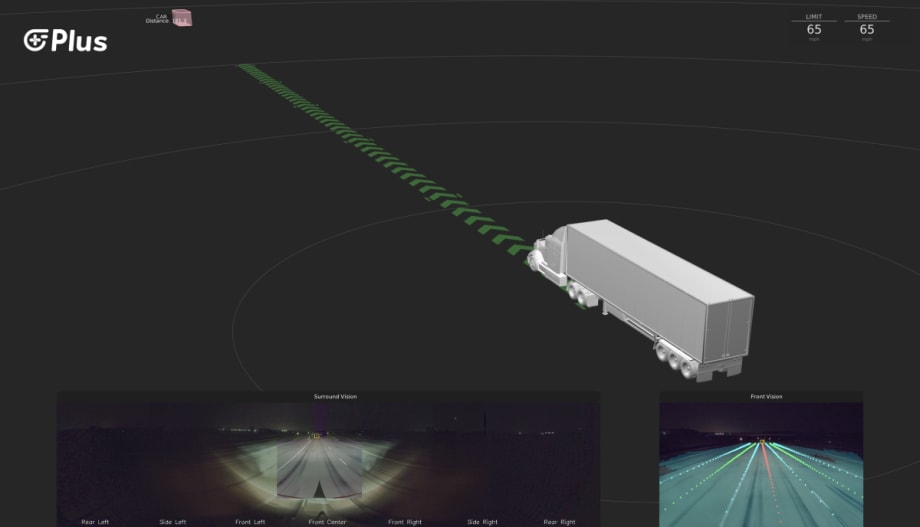
PlusProtect is an AI-powered safety system that can predict the movement of surrounding vehicles and obstacles and assist the driver by reacting quickly and automatically in order to help mitigate potential forward collisions.
Graphic: Plus
Automated and autonomous driving solutions company Plus is offering a new vehicle safety system that uses artificial intelligence. PlusProtect is an AI-based software that enhances next-generation vehicle safety systems for all vehicle types, such as high performance automatic collision mitigation.
2029 Safety Standards Today
According to Plus, this scalable technology will allow global Tier 1 automotive suppliers and vehicle manufacturers to offer enhanced safety features in their next-generation safety systems.
These features would address, if not exceed, the performance requirements mandated for automatic emergency braking (AEB) on all passenger vehicles and light trucks by September 2029, according to Plus.
Last year, the National Highway Traffic Safety Administration and the Federal Motor Carrier Safety Administration published a proposal that would require heavy vehicles (gross vehicle weight rating of more than 10,000 pounds) to have automatic emergency braking systems, as well.
Key features offered by PlusProtect include:
High performance AEB.
Expanded-coverage lane departure warning.
Traffic jam assist
Predictive fuel optimization.
Self-calibrated sensors.
Over-the-air updates.
Additional options include GSR-compliant features and an event data recorder that can provide a recording of a vehicle’s operational data immediately preceding and following a safety critical event.
The advanced features in PlusProtect are made possible by using cameras and radars to see objects more than approximately 650 feet (200 meters) ahead. Compared to safety systems that react to obstacles in the vehicle's lane, PlusProtect has full situational awareness to understand where the vehicle is located and what objects are in its own lane as well as nearby lanes.
Predictive Vehicle Tracking Capability
PlusProtect technology helps reduce false positives and can also handle AEB on curved roads, Plus said. Combined with Plus’s proprietary AI-based autonomous driving software and perception technology, the vehicle has an accurate view of the world around it. It is also able to predict the movement of surrounding vehicles and obstacles and assist the driver by reacting quickly and automatically in order to help mitigate potential forward collisions.
“While improved road safety underlies all of our solutions, we created PlusProtect specifically to enable Tier 1s and OEMs to build market-leading next-generation safety systems,” said Shawn Kerrigan, COO and co-founder at Plus.
“Features such as high-performance collision mitigation not only necessitate a new technology approach, adopting PlusProtect as part of the integrated safety solutions also helps them pave the way for higher levels of automation in their product portfolio."
PlusProtect is built on a flexible architecture that adapts to different sensor configurations and handles variations in platform, such as U.S. and Europe truck designs and both left- and right-hand driving.
Long range cameras continuously auto-calibrate, offering cost-effective and accurate depth at extended ranges.
Kerrigan emphasized that advanced safety technologies like PlusProtect do not replace skilled, alert drivers exercising safe driving techniques. Proactive, comprehensive driver training is also essential. He noted that responsibility for safe vehicle operation always rests with the driver and that limitations exist. Drivers should become familiar with these limitations before operating any equipped vehicle.
More Safety & Compliance

FMCSA Pauses Biennial-Update Enforcement Amid Motus Transition
Carriers whose updates were due on or after June 1 have more time, while FMCSA works to stabilize its new registration system and warns of phishing sites impersonating its new carrier registration system, Motus.
Read More →
ZF Expands Commercial Vehicle Push in North America
ZF is expanding its North American commercial-vehicle presence with new transmission applications, electrification, trailer technology and autonomous-driving systems.
Read More →
Truck Drivers Need More Than Another Alert
Fleets have more visibility into truck health, safety events, and driver activity than ever. The next challenge is turning all that information into useful guidance for the person who has to decide what to do next.
Read More →
Tesla Wants a Self-Driving Semi. Are Cameras Enough?
Could Tesla’s camera-only autonomous driving technology work on an 80,000-pound Semi? In this commentary, HDT's Deborah Lockridge takes a look at Tesla, Cybercab, and how autonomous trucks see the road.
Read More →
What DOT’s Automated Vehicle Strategy Means for Trucking
The U.S. Department of Transportation issued a new automated-vehicle strategy that outlines plans for driverless-truck regulations, cross-state freight corridors, and federal safety standards.
Read More →
NYC Expands Speed, Pedestrian Safety Tech Across Fleet
New York City is expanding intelligent speed assistance and pedestrian-alert systems across its municipal fleet, moving the technologies from pilot programs into vehicle procurement and retrofit requirements.
Read More →
FMCSA Removes 110 Truck Driver Training Schools from Certified ELDT List
Federal regulators also are targeting more than 160 additional training providers and launching a nationwide audit of third-party CDL skills testers as part of a broader crackdown on trucking fraud.
Read More →
Beyond DOT Compliance: What Makes a Trucking Fleet Truly Safe?
A trucking fleet can follow every rule and still make unsafe decisions. The real test comes when safety conflicts with freight, productivity, or cost.
Read More →
Hours of Service Pilot Programs: FMCSA Readies for 2027 Rollout
Two pilot programs could eventually reshape hours-of-service rules, giving truck drivers options to pause their 14-hour clock or use longer split sleeper rest periods.
Read More →
New Guide Offers Pet Safety Tips for Truck Drivers
Hundreds of thousands of pets travel in truck cabs. A new safety guide from Volvo Trucks and the Center for Pet Safety offers practical advice for truck drivers who bring dogs and cats along for the ride.
Read More →