




Related: Otto to Test Autonomous Rig in Ohio
Pennsylvania Releases Autonomous Vehicle Recommendations
Pennsylvania’s Autonomous Vehicles Testing Policy Task Force has delivered recommended guidance to the Pennsylvania Department of Transportation to help develop policies for testing highly automated vehicles.
by Staff
December 7, 2016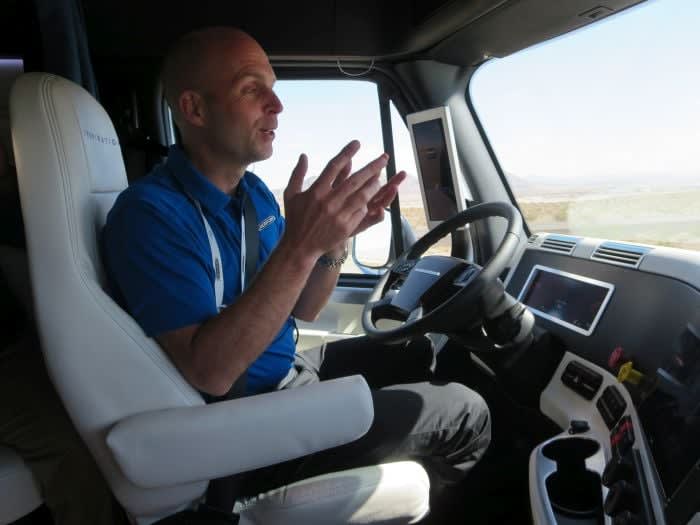
A Freightliner demo driver demonstrates autonomous mode for Daimler Trucks North America's Inspiration Truck, the first autonomous truck to have a license to legally operate on U.S. public highways. Photo: Deborah Lockridge
3 min to read
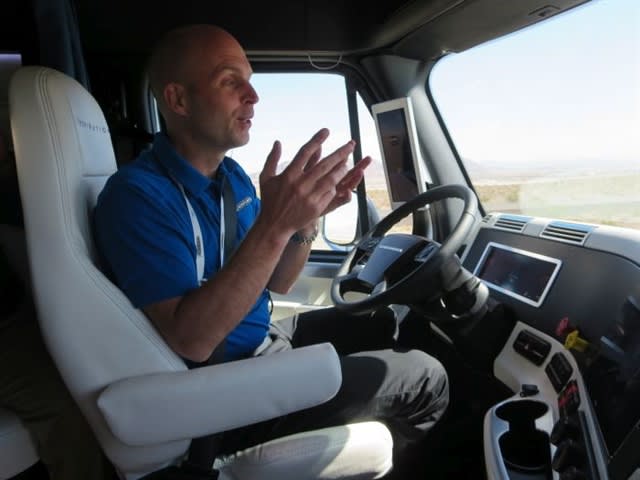
A Freightliner demo driver demonstrates autonomous mode for Daimler Trucks North America's Inspiration Truck, the first autonomous truck to have a license to legally operate on U.S. public highways. Photo: Deborah Lockridge
Pennsylvania’s Autonomous Vehicles Testing Policy Task Force has delivered recommended guidance to the Pennsylvania Department of Transportation to help develop policies for testing highly automated vehicles.
PennDOT Secretary Leslie Richards has scheduled an online public forum for Dec. 12 to review the report.
The task force’s goal was to create a framework for testing HAVs that balances public safety with innovation while also remaining flexible enough to keep the state in the forefront of developing the emerging and potentially transformative technology.
"Autonomous and connected vehicles will change transportation and could bring benefits of safer travel and greater ease of mobility for all if rules are in place to ensure passenger and pedestrian safety," said Richards. "This guidance shows Pennsylvania's understanding of public concerns and our commitment to being a leader in the research and testing of these technologies in ways that are both safe and innovative.”
The guidance was produced from a collaboration of state, federal, and state industry officials including the Fedral Highway Administration, AAA, Carnegie Mellon University, General Motors, Uber, the University of Pennsylvania, SAE and the Pennsylvania Motor Truck Association. PennDOT chaired the task force.
The task force made a series of recommendations that included the following:
Testers of highly automated vehicles (HAVs) must submit testing proposals to PennDOT and enter contracts attesting that the vehicles meet all federal and state safety standards and meet the policies adopted by PennDOT.
PennDOT has to be notified prior to any HAV being used without an operator in fully self-driving mode.
PennDOT and the Pennsylvania Turnpike Commission may temporarily restrict HAVs from certain routes. Otherwise, HAVs may be tested on any road in the state. Municipalities can also ask PennDOT to temporarily restrict HAVs on local routes.
Platooning of HAVs will be restricted to two commercial or three passenger vehicles. However, testers can ask to use more HAVs in platooning, but PennDOT can ask for a safety demonstration first.
The HAVs must be able to record data that can be used to investigate crashes involving the HAVs. PennDOT will have access to the data.
Testers must certify that cybersecurity protections are in place for the HAVs.
PennDOT will collect data on total miles operated by HAVs, total number of hours of operation, and size of HAV fleets. PennDOT may also ask for other information such as counties where HAVs are being tested and percentage of testing done on limited access highways.
The adoption of these policies will be reliant on the enactment of authorizing legislation in the next session of the state legislature in 2017.
The public is invited to participate in an online public meeting on Dec.12. The public may join the meeting by visiting PennDOT's automated vehicle testing page and clicking on the webinar link at the time of the meeting. The public is encouraged to review the policy on PennDOT's website and is welcome to ask questions of the panelists during the online meeting. Email questions to penndotav@pa.gov.
Following the online meeting, the task force's final recommendations will be posted on the PennDOT website, www.penndot.gov. Through January 12, 2017, the public may submit feedback by emailing penndotav@pa.gov .
More Fleet Management

Sponsored•September 16, 2026
Color Match Smarter: Tools That Restore & Perform
For fleet managers and collision repair professionals keeping heavy-duty trucks on the road, getting the color right the first time isn't just about appearance — it's about efficiency, turnaround time, and bottom-line results. Discover how today's digital color tools are transforming the repair process from guesswork to precision.
Read More →
FMCSA Pauses Biennial-Update Enforcement Amid Motus Transition
Carriers whose updates were due on or after June 1 have more time, while FMCSA works to stabilize its new registration system and warns of phishing sites impersonating its new carrier registration system, Motus.
Read More →
Sponsored•September 14, 2026
2026 Blueprint for Countering Smarter Supply Chain Theft
Cargo theft is no longer just the cost of doing business. It's a multi-billion-dollar criminal enterprise exploiting vulnerabilities across your fleet, drivers, and supply chain.
Read More →


Sponsored•September 1, 2026
How Telematics Improves Visibility, Control, and Performance in Refrigerated Fleets
Explore how telematics help refrigerated fleets improve visibility, uptime, efficiency, compliance, and cargo protection across connected cold chain operations.
Read More →
What the U.S.-Canada Trade War Means for Trucking
Escalating U.S.-Canada tariffs could disrupt cross-border freight, reduce truck volumes, raise costs, and create new uncertainty for carriers on both sides of the border.
Read More →
What Are Trucking’s Top Concerns for 2026?
The American Transportation Research Institute wants to know what's worrying trucking fleet managers, drivers, and other stakeholders in its annual Industry Issues survey.
Read More →
American Trucking Associations Looks for a New Leader
ATA President and CEO Chris Spear abruptly left his job at the association on August 21, at a pivotal time for the trucking industry.
Read More →
Public Wi-Fi Cybersecurity Risks: How Truck Drivers and Fleets Can Protect Their Data
Public Wi-Fi can expose truck drivers and fleets to credential theft, malware, and other cyber threats. Here’s how to reduce the risk on the road.
Read More →
For Nicky Cupp, Fleet Innovation Starts With Frustration
HDT Truck Fleet Innovator Nicky Cupp turns everyday pain points at Fraley & Schilling into opportunities for better technology and smarter processes.
Read More →
Adam Buttgenbach’s Approach to Electric Trucks: Start With Where They Fit
HDT Truck Fleet Innovator Adam Buttgenbach helped PepsiCo build one of North America’s largest EV fleets by focusing on where electric trucks make operational sense.
Read More →