




Otto to Test Autonomous Rig in Ohio
A demonstration on Monday, using a 35-mile stretch of U.S. 33 northwest of Columbus, was postponed, but may be rescheduled. Next week, the Otto truck will run on the Ohio Turnpike.

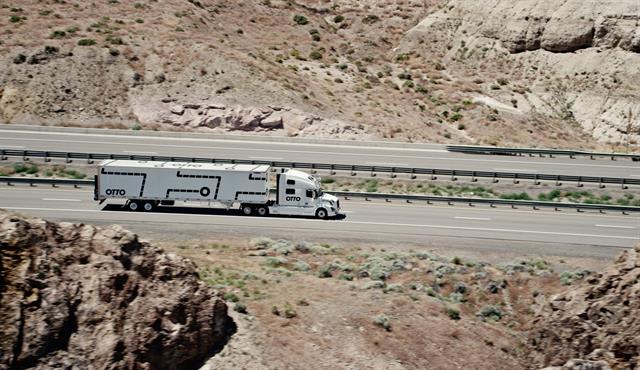
Otto has tested its self-driving rigs in western states, and this week will begin demonstrations amid midwestern terrain in Ohio. Photo: Otto
Otto has tested its self-driving rigs in western states, and this week will begin demonstrations amid midwestern terrain in Ohio. Photo: Otto
Ohio is the next venue for autonomous truck tests by Otto, the Uber-owned development company that made a well-reported driverless beer delivery in Colorado several weeks ago.
An Otto vehicle was supposed to travel a 35-mile stretch of U.S. 33 on Monday in central Ohio, between Dublin and East Liberty, home to the Transportation Research Center, an independent testing facility, according to an Associated Press report.
An appearance by Ohio Gov. John Kasich during the demo was canceled when a brief stabbing rampage on the campus of Ohio State University in Columbus began about 10 a.m., and the governor shifted his attention to that, said ODOT spokesman Matt Bruning. (The incident, first reported as an active-shooter situation, ended quickly when an OSU police officer shot the perpetrator, though local media coverage remains intense.)
The public demonstration with Kasich involved will be rescheduled, perhaps for later in the week, Bruning said. Kasich has pushed for Ohio to be a leader in the fast-advancing testing and research of autonomous vehicles.
State officials say Ohio is well-positioned for such a role for many reasons, including a significant presence from the automotive industry, partnerships with university researchers, and seasonal weather changes that enable testing a variety of driving conditions in one place. Also, extensive logistics operations rely on transportation, so would be affected and perhaps aided by autonomous trucks.
The Otto truck will travel in regular traffic and a driver will be in the cab to intervene should anything go awry, ODOT officials said. That section of Route 33 — built to freeway standards -- will become a corridor where new technologies can be safely tested in real-life traffic. A fiber-optic cable network and sensor systems are slated for installation next year.
"Certainly we think it's going to be one of the foremost automotive research corridors in the world," Bruning said.
The self-driving truck is also expected to travel next week on part of the Ohio Turnpike. The turnpike's executive director said in August that officials were moving toward allowing testing of self-driving vehicles on the 241-mile toll road, which cuts across northern Ohio and is a heavily traveled connector between the East Coast and Chicago.
More Fleet Management

How Telematics Improves Visibility, Control, and Performance in Refrigerated Fleets
Explore how telematics help refrigerated fleets improve visibility, uptime, efficiency, compliance, and cargo protection across connected cold chain operations.
Read More →
What the U.S.-Canada Trade War Means for Trucking
Escalating U.S.-Canada tariffs could disrupt cross-border freight, reduce truck volumes, raise costs, and create new uncertainty for carriers on both sides of the border.
Read More →
What Are Trucking’s Top Concerns for 2026?
The American Transportation Research Institute wants to know what's worrying trucking fleet managers, drivers, and other stakeholders in its annual Industry Issues survey.
Read More →

American Trucking Associations Looks for a New Leader
ATA President and CEO Chris Spear abruptly left his job at the association on August 21, at a pivotal time for the trucking industry.
Read More →
Public Wi-Fi Cybersecurity Risks: How Truck Drivers and Fleets Can Protect Their Data
Public Wi-Fi can expose truck drivers and fleets to credential theft, malware, and other cyber threats. Here’s how to reduce the risk on the road.
Read More →
For Nicky Cupp, Fleet Innovation Starts With Frustration
HDT Truck Fleet Innovator Nicky Cupp turns everyday pain points at Fraley & Schilling into opportunities for better technology and smarter processes.
Read More →
Adam Buttgenbach’s Approach to Electric Trucks: Start With Where They Fit
HDT Truck Fleet Innovator Adam Buttgenbach helped PepsiCo build one of North America’s largest EV fleets by focusing on where electric trucks make operational sense.
Read More →
Deen Albert: Let Automation Do the Math, People Make the Decisions
HDT Truck Fleet Innovator Deen Albert makes sure people are still at the heart of operations at Grand Island Express, even while adopting artificial intelligence tools. AI-assisted dispatch helped boost revenue 25% with the same number of trucks.
Read More →
Trimble’s New AI Agent Takes Aim at Fleet Back-Office Busywork
Arc Agent works across Trimble TMS products to automate repetitive tasks such as freight orders, maintenance, invoices, fuel costs and more.
Read More →
How HDT’s 2026 Truck Fleet Innovators Are Rethinking Fleet Operations
Meet five trucking leaders who are challenging assumptions, solving operational problems, and putting innovative ideas to work.
Read More →