




Related: Autonomous Technologies Could Transform Trucking
Peloton Logs Over 1,000 Miles in Florida Platooning Demonstration
A series of just-concluded demonstrations in Florida will help officials there prepare for platooning legislation in the future, Peloton says.
by Staff
December 28, 2017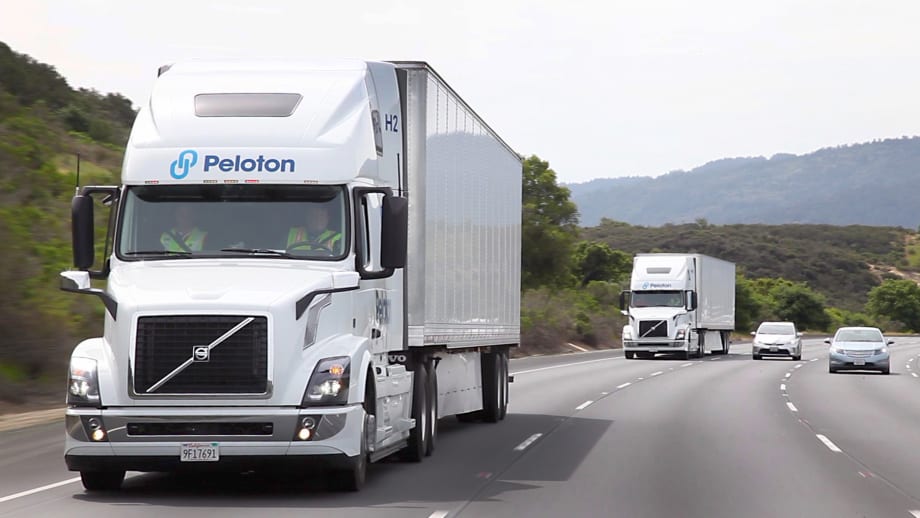
Peloton says trucks equipped with its latest platooning technology logged more than 1,000 miles in a series of tests in Florida earlier this month. Photo: Peloton
2 min to read
Peloton says trucks equipped with its latest platooning technology logged more than 1,000 miles in a series of tests in Florida earlier this month. Photo: Peloton
Connected and automated vehicle technology developer Peloton has completed a series of real-world truck platooning demonstrations in Florida, logging over 1,000 test miles in the process.
The demonstration occurred in collaboration with the Florida Department of Transportation, Florida’s Turnpike Enterprise and the Florida Department of Highway Safety and Motor Vehicles. It featured two Peloton-equipped Volvo VNL670 Class 8 trucks equipped with Peloton’s linked, collision-avoidance platooning technology. According to Peloton, the two trucks traveled at a separation distance of approximately 65 feet, with professional drivers remaining fully in command of each truck at all times.
Peloton’s driver-assistive system enhances driver teamwork by enabling two individual drivers to form a two-truck platoon under appropriate highway conditions. Unlike highly automated vehicles, Peloton’s system requires drivers of each truck to be in full control of steering and remain actively engaged in driving. The system links the active safety systems of Class 8 trucks, enabling pairs of trucks to coordinate their speeds and maintain a safe, aerodynamic following distance.
Currently, according to Peloton, nine states have confirmed allowance for commercial deployment of truck platooning technology: Arkansas, Georgia, Michigan, Nevada, North Carolina, Ohio, South Carolina, Tennessee, and Texas, with additional states considering confirming allowance the technology as well. The company says the just-completed demonstrations will help set the stage for the State of Florida to consider joining others in allowing full commercial deployment.
“Peloton Technology appreciates the opportunity to demonstrate its driver-assistive truck platooning technology as part of Florida’s connected vehicle pilot project.” said Steve Boyd, Peloton co-founder and VP of external affairs, in a release. “The demonstrations this week were very successful, and we look forward to working with the Florida transportation agencies, the Florida Trucking Association, major fleets and others as we bring this safety and efficiency technology to the Sunshine State.”
“As a leader in transportation technology, Florida is proud to participate in the piloting of transportation technologies that benefit the commercial trucking industry, while improving the safety of Florida’s roadways,” added Tom Byron, assistant secretary of strategic development for the Florida Department of Transportation. “We welcome this and other opportunities to test connected vehicle systems and other advanced transportation concepts that will improve roadway safety and bring new economic opportunities to the region.”
More Fleet Management

Sponsored•September 16, 2026
Color Match Smarter: Tools That Restore & Perform
For fleet managers and collision repair professionals keeping heavy-duty trucks on the road, getting the color right the first time isn't just about appearance — it's about efficiency, turnaround time, and bottom-line results. Discover how today's digital color tools are transforming the repair process from guesswork to precision.
Read More →
FMCSA Pauses Biennial-Update Enforcement Amid Motus Transition
Carriers whose updates were due on or after June 1 have more time, while FMCSA works to stabilize its new registration system and warns of phishing sites impersonating its new carrier registration system, Motus.
Read More →
Sponsored•September 14, 2026
2026 Blueprint for Countering Smarter Supply Chain Theft
Cargo theft is no longer just the cost of doing business. It's a multi-billion-dollar criminal enterprise exploiting vulnerabilities across your fleet, drivers, and supply chain.
Read More →


Sponsored•September 1, 2026
How Telematics Improves Visibility, Control, and Performance in Refrigerated Fleets
Explore how telematics help refrigerated fleets improve visibility, uptime, efficiency, compliance, and cargo protection across connected cold chain operations.
Read More →
What the U.S.-Canada Trade War Means for Trucking
Escalating U.S.-Canada tariffs could disrupt cross-border freight, reduce truck volumes, raise costs, and create new uncertainty for carriers on both sides of the border.
Read More →
What Are Trucking’s Top Concerns for 2026?
The American Transportation Research Institute wants to know what's worrying trucking fleet managers, drivers, and other stakeholders in its annual Industry Issues survey.
Read More →
American Trucking Associations Looks for a New Leader
ATA President and CEO Chris Spear abruptly left his job at the association on August 21, at a pivotal time for the trucking industry.
Read More →
Public Wi-Fi Cybersecurity Risks: How Truck Drivers and Fleets Can Protect Their Data
Public Wi-Fi can expose truck drivers and fleets to credential theft, malware, and other cyber threats. Here’s how to reduce the risk on the road.
Read More →
For Nicky Cupp, Fleet Innovation Starts With Frustration
HDT Truck Fleet Innovator Nicky Cupp turns everyday pain points at Fraley & Schilling into opportunities for better technology and smarter processes.
Read More →
Adam Buttgenbach’s Approach to Electric Trucks: Start With Where They Fit
HDT Truck Fleet Innovator Adam Buttgenbach helped PepsiCo build one of North America’s largest EV fleets by focusing on where electric trucks make operational sense.
Read More →