





Related: Photo Gallery: Seimens Hybrid-Electric Truck Trials Begin in California
Overhead-Charging Test Route for Electrified Trucks Opens in Germany
A new test route to determine the viability of using overhead electric wires to power specially equipped, diesel-hybrid trucks in Germany has opened on a stretch of autobahn in the State of Hesse.
May 13, 2019
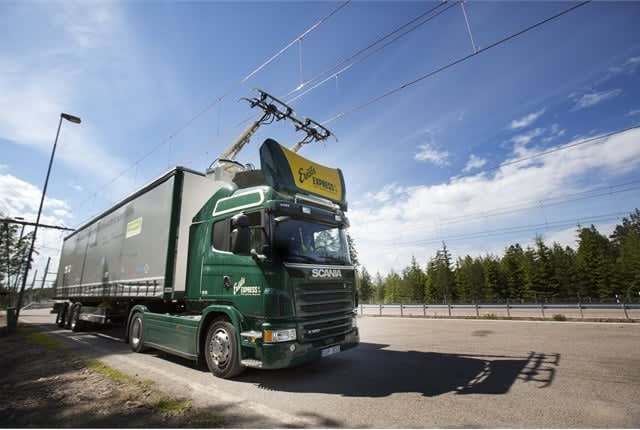
Specially equipped trucks that can run on either electric or diesel power are undergoing testing on a stretch of autobahn highway in Germany.
Photo: Siemens
3 min to read
Germany-based Siemens AG, a leading global technology firm, has been experimenting with a specialized stretch of highway equipped with overhead power lines and specially equipped diesel-electric trucks to determine if it is possible to power them in electric mode while on the move. The project has reached the point that larger tests are under way in the German State of Hesse.
The Siemens system uses specially equipped Class 8 European tractors with diesel-electric powertrains. But unlike most hybrid trucks, these are fitted with an extendable pantograph on top of the truck cab. A pantograph is the fork-shaped electrical conduit commonly seen on trams, streetcars, and light railcars that physically connects an electrically powered vehicle with the overhead power lines that provide electricity.
Under the Siemens experimental system, these trucks can operate normally under diesel power in areas where no overhead lines are available. But, on specially built roads with dedicated electric truck lanes, the driver can extend the pantograph, making contact with the high voltage power lines overhead. Once contact is secured, the truck’s diesel engine goes to idle and the electric drive system propels the vehicle down the road at normal highway speeds.
The system was initially tested on closed track conditions in Germany, Sweden and California. Now, the first test route for overhead-line hybrid trucks (OH trucks) has been inaugurated on the A5 autobahn in Hesse in real-world driving conditions. Plans call for five OH trucks to be running regularly on the route between Weiterstadt and Langen/Mörfelden by the middle of next year.
Germany’s Federal Ministry for the Environment has funded construction of the pilot project with 14.6 million euros ($16.4 million). A further 15.3 million euros ($17.2 million) available for conducting the field trials in Hesse that will run until the end of 2022. The Hessian road authority is coordinating the project and is responsible for the operation of the eHighway. The Technical University Darmstadt, Siemens Mobility GmbH, and ENTEGA AG are also participating in the project.
“Electrified overhead line trucks are a particularly efficient solution on the way to climate-neutral freight transport,” said Rita Schwarzelühr-Sutter, parliamentary state secretary of the Federal Ministry for the Environment, Nature Conservation and Nuclear Safety. “We’ve tested the system for many years on private test routes. We’re now inaugurating practical tests on the A5 autobahn between Frankfurt and Darmstadt, and two further test stretches will follow in the States of Schleswig-Holstein and BadenWürttemberg.”
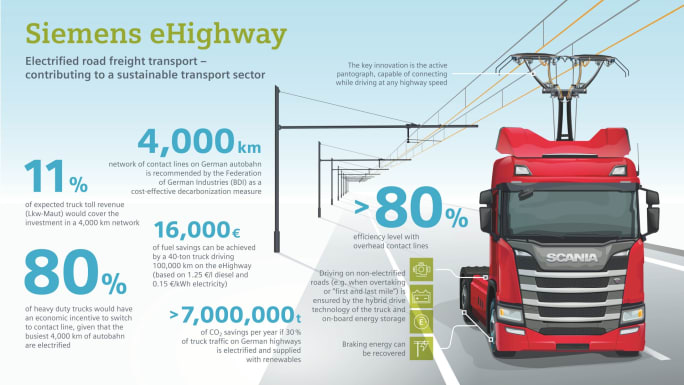
Flexibility and low emissions are the key attributes of the eHighway program, according to Siemens.
Graphic: Siemens
“The inauguration of Germany’s first eHighway in Hesse marks a milestone in the de-carbonization of road freight transport in the country," said Roland Edel, Chief Technology Officer of Siemens Mobility GmbH. “The Siemens Mobility innovation combines the advantages of electrified rail lines with the flexibility of road freight transport, thus offering an efficient, economical and environmentally compatible alternative to truck transport with combustion engines,”
As the project progresses, ENTEGA will work out energy-related and legal planning issues and develop a billing system concept for fleets. Other research will evaluate the system from the point of view of power utilities and for all issues related to energy laws and regulatory matters.
More Fuel Smarts

How Volvo Updated Its D13 for EPA 2027 [Watch]
Volvo’s updated D13 promises lower emissions without sacrificing performance or fuel economy. Take a closer look at what changed inside the engine in this HDT Spotlight video.
Read More →
Diesel Price Spike Shortens Payback for Natural Gas Trucks, Report Says
Energy Vision estimates fleets could recover the higher purchase price of an RNG-fueled Class 8 tractor in 1.3 to 2.8 years under current fuel-price scenarios.
Read More →
Calstart Becomes Catalyst Mobility, Reflecting Broader Focus
Calstart is now Catalyst Mobility, reflecting the nonprofit’s growing national role in clean transportation, including zero-emission trucks, infrastructure and incentive programs.
Read More →

Record Diesel Prices Squeeze Trucking Fleets
Average U.S. diesel prices have climbed to nearly $6 a gallon, surpassing the 2022 record as tight refinery capacity and Middle East disruptions keep fuel costs elevated.
Read More →
Sponsored•September 9, 2026
How Fuel Delivery Shapes Engine Performance
Fuel delivery depends on more than what happens at the injector. For fleet, maintenance and technical professionals, looking at the full path from pump to injector can provide useful context for understanding engine performance.
Read More →
East Coast Port Launches $45M Electric Truck Push
The Port Authority of New York and New Jersey announced millions in incentives for zero-emission drayage trucks, yard tractors, and new charging hubs near the port.
Read More →
California Bill Could Shed Light on Electric Truck Prices
Why do battery-electric Class 8 trucks remain so expensive? A California bill headed to Gov. Gavin Newsom would give fleets and state agencies more visibility into what manufacturers charge.
Read More →
Detroit Opens Orders for EPA 2027 Engines
Detroit isn’t starting from scratch to meet EPA 2027 diesel emissions standards. Its Gen 6 DD13 and DD15 engines keep much of today’s platform while updating the fuel and aftertreatment systems.
Read More →
Zero-Emission Truck Corridor Planned for West Coast
California, Oregon, Washington, British Columbia and Baja California are coordinating plans for truck charging and hydrogen fueling from Canada to Mexico.
Read More →
A Closer Look at Kenworth’s Electric T880E Vocational Truck [Video]
Learn more about Kenworth's T880E battery-electric vocational truck at the Paccar Technical Center, including its range, applications, upfitting considerations, and PTO options, in this HDT Spotlight video.
Read More →