




OSHA To Enforce Wheel Chock Rule
The Occupational Safety and Health Administration says it will enforce regulations requiring the use of wheel chocks to secure trucks and trailers when loading and loading, though it’s not clear who will be responsible
The Occupational Safety and Health Administration says it will enforce regulations requiring the use of wheel chocks to secure trucks and trailers when loading and loading, though it’s not clear who will be responsible.
OSHA’s regulations governing lift trucks dictate that “the brakes of highway trucks shall be set and wheel chocks placed under the rear wheels to prevent the trucks from rolling while they are boarded with powered industrial trucks.” In 1973 an OSHA review commission decided that those rules were pre-empted by a federal highway safety regulation which required brakes to be set on unattended vehicles. The Department of Transportation rescinded that rule (49CFR 392.20) last year, stating that state and local governments were in a better position to monitor and enforce regulations of that nature.
The OSHA rules, contained in 29 CFR 1910.178(k)(1) and (m)(7), further state that “fixed jacks may be necessary to support a semitrailer during loading or unloading when the trailer is not coupled to a tractor” and that “the flooring of trucks and trailers must be checked for breaks and weakness before they are driven onto.”
While the regulations are aimed at protecting dock workers, responsibility for compliance isn’t entirely clear, says Stuart Flatow, the American Trucking Assn.’s director of occupational safety and health. Citations for violations will most likely go to the employer of those workers -- i.e. the owner or operator of the loading dock -- and he says truck drivers and motor carriers may be expected to carry wheel chocks in their trucks or at least be on the alert that rear wheels must be chocked.
Flatow says ATA tried to arrange a meeting with OSHA before the directive was issued but its request was denied. “Loading dock safety of course is critical,” he says. “But we believe it’s a multi-prong approach, not just the use of one device.” That approach might include parking brakes, dock locks or similar devices, as well as employee communications and training.
The directive can be accessed via OSHA’s Internet site (http://www.osha.gov). The regulations can be found at www.access.gpo.gov/su_docs/aces/aces140.
More Drivers

When Language Stops the Truck: The Return of ELP Out-of-Service Orders
English language proficiency rules for commercial drivers aren’t new, but renewed out-of-service enforcement has raised the stakes. Here’s what carriers need to know before a driver reaches a roadside inspection.
Read More →
Samsara Launches Custom AI Agent Builder
Agent Studio lets fleets create AI tools for hours-of-service monitoring, reporting and driver support, including agents that communicate by phone.
Read More →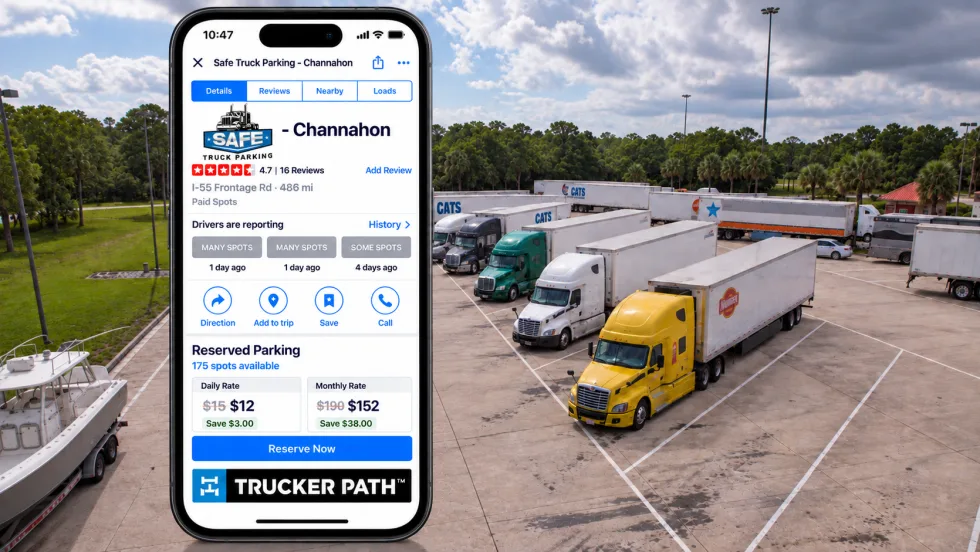
Trucker Path Expands Reserved Parking Network
Trucker Path has added close to 6,000 more truck parking spaces to its Trucker Path Reserved Parking Network with the addition of Safe Truck Parking.
Read More →
EEOC Sues Texas Trucking Company Over Driver Age Limits
The agency says Trancasa USA rejected applicants over 65 and applied tougher driving-record standards to those over 60.
Read More →
Nussbaum, Roehl Announce Second Driver Pay Increase This Year
This year has seen a swath of major truck driver pay increases as freight capacity has tightened.
Read More →
From One Generation to the Next: How Mentorship Builds Safer Truck Drivers
After three decades in trucking, Harold Perry shares what he's learned about driver safety, mentorship, and helping the next generation build confidence behind the wheel.
Read More →
Truck Drivers Need More Than Another Alert
Fleets have more visibility into truck health, safety events, and driver activity than ever. The next challenge is turning all that information into useful guidance for the person who has to decide what to do next.
Read More →
FMCSA Removes 110 Truck Driver Training Schools from Certified ELDT List
Federal regulators also are targeting more than 160 additional training providers and launching a nationwide audit of third-party CDL skills testers as part of a broader crackdown on trucking fraud.
Read More →
Hours of Service Pilot Programs: FMCSA Readies for 2027 Rollout
Two pilot programs could eventually reshape hours-of-service rules, giving truck drivers options to pause their 14-hour clock or use longer split sleeper rest periods.
Read More →
Medical Cards, English Proficiency Reshape Roadcheck Violations
Medical-card violations jumped to the top of the driver out-of-service list during CVSA’s 2026 International Roadcheck, while English-language proficiency violations appeared among the leading violations for the first time.
Read More →