




Ohio Launches Major Effort to Expand Truck Parking in State
Ohio Gov. Mike DeWine and the Ohio Department of Transportation announced a plan to add at least 1,400 new truck parking spaces across the state.

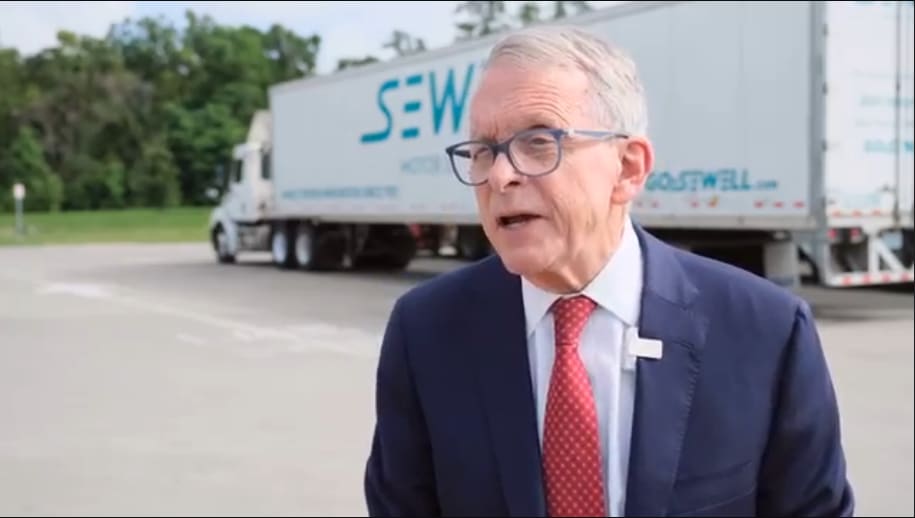
Ohio Gov. Mike DeWine talks about why more truck parking is needed.
Image: Screen capture from Gov. DeWine video.
Ohio Gov. Mike DeWine and the Ohio Department of Transportation announced a plan to add at least 1,400 new truck parking spaces across the state.
Following an extensive review of ODOT property, officials identified 33 sites in 19 counties where long-term truck parking lots will be created or expanded, more than doubling current truck parking capacity at ODOT-maintained sites.
“As Ohio’s economy continues to grow, so do the number of trucks traveling on Ohio's network of interstates and state routes,” said DeWine in a news release.
“By expanding safe, accessible places for drivers to rest, we’re supporting the people who keep our economy moving and making it safer for everyone on our roads.”
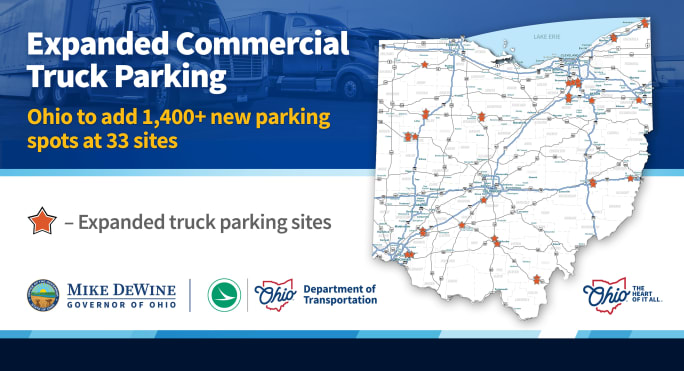
Source: Ohio DOT
About Ohio's New Truck Parking Effort
Located within a day’s drive of 60% of the U.S. and Canadian population, Ohio is one of America’s most critical freight corridors. In 2023 alone, trucks logged 27.5 million miles on Ohio roads, and ODOT estimates that freight volume will increase 26% by 2045.
The 33 new truck parking areas will be located in Allen, Ashland, Ashtabula, Auglaize, Belmont, Clermont, Fayette, Franklin, Gallia, Guernsey, Henry, Lake, Mahoning, Medina, Ross, Summit, Warren, and Wyandot counties.
Once complete, the American Transportation Research Institute projects that Ohio will lead the nation in the total number of long-term truck parking spaces available on state-owned property.
In total, there are currently around 14,200 truck parking spaces available in Ohio, with most located at privately owned truck stops or businesses.
The Consequences of the Truck Parking Shortage
According to the American Trucking Associations, there is one truck parking space for every 11 trucks on the road in the United States, forcing truck drivers who can’t find a spot to drive drowsy or pull over to sleep in unsafe areas such as highway shoulders and entrance/exit ramps.
A total of 689 crashes were caused by drowsy semi-truck drivers in Ohio since 2015, resulting in 345 injuries and two fatalities, according to the announcement.
Ohio's commercial-truck parking plan is funded with $150 million from the current state transportation budget.
Construction is scheduled to begin in 2026, with all work expected to be complete by the end of 2027. Each site will include lighting and restroom facilities to support driver safety and comfort.
More Ohio Truck Parking Efforts
The parking expansion is part of a continued push by the DeWine administration to support freight mobility, bolster economic competitiveness, and improve highway safety. Other initiatives include:
2019: Launch of a Truck Parking Information Management System (TPIMS) in partnership with Midwest states to provide real-time parking availability updates on digital signs, in-cab systems, and OHGO.com.
2022: Conversion of more than a dozen unused weigh stations into truck parking areas, creating 144 new spaces.
2023: Announcement of a statewide initiative to modernize 36 rest areas, including 401 new truck parking spots.
2024: Transformation of two abandoned rest areas in Preble and Trumbull counties into dedicated truck parking, adding 138 spaces.
More Drivers

Truck Drivers Need More Than Another Alert
Fleets have more visibility into truck health, safety events, and driver activity than ever. The next challenge is turning all that information into useful guidance for the person who has to decide what to do next.
Read More →
FMCSA Removes 110 Truck Driver Training Schools from Certified ELDT List
Federal regulators also are targeting more than 160 additional training providers and launching a nationwide audit of third-party CDL skills testers as part of a broader crackdown on trucking fraud.
Read More →
Hours of Service Pilot Programs: FMCSA Readies for 2027 Rollout
Two pilot programs could eventually reshape hours-of-service rules, giving truck drivers options to pause their 14-hour clock or use longer split sleeper rest periods.
Read More →
Medical Cards, English Proficiency Reshape Roadcheck Violations
Medical-card violations jumped to the top of the driver out-of-service list during CVSA’s 2026 International Roadcheck, while English-language proficiency violations appeared among the leading violations for the first time.
Read More →
Driver Trust Can Make or Break the Success of Fleet Safety Technology
New Teletrac Navman research suggests that onboarding, transparency about driver data, and positive feedback can play a significant role in how commercial drivers respond to safety and coaching technology.
Read More →
EEOC Sues KLLM Over Alleged Sex Discrimination in Driver Training
KLLM is facing a federal sex-discrimination lawsuit over policies the EEOC alleges put female truck driver trainees at a disadvantage.
Read More →
FMCSA Moves to Codify English Language Requirements for Commercial Drivers
By changing regulations on English-language proficiency requirements for commercial drivers, rather than relying on a guidance memo, the FMCSA said future administrations won't be able to walk back the Trump administration's stricter enforcement with just a memo.
Read More →
Drivers Put Western Star Trucks to the Test at Star Nation Experience
Watch to get an inside look at the Western Star trucks, technology, and community behind the Star Nation Experience 2026!
Read More →
Trump Administration Looks to Put More Veterans Behind the Wheel
The Freedom Haulers program pulls together existing and expanded programs at several federal agencies to recruit veterans to drive commercial heavy-duty trucks and cut the red tape for them to get a CDL, training, and employment.
Read More →
Putting Mack’s Command Steer to the Test
A test drive of Mack’s Command Steer active steering system evaluates how it can make truck driving easier and less tiring.
Read More →