




Obama, Congress Talk Infrastructure Funding
As Congress squares for the fight over 2014 transportation spending and long-term transportation policy, President Obama called for more infrastructure investment to create jobs and support the middle class.

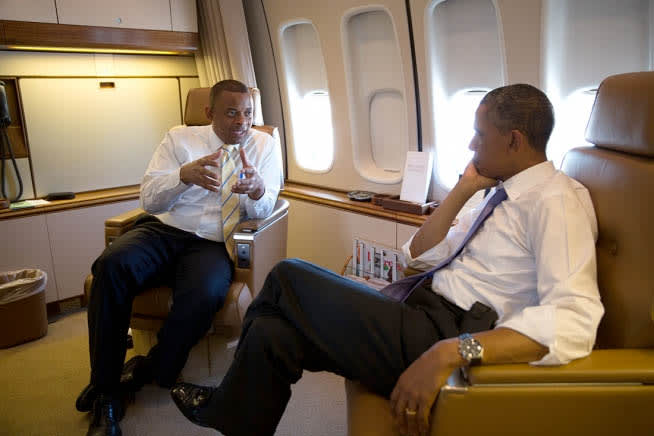
President Barack Obama talks with Transportation Secretary Anthony Foxx aboard Air Force One during the flight to Jacksonville, Fla., where the president called for more infrastructure investment to create jobs and support the middle class.
(White House photo)
As Congress squares for the fight over 2014 transportation spending and long-term transportation policy, President Obama called for more infrastructure investment to create jobs and support the middle class.
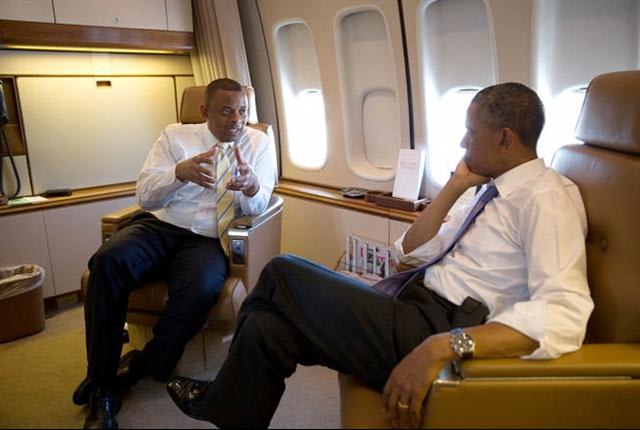
President Barack Obama talks with Transportation Secretary Anthony Foxx aboard Air Force One during the flight to Jacksonville, Fla., where the president called for more infrastructure investment to create jobs and support the middle class.
(White House photo)
Speaking Thursday at the Port Authority in Jacksonville, Fla., Obama focused on the need to deepen channels at U.S. ports to handle the supertankers that will be transiting the Panama Canal when its expansion is complete in 2015.
“We want them to come to Jacksonville,” he said.
The bigger ships will create more jobs at terminals and nearby warehouses, as well as in local economies.
“Ports have to be ready to receive them,” he said. “The businesses of tomorrow will go to where infrastructure is good.”
Obama said he has taken executive action to speed up permitting for port projects, referencing an order he issued last year requiring federal agencies to streamline their procedures.
But he pointed toward appropriations legislation in the House that would cut transportation spending as evidence of unwillingness to reinvest in infrastructure.
Obama has endorsed the Senate version of the 2014 appropriations bill over the House version, which would cut some transportation and housing programs.
“Deferring maintenance only adds to expense over time,” he said.
The U.S. is investing less in infrastructure than global competitors China and Germany, he said.
“The irony is that it’s cheaper to build now than it’s been since 1950,” a reference to low interest rates.
“Now is the time for us to do it. The longer we put it off the more expensive it will be.”
The speech was the third stop in an extended grassroots reach-out to build support for the administration’s approach to creating jobs and strengthening the middle class.
Obama called on Congress to “take a few bold steps” but he did not offer any bold moves to fund infrastructure investment.
The administration has opposed increasing fuel taxes, the traditional method of paying for infrastructure investment. Instead it has called for spending a portion of the “peace dividend” – the savings from winding down the wars in Iraq and Afghanistan.
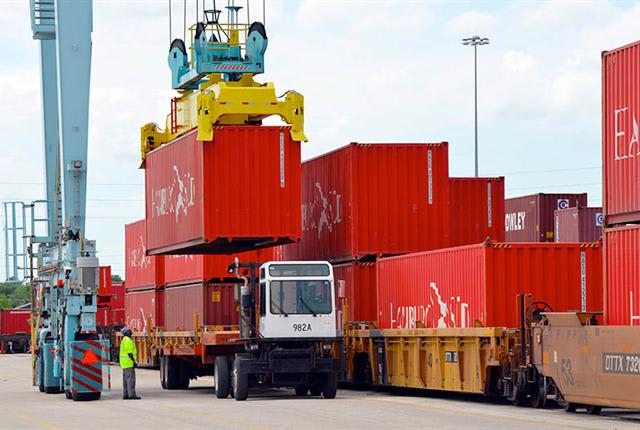
Intermodal containers transferring from rail at the Port of Jacksonville.
This would in effect take money out of the General Fund, an idea that the Republican-led House has rejected.
In its report on the 2014 transportation appropriations bill, the House Appropriations Committee notes that the Highway Trust Fund is sliding into red territory and says it will not support plugging the gap by transferring money from the General Fund.
“The Administration and the Congress must come up with a new authorization and a funding stream to meet the demands of repairing, maintaining and operating our Nation’s transportation infrastructure,” the committee writes in its report.
The report does not make any recommendations on how Congress should generate the revenue stream.
Meanwhile, the Senate this week is voting on its version of the 2014 transportation appropriations bill.
There are significant differences between this bill and the House version, particularly with respect to how they treat the Department of Transportation’s TIGER grant program.
The Senate bill continues to fund the program, which uses a competitive process to select state and local bids for federal dollars. The House Appropriations Committee, however, denies DOT’s $7.5 million request for the program.
Both bills would fully fund the federal truck safety program, and both urge the Federal Motor Carrier Safety Administration to redouble its efforts to crack down on “chameleon carriers” that come back into business under a new identity after they have been found unsafe.
The House version urges DOT to conduct a study of the impact of the hours of service rule on small business operators, and to consider a “low-cost option” to address any adverse impacts.
The Senate version presses FMCSA to act quickly on its safety fitness rule, and to come up with a way to determine a carrier’s fault in the crash data that gets plugged into the CSA safety enforcement program. It also encourages the agency to move aggressively on the pending electronic logging mandate.
More Fleet Management

Color Match Smarter: Tools That Restore & Perform
For fleet managers and collision repair professionals keeping heavy-duty trucks on the road, getting the color right the first time isn't just about appearance — it's about efficiency, turnaround time, and bottom-line results. Discover how today's digital color tools are transforming the repair process from guesswork to precision.
Read More →
FMCSA Pauses Biennial-Update Enforcement Amid Motus Transition
Carriers whose updates were due on or after June 1 have more time, while FMCSA works to stabilize its new registration system and warns of phishing sites impersonating its new carrier registration system, Motus.
Read More →
2026 Blueprint for Countering Smarter Supply Chain Theft
Cargo theft is no longer just the cost of doing business. It's a multi-billion-dollar criminal enterprise exploiting vulnerabilities across your fleet, drivers, and supply chain.
Read More →


How Telematics Improves Visibility, Control, and Performance in Refrigerated Fleets
Explore how telematics help refrigerated fleets improve visibility, uptime, efficiency, compliance, and cargo protection across connected cold chain operations.
Read More →
What the U.S.-Canada Trade War Means for Trucking
Escalating U.S.-Canada tariffs could disrupt cross-border freight, reduce truck volumes, raise costs, and create new uncertainty for carriers on both sides of the border.
Read More →
What Are Trucking’s Top Concerns for 2026?
The American Transportation Research Institute wants to know what's worrying trucking fleet managers, drivers, and other stakeholders in its annual Industry Issues survey.
Read More →
American Trucking Associations Looks for a New Leader
ATA President and CEO Chris Spear abruptly left his job at the association on August 21, at a pivotal time for the trucking industry.
Read More →
Public Wi-Fi Cybersecurity Risks: How Truck Drivers and Fleets Can Protect Their Data
Public Wi-Fi can expose truck drivers and fleets to credential theft, malware, and other cyber threats. Here’s how to reduce the risk on the road.
Read More →
For Nicky Cupp, Fleet Innovation Starts With Frustration
HDT Truck Fleet Innovator Nicky Cupp turns everyday pain points at Fraley & Schilling into opportunities for better technology and smarter processes.
Read More →
Adam Buttgenbach’s Approach to Electric Trucks: Start With Where They Fit
HDT Truck Fleet Innovator Adam Buttgenbach helped PepsiCo build one of North America’s largest EV fleets by focusing on where electric trucks make operational sense.
Read More →