




NTSB Says Train and Tractor-Trailer/Parade Float Crash and Deaths Due to Poor Planning
A fatal accident in which a freight train struck a tractor-trailer hauling a parade float in Midland, Tex. last November was caused by the failure of both the city and the parade organizer to address the risks associated with routing a parade through an active grade crossing and it serves as a cautionary tale to any trucking operation that volunteers equipment or people for such events.
A fatal accident in which a freight train struck a tractor-trailer hauling a parade float in Midland, Tex. last November was caused by the failure of both the city and the parade organizer to address the risks associated with routing a parade through an active grade crossing, the National Transportation Safety Board said on Tuesday.
Furthermore, it serves as a cautionary tale to any trucking operation that volunteers equipment or people for such events.
The float consisted of a 2006 Peterbilt truck-tractor in combination with a 2005 Transcraft D-Eagle drop-deck flatbed semitrailer, was part of a parade procession honoring US military men and women.
The truck-tractor was driven by a 50-year-old male, and the flatbed was occupied by 12 veterans and each of their spouses. The float was flanked by two law enforcement escort vehicles.
At about 4:35 p.m., Central Time, on Nov. 15, 2012, the tractor-trailer float approached a section of the parade route that traversed an active highway-railroad grade crossing. The float entered the grade crossing after the grade-crossing warning system had activated. The float continued across the railroad tracks at an estimated speed of 5 mph.
At about the same time, an 84-car Union Pacific freight train approached the crossing from the west at a speed of 62 MPH. As the front of the float crossed the tracks, the train engineer sounded the horn and placed the train into emergency braking. Seconds later, the train reached the crossing and struck the right rear section of the float.
As a result of the collision, four float passengers were killed and 11 passengers and a sheriff's deputy were injured. The two train crewmembers, the float driver, and nine other passengers were uninjured.
For 34 minutes prior to the accident, the float had traveled along the parade route with a continuous police escort, which allowed the float to proceed through red traffic signal lights at four intersections without stopping, according to NTSB. This created what investigators called an "expectancy of safety and right of way," which the NTSB said contributed to the cause of the accident, because it led the driver to conclude that police were controlling all intersections and associated traffic hazards.
NTSB says the float driver told investigators that he did not see the flashing lights of the grade-crossing warning system or detect the presence of the train until the float was on the tracks because he was looking at his side-view mirror to monitor the well-being of his float passengers as he negotiated a dip in the roadway on approach to the grade crossing.
The NTSB concluded that the noise generated by the parade, combined with the float driver's expectation of safety, likely reduced his ability to hear or properly interpret the grade crossing system warning bells and lights, as well as the train horn.
The NTSB determined that the grade crossing system provided the required 20 seconds of advance warning through warning bells, lights and gates. However, the NTSB cited as another contributing factor to the collision, the lack of visual traffic signal cues to indicate to the police officers escorting the float that an approaching train had preempted the normal highway traffic signal sequence at the intersection adjacent to the grade crossing, which would have provided as much as 10 additional seconds to warn law enforcement officers and the float driver of the approaching train.
The investigation revealed that the parade organizer, Show of Support, failed to obtain a parade permit and the city of Midland failed to enforce its ordinance by allowing the parade to take place anyway, which investigators characterized as indicative of the "lax and informal manner" by which the parade was organized, approved and executed.
Had the parade organizer and the city of Midland created and followed a safety plan that included a requirement that railroads be notified of any parade route that crossed the tracks, the railroad may have arranged to halt train traffic, restrict train speeds, or provide a flagman, any one of which would likely have prevented the accident, said NTSB
As part of the investigation, the NTSB also looked at three other parade accidents occurring this year and determined that many communities and organizations across the U.S. don't conduct risk assessments and implement safety plans. The NTSB is calling for the development of guidelines that state and local officials can use as a resource for the safe planning and operation of parades and other special events. The NTSB is also encouraging jurisdictions across the U.S. to require written safety plans as part of the approval process for a parade or special event.
A synopsis of the NTSB report, including the probable cause, findings, and a complete list of the safety recommendations, is available at http://go.usa.gov/WBTR. The full report will be available on the website in several weeks.
More Fleet Management

How Telematics Improves Visibility, Control, and Performance in Refrigerated Fleets
Explore how telematics help refrigerated fleets improve visibility, uptime, efficiency, compliance, and cargo protection across connected cold chain operations.
Read More →
What the U.S.-Canada Trade War Means for Trucking
Escalating U.S.-Canada tariffs could disrupt cross-border freight, reduce truck volumes, raise costs, and create new uncertainty for carriers on both sides of the border.
Read More →
What Are Trucking’s Top Concerns for 2026?
The American Transportation Research Institute wants to know what's worrying trucking fleet managers, drivers, and other stakeholders in its annual Industry Issues survey.
Read More →

American Trucking Associations Looks for a New Leader
ATA President and CEO Chris Spear abruptly left his job at the association on August 21, at a pivotal time for the trucking industry.
Read More →
Public Wi-Fi Cybersecurity Risks: How Truck Drivers and Fleets Can Protect Their Data
Public Wi-Fi can expose truck drivers and fleets to credential theft, malware, and other cyber threats. Here’s how to reduce the risk on the road.
Read More →
For Nicky Cupp, Fleet Innovation Starts With Frustration
HDT Truck Fleet Innovator Nicky Cupp turns everyday pain points at Fraley & Schilling into opportunities for better technology and smarter processes.
Read More →
Adam Buttgenbach’s Approach to Electric Trucks: Start With Where They Fit
HDT Truck Fleet Innovator Adam Buttgenbach helped PepsiCo build one of North America’s largest EV fleets by focusing on where electric trucks make operational sense.
Read More →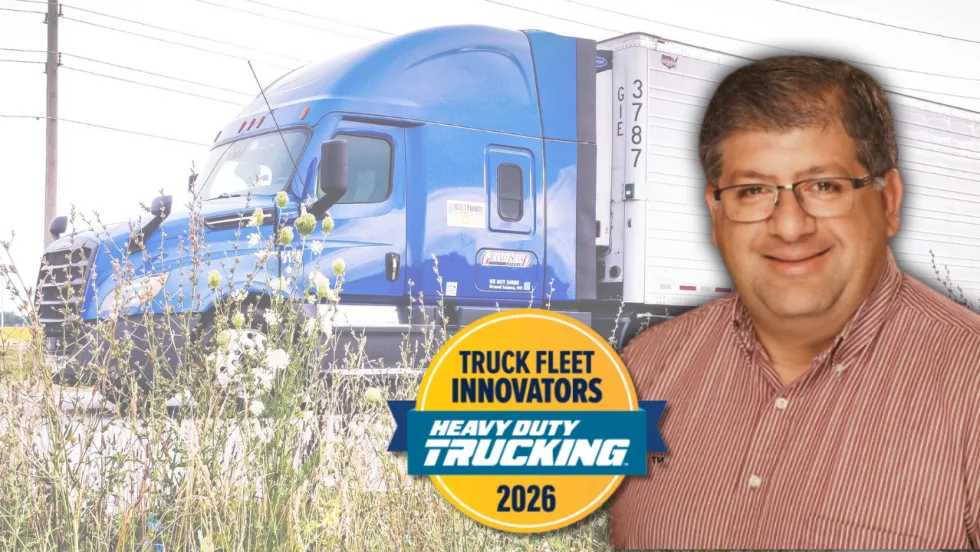
Deen Albert: Let Automation Do the Math, People Make the Decisions
HDT Truck Fleet Innovator Deen Albert makes sure people are still at the heart of operations at Grand Island Express, even while adopting artificial intelligence tools. AI-assisted dispatch helped boost revenue 25% with the same number of trucks.
Read More →
Trimble’s New AI Agent Takes Aim at Fleet Back-Office Busywork
Arc Agent works across Trimble TMS products to automate repetitive tasks such as freight orders, maintenance, invoices, fuel costs and more.
Read More →
How HDT’s 2026 Truck Fleet Innovators Are Rethinking Fleet Operations
Meet five trucking leaders who are challenging assumptions, solving operational problems, and putting innovative ideas to work.
Read More →