




NHTSA's Stability Control Proposal Gets First Public Airing
Trucking interests, including manufacturers and carriers, support the idea of a federal mandate for stability control systems in new tractors, but have concerns about details in the National Highway Traffic Safety Administration's proposed rule
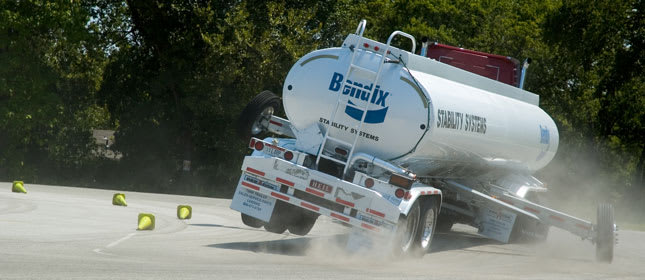
Trucking interests, including manufacturers and carriers, support the idea of a federal mandate for stability control systems in new tractors, but have concerns about details in the National Highway Traffic Safety Administration's proposed rule.
At a hearing hosted by NHTSA yesterday, truck and equipment suppliers uniformly applauded the agency's proposal to require electronic stability control systems, but warned that the certification method the agency is considering will create more problems than it solves.
American Trucking Associations likes stability control technology but is not so keen on the agency's choice of ESC versus roll stability control.
Both systems detect the risk of rollover or instability and slow the vehicle by cutting back the throttle and applying the brakes automatically. But RSC is triggered only by roll instability, while ESC reacts to both roll instability and yaw instability, such as a skid that could lead to a jackknife.
Ted Scott, director of engineering at ATA, said the rule needs to consider the diversity of the industry.
"One size does not fit all," he said. ESC is more effective than RSC, but the difference is not enough to justify going with the ESC mandate, he said.
"The point is that such a diverse industry needs standards that provide flexibility."
But ATA does not speak for all carriers.
Jim Burg, president of steel hauler James Burg Trucking, has ESC systems in a half-dozen new tractors and has RSC on 10 trailers. He sees ESC as the common-sense approach.
He prefers ESC to RSC on his power units because it provides both roll and directional control.
"I was convinced to purchase ESC technology after watching a 10-minute video demonstration taped on a snow-covered test track in Michigan's Upper Peninsula," he said. "I have driven over 1.2 million miles in a commercial motor vehicle and immediately recognized the value ESC could bring in unpredictable circumstances."
The hearing was the beginning of the public phase of the agency's rulemaking process. The agency posted the proposed rule last May and will accept comments until August 21.
The rule, aimed at vehicles rated 26,000 pounds or more, would be phased in over two to four years after it goes through public comment and becomes final, a process that probably will take a year or more.
The Certification Concern
Manufacturing interests at the hearing unanimously said that the agency needs to reconsider its approach to certifying ESC systems.
The agency is proposing a "sine with dwell" procedure that would put trucks through high-speed maneuvers that can only be done at one facility in the country, said Tim Blubaugh of the Truck and Engine Manufacturers Association.
The agency is borrowing this procedure from its testing of stability control systems on cars, but it won't work with trucks, he said.
It requires expensive and complicated new equipment on the truck, and the maneuvering that's required could damage the truck. Moreover, it does not reflect how trucks have to maneuver on the highway, he said.
He warned that the agency's certification approach could jeopardize the entire rule.
"The sine with dwell certification test would impose enormous resource demands on heavy-duty truck manufacturers for no purpose, and would make the rule impractical to implement," he said.
Manufacturers are working on alternative certification procedures that they intend to recommend to the agency, said Blubaugh.
A number of manufacturers testified in the same vein, including Navistar, Volvo, Daimler Trucks North America, Meritor Wabco, Bendix Commercial Vehicle Systems and the Heavy Duty Brake Manufacturers Council.
Also testifying in support of the proposal were Rep. Betty Sutton, D-Ohio, whose district includes the headquarters of Bendix, and John Hill, former chief of the Federal Motor Carrier Safety Administration and a long-time advocate of advanced safety technologies.
More Drivers
EEOC Sues Texas Trucking Company Over Driver Age Limits
The agency says Trancasa USA rejected applicants over 65 and applied tougher driving-record standards to those over 60.
Read More →
Nussbaum, Roehl Announce Second Driver Pay Increase This Year
This year has seen a swath of major truck driver pay increases as freight capacity has tightened.
Read More →
From One Generation to the Next: How Mentorship Builds Safer Truck Drivers
After three decades in trucking, Harold Perry shares what he's learned about driver safety, mentorship, and helping the next generation build confidence behind the wheel.
Read More →
Truck Drivers Need More Than Another Alert
Fleets have more visibility into truck health, safety events, and driver activity than ever. The next challenge is turning all that information into useful guidance for the person who has to decide what to do next.
Read More →
FMCSA Removes 110 Truck Driver Training Schools from Certified ELDT List
Federal regulators also are targeting more than 160 additional training providers and launching a nationwide audit of third-party CDL skills testers as part of a broader crackdown on trucking fraud.
Read More →
Hours of Service Pilot Programs: FMCSA Readies for 2027 Rollout
Two pilot programs could eventually reshape hours-of-service rules, giving truck drivers options to pause their 14-hour clock or use longer split sleeper rest periods.
Read More →
Medical Cards, English Proficiency Reshape Roadcheck Violations
Medical-card violations jumped to the top of the driver out-of-service list during CVSA’s 2026 International Roadcheck, while English-language proficiency violations appeared among the leading violations for the first time.
Read More →
Driver Trust Can Make or Break the Success of Fleet Safety Technology
New Teletrac Navman research suggests that onboarding, transparency about driver data, and positive feedback can play a significant role in how commercial drivers respond to safety and coaching technology.
Read More →
EEOC Sues KLLM Over Alleged Sex Discrimination in Driver Training
KLLM is facing a federal sex-discrimination lawsuit over policies the EEOC alleges put female truck driver trainees at a disadvantage.
Read More →
FMCSA Moves to Codify English Language Requirements for Commercial Drivers
By changing regulations on English-language proficiency requirements for commercial drivers, rather than relying on a guidance memo, the FMCSA said future administrations won't be able to walk back the Trump administration's stricter enforcement with just a memo.
Read More →