





Port of Los Angeles Plans Clean Truck Spending For Next 3 Years
New ZEV Drayage Incentives for Seattle-Tacoma Port Truckers
Program brings first electric semi-trucks and charging infrastructure to local fleet operators.
July 11, 2025
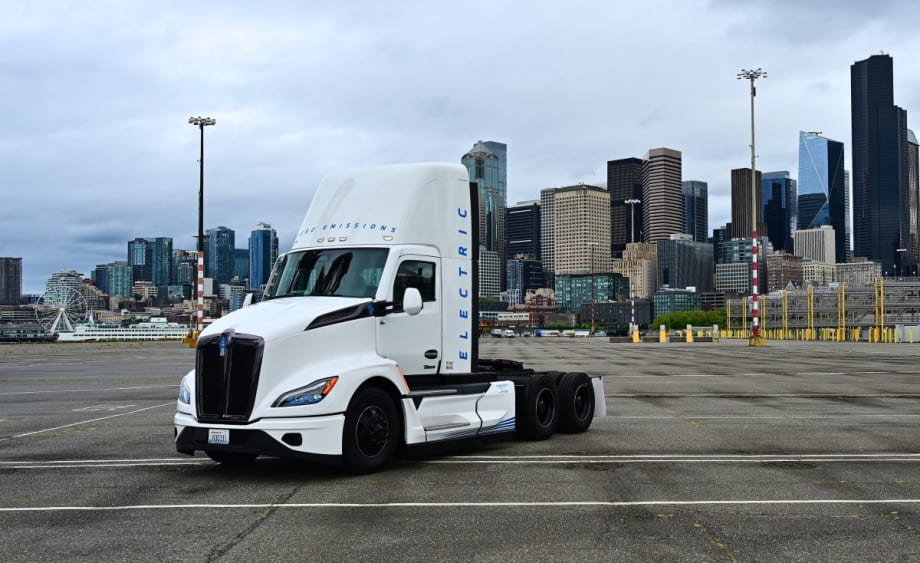
“The absolute scale of the transition for trucks and ports to a zero-emission future is a journey no one entity can do on their own," said NWSA Co-Chair and Port of Tacoma Commission President John McCarthy.
Photo: Northwest Seaport Alliance
3 min to read
The Northwest Seaport Alliance announced an incentive program for zero-emission truck and charging deployment in the Seattle-Tacoma gateway.
Made possible by a $6.2 million grant from the Washington State Department of Transportation, the incentives will collectively bring 19 zero-emission trucks and charging infrastructure to the Puget Sound region.
After a competitive bid process, the NWSA identified Zeem Solutions (Zeem) as the awarded subrecipient.
Zeem offers charging, parking, fleet management services, and electric vehicle leases to help fleets transition to zero-emissions vehicles. This will be their first deployment in Washington state.
This grant serves as a catalyst for private investment from project participants, according to a news release, with Zeem and its fleet partners contributing a substantial portion of the total project costs.
The Electric-Vehicle Charging Site
The Zeem project also includes building out a charging site that will enable 250 vehicles to charge per day, with parking capacity for 70 vehicles overnight.
The charging site will be located near the new I-5 exit ramp just south of SeaTac Airport, along SR-99 (International Blvd / Pacific Hwy), convenient for nearby warehouse and distribution centers with a large volume of truck deliveries.
In addition to serving trucks, the Zeem site will serve other fleets operating light-, medium- and heavy-duty electric commercial vehicles.
The charging site will break ground this fall, with the ZEVs expected on the road by 2026.
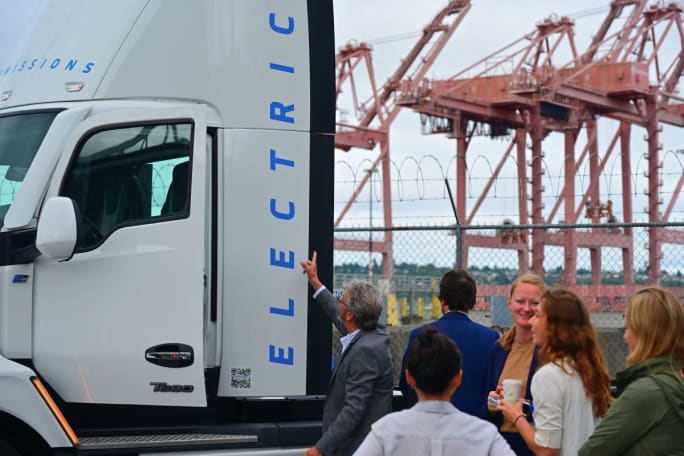
People check out an electric Kenworth truck at a Northwest Seaport Alliance event.
Photo: Northwest Seaport Alliance
Funding for the Project
This program was made possible by Climate Commitment Act funding, Washington’s cap-and-invest program supporting climate, jobs and public health.
“This transition is a necessary but expensive one, and we need all the partners at the table that we can get,” said NWSA Co-Chair and Port of Tacoma Commission President John McCarthy.
“Funding from the Washington State Legislature and their recognition of the importance of decarbonizing ports was key to making this happen, and continued investment and partnership will be crucial to future iterations of this program.
“The absolute scale of the transition for trucks and ports to a zero-emission future is a journey no one entity can do on their own.”
Washington’s ZEV Drayage Roadmap
This launch of the incentive program and inaugural award follows closely on the heels of the release of the Decarbonizing Drayage Roadmap announced in April.
The Roadmap outlines almost 70 recommendations for getting the full Puget Sound region drayage fleet into ZEVs by 2050 or sooner.
This incentive program was designed in tangent with the Roadmap, according to a news release, and used the lessons learned and feedback received from the driver community through that process.
These incentives were also designed to alleviate cost burden and risk to drivers, and to ensure the co-development of the necessary charging infrastructure.
According to the news release, truck emissions represent about 6% of all seaport-related diesel pollution and about 30% of all seaport-related climate pollution in the region.
About The Northwest Seaport Alliance
The Northwest Seaport Alliance is a marine cargo operating partnership of the ports of Seattle and Tacoma.
Combined, the North and South harbors are a major North American gateway for containerized trade and the handling of non-containerized commodities (bulk, breakbulk, project/heavy-lift cargoes, and automobiles).
More Fuel Smarts

How Volvo Updated Its D13 for EPA 2027 [Watch]
Volvo’s updated D13 promises lower emissions without sacrificing performance or fuel economy. Take a closer look at what changed inside the engine in this HDT Spotlight video.
Read More →
Diesel Price Spike Shortens Payback for Natural Gas Trucks, Report Says
Energy Vision estimates fleets could recover the higher purchase price of an RNG-fueled Class 8 tractor in 1.3 to 2.8 years under current fuel-price scenarios.
Read More →
Calstart Becomes Catalyst Mobility, Reflecting Broader Focus
Calstart is now Catalyst Mobility, reflecting the nonprofit’s growing national role in clean transportation, including zero-emission trucks, infrastructure and incentive programs.
Read More →

Record Diesel Prices Squeeze Trucking Fleets
Average U.S. diesel prices have climbed to nearly $6 a gallon, surpassing the 2022 record as tight refinery capacity and Middle East disruptions keep fuel costs elevated.
Read More →
Sponsored•September 9, 2026
How Fuel Delivery Shapes Engine Performance
Fuel delivery depends on more than what happens at the injector. For fleet, maintenance and technical professionals, looking at the full path from pump to injector can provide useful context for understanding engine performance.
Read More →
East Coast Port Launches $45M Electric Truck Push
The Port Authority of New York and New Jersey announced millions in incentives for zero-emission drayage trucks, yard tractors, and new charging hubs near the port.
Read More →
California Bill Could Shed Light on Electric Truck Prices
Why do battery-electric Class 8 trucks remain so expensive? A California bill headed to Gov. Gavin Newsom would give fleets and state agencies more visibility into what manufacturers charge.
Read More →
Detroit Opens Orders for EPA 2027 Engines
Detroit isn’t starting from scratch to meet EPA 2027 diesel emissions standards. Its Gen 6 DD13 and DD15 engines keep much of today’s platform while updating the fuel and aftertreatment systems.
Read More →
Zero-Emission Truck Corridor Planned for West Coast
California, Oregon, Washington, British Columbia and Baja California are coordinating plans for truck charging and hydrogen fueling from Canada to Mexico.
Read More →
A Closer Look at Kenworth’s Electric T880E Vocational Truck [Video]
Learn more about Kenworth's T880E battery-electric vocational truck at the Paccar Technical Center, including its range, applications, upfitting considerations, and PTO options, in this HDT Spotlight video.
Read More →