




New York Law Requires Convex Mirrors on Trucks in Big Apple
New York Gov. Andrew Cuomo signed a law Monday that requires convex mirrors, or "crossover mirrors," to be placed on the front of trucks being driven in New York City to eliminate blind spots directly in front of the truck
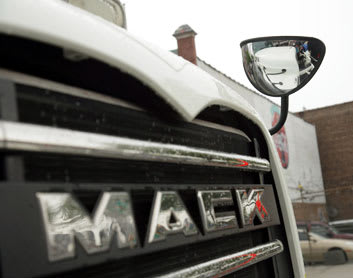
A new state law requires crossover mirrors on many trucks in NYC.
New York Gov. Andrew Cuomo signed a law Monday that requires convex mirrors, or "crossover mirrors," to be placed on the front of trucks being driven in New York City to eliminate blind spots directly in front of the truck.
Under the law, all large trucks registered in New York state with a maximum gross weight of 26,000 pounds or more are required to be equipped with a convex mirror on the front of the vehicle when driving in the Big Apple.
"Convex mirrors are an effective tool to protect pedestrians from accidents caused by blind spots," Cuomo said. "This law will allow truck operators to see pedestrians or objects directly in front of them and will offer new safety protections to many New Yorkers."
The law, which has been considered several times in the past decade, was given a boost in support this past May following the death of a toddler in Brooklyn. Four-year-old Moses Englander was struck by a delivery truck while riding his tricycle. Police said the driver did not see the boy, and he was not charged in the accident.
Not everyone, however, supports of the law. The New York State Motor Truck Association believes it will not actually increase safety.
Kendra Adams, executive director of NYSMTA, said the main problem with requiring trucks to have crossover mirrors is that the mirrors lose effectiveness when the vehicle is in motion. The majority of accidents involving trucks, she said, occur when the truck is moving forward. If a pedestrian steps in front of a moving vehicle, the mirror cannot help the situation.
A better solution, Adams suggested, would be to equip telephone poles throughout New York City with large, convex mirrors that will allow cars and trucks alike to see around corners.
There are other problems with the law as well. It only applies to vehicles registered in New York State, so vehicles from neighboring states, such as New Jersey and Pennsylvania, are not obliged to use the equipment. This leaves a substantial number of trucks without mirrors, according to Adams.
Finally, some out-of-city companies, such as truck rental companies, may find themselves installing mirrors essentially for no reason. If you are a renting operation in Buffalo, the argument goes, you cannot be sure if your vehicles will be driven in Manhattan, although it is unlikely. At around $120 per mirror including installation, the cost may add up for companies with large fleets.
Corrected 12:45 EDT 7/21/2011 to clarify weight ratings affected.
More Drivers
Trucker Path Expands Reserved Parking Network
Trucker Path has added close to 6,000 more truck parking spaces to its Trucker Path Reserved Parking Network with the addition of Safe Truck Parking.
Read More →
EEOC Sues Texas Trucking Company Over Driver Age Limits
The agency says Trancasa USA rejected applicants over 65 and applied tougher driving-record standards to those over 60.
Read More →
Nussbaum, Roehl Announce Second Driver Pay Increase This Year
This year has seen a swath of major truck driver pay increases as freight capacity has tightened.
Read More →
From One Generation to the Next: How Mentorship Builds Safer Truck Drivers
After three decades in trucking, Harold Perry shares what he's learned about driver safety, mentorship, and helping the next generation build confidence behind the wheel.
Read More →
Truck Drivers Need More Than Another Alert
Fleets have more visibility into truck health, safety events, and driver activity than ever. The next challenge is turning all that information into useful guidance for the person who has to decide what to do next.
Read More →
FMCSA Removes 110 Truck Driver Training Schools from Certified ELDT List
Federal regulators also are targeting more than 160 additional training providers and launching a nationwide audit of third-party CDL skills testers as part of a broader crackdown on trucking fraud.
Read More →
Hours of Service Pilot Programs: FMCSA Readies for 2027 Rollout
Two pilot programs could eventually reshape hours-of-service rules, giving truck drivers options to pause their 14-hour clock or use longer split sleeper rest periods.
Read More →
Medical Cards, English Proficiency Reshape Roadcheck Violations
Medical-card violations jumped to the top of the driver out-of-service list during CVSA’s 2026 International Roadcheck, while English-language proficiency violations appeared among the leading violations for the first time.
Read More →
Driver Trust Can Make or Break the Success of Fleet Safety Technology
New Teletrac Navman research suggests that onboarding, transparency about driver data, and positive feedback can play a significant role in how commercial drivers respond to safety and coaching technology.
Read More →
EEOC Sues KLLM Over Alleged Sex Discrimination in Driver Training
KLLM is facing a federal sex-discrimination lawsuit over policies the EEOC alleges put female truck driver trainees at a disadvantage.
Read More →