




Trucking, Trump Administration Fight New York Congestion Pricing
New York officials continue to say they won't kill off the controversial congestion pricing program in New York City.

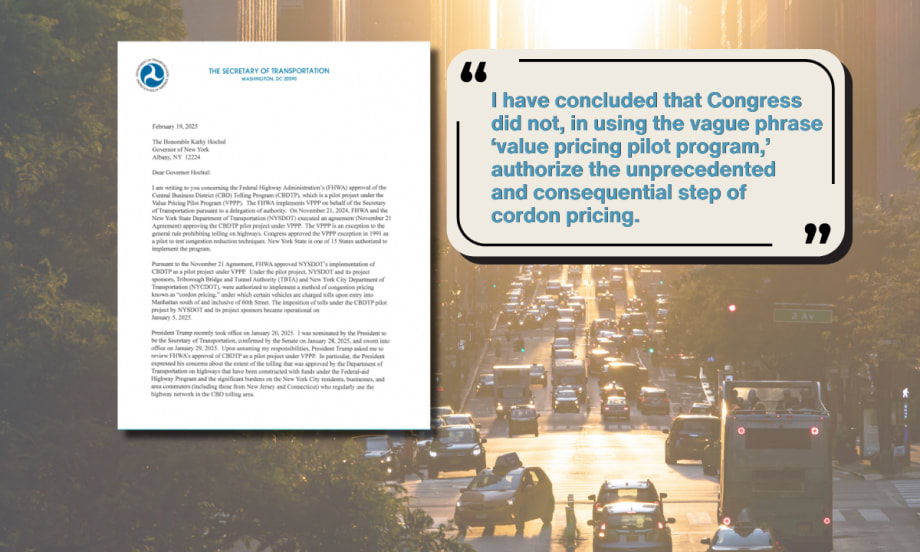
Transportation Secretary Sean Duffy said the previous administration erred when it approved New York City's congestion pricing plan.
Image: HDT Graphic
The day before the latest deadline from the Trump administration for New York to kill off its controversial congestion pricing program in Manhattan, a federal judge issued a temporary restraining order to keep the Department of Transportation from making good on its threats to block funding.
U.S. District Judge Lewis Liman's May 27 order keeps the tolls in place through at least June 9. It bars the U.S. DOT from withholding federal funding from New York as the legal fight continues.
New York's congestion pricing program, officially called the Central Business District Tolling Program, went into effect in January. Heavy-duty trucks now must pay $21.60 each time they enter Manhattan south of 60th Street between 5 a.m. and 9 p.m. on weekdays and between 9 a.m. and 9 p.m. on weekends. The trucking industry has criticized the program as unfairly targeting trucks.
But the Trump Administration in February said it was withdrawing the approval for the pilot program, approved during the Biden administration. Since then, the state has ignored several deadlines set by the Department of Transportation and Transportation Secretary Sean P. Duffy and filed suit against the federal government challenging its attempt to cancel the program.
A month ago, Secretary Duffy gave New York 30 days to show how its non-compliance with federal orders is not illegal. He said if they didn't, the agency will halt approvals of various Federal Highway Administration projects (other than those it deems essential for safety.)
The Metropolitan Transportation Authority, which operates the toll program, sought a preliminary injunction to prevent the federal government from withholding approvals or funds for continuing to collect tolls. Judge Liman agreed.
“We’ve won — again," said New York Gov. Kathy Hochul in a statement, "vindicating our right as a state to make decisions regarding what’s best for our streets.
"Secretary Duffy can issue as many letters and social media posts as he wants, but a court has blocked the Trump Administration from retaliating against New York for reducing traffic and investing in transit.
“Congestion pricing is legal, it's working and we're keeping the cameras on.”
However, a spokesman for the DOT downplayed the decision, saying the judge’s ruling was not on the merits of its case, but rather a temporary pause to have more time to reach a decision. And, they said, the threatened fund-withholding was merely under consideration.
Previous coverage
New York Ignores Administration Deadline to Shut Down Congestion Pricing
APRIL 21: New York officials have ignored the April 20 deadline set by the federal government to shut down its controversial congestion pricing program, and Transportation Secretary Sean Duffy is threatening to halt federally funded projects in the city.
The transportation secretary reiterated in a letter to New York officials that the U.S. DOT canceled the agreement authorizing New York to implement a temporary cordon pricing program. Without the agreement, Duffy said, the state has zero legal basis to continue.
“Perpetuating this type of cordon pricing program forever on federal-supported roads is unprecedented in the history of the United States and completely inconsistent with any previous pilot project,” he said in the letter.
Duffy gave the state DOT 30 days to state how their non-compliance is not illegal. If the unlawful tolls are not stopped, or if that response isn’t satisfactory, he said the agency will halt approvals of various Federal Highway Administration projects (other than those it deems essential for safety.)
N.Y. Gov. Kathy Hochul and the Metropolitan Transit Authority, which is in charge of the program, have both said the toll program will remain in place until a judge rules otherwise.
Judge Dismisses Legal Challenge to Congestion Pricing
In addition, the Trucking Association of New York said it plans to continue fighting the congestion pricing program after a district judge dismissed all lawsuits challenging it, including the association’s litigation.
TANY all along has said it’s not opposed to congestion pricing in general, but that the plan unfairly targets commercial trucking.
“Amidst lingering economic uncertainty, further disruptions to New York’s supply chain will harm New Yorkers, especially those across the five boroughs already struggling to make ends meet,” said TANY President Kendra Hems in a statement.
“We have repeatedly emphasized our willingness to work towards a fair solution that reduces traffic and maintains lower costs for New Yorkers. Time and time again, our concerns and those of New Yorkers have been brushed to the side.
"As our legal team reviews Judge Liman’s decision, we will continue to evaluate our options — we are prepared to take this fight to the furthest extent possible.”
New York, USDOT Clash on What Court Document Means for Congestion Pricing Program
APRIL 8: Although a court document appears to indicate that New York City's controversial congestion pricing program will be in place at least until the fall, the U.S. Department of Transportation insists that April 20 is still the deadline to kill the program — although indications seem to be that New York will ignore it.
The congestion pricing program, implemented in January after multiple delays, imposes tolls on drivers entering Manhattan below 60th Street in an effort to reduce congestion and pollution. The trucking industry has criticized the program as unfairly targeting trucks.
The Trump administration vowed to end the program, and in February the Department of Transportation said it had terminated approval of the pilot for the program, officially called the Central Business District Tolling Program.
New York Gov. Kathy Hochul vowed to fight back, and the MTA has filed a lawsuit against the DOT.
The federal government and NYC's Metropolitan Transportation Authority, which operates the program, have agreed to a timeline that would keep congestion pricing tolls on through late October, giving the case a chance to go through the courts.
The timeline is set forth in a letter filed on April 4 in federal court in Manhattan as part of the MTA lawsuit.
However, the New York Times noted that "it remains unclear whether the federal Department of Transportation, which has raised the specter of defunding mass transit projects in the state, could exert pressure outside the court system to try to force the program to end sooner. Sean Duffy, the secretary of transportation, has said he wants the toll to end by April 20."
And in fact, the DOT on social media platform X called reports of the new timeline a "lie by the elitist New York liberal media."
This is a complete lie by the elitist New York liberal media, whose rich buddies love the idea of pricing poor people out of the city.
The truth is simple agreements on judicial timelines have no bearing on the underlying merits of our case or our position.
Here are the… https://t.co/xq45hLPp9d— USDOT Rapid Response (@USDOTRapid) April 8, 2025
March 21: Congestion Pricing Gets a One-Month Reprieve
Less than 24 hours before the deadline the Trump Administration had given New York City to end its congestion pricing plan, the state got a one-month reprieve — but it also was "put on notice" by Transportation Secretary Sean Duffy.
In a March 20 post on social media, Duffy said, "Know that the billions of dollars the federal government sends to New York are not a blank check. Continued noncompliance will not be taken lightly."
.@GovKathyHochul — the federal government and @POTUS are putting New York on notice.
Your refusal to end cordon pricing and your open disrespect towards the federal government is unacceptable.
Just as your high tolls and no free road option are a slap in the face to hard…— Secretary Sean Duffy (@SecDuffy) March 20, 2025
The trucking industry has opposed the congestion pricing plan because of the way it unfairly treats trucks.
While passenger vehicles pay a $9 daily fee that gives them unlimited passage into the Congestion Relief Zone (a requirement of New York State law), trucks are forced to pay up to $21.60 each time they enter the zone.
In a March 19 letter to Duffy, the American Trucking Associations and the Trucking Association of New York expressed their support for killing off the congestion pricing plan.
"While the Metropolitan Transportation Authority claims reductions in congestion, to date our members report that improvements to delivery times have varied, and overall benefits are minimal and do not come close to offsetting massive operating cost increases," the letter noted.
According to the New York Times, the 30-day extension to the deadline "remains largely symbolic, as the case wends its way through federal court, but it could signal a prelude to a broader legal and political battle that could drag out for years."
Feb. 28: Trump Administration Withdraws Congestion Pricing Approval
The Trump administration said it is putting the kibosh on New York City’s controversial congestion pricing plan, which trucking interests have opposed. However, New York said the courts will decide whether the program actually ends on March 21 as the Federal Highway Administration has ordered.
After multiple delays, the city officially implemented the plan in January. The program imposes tolls on drivers entering Manhattan below 60th Street.
Heavy-duty trucks now must pay $21.60 each time they enter Manhattan south of 60th Street between 5 a.m. and 9 p.m. on weekdays and between 9 a.m. and 9 p.m. on weekends. The trucking industry has criticized the program as unfairly targeting trucks.
On Feb. 19, the Federal Highway Administration announced it had terminated approval of the pilot for the program, officially called the Central Business District Tolling Program.
In a letter to New York Gov. Kathy Hochul, Transportation Secretary Sean Duffy said FHWA was rescinding a November 21, 2024, agreement signed under the Value Pricing Pilot Program.
The move effectively ends tolling authority for the program, according to Duffy.
“New York State’s congestion pricing plan is a slap in the face to working class Americans and small business owners,” Duffy said in a statement.
“Commuters using the highway system to enter New York City have already financed the construction and improvement of these highways through the payment of gas taxes and other taxes. But now the toll program leaves drivers without any free highway alternative, and instead, takes more money from working people to pay for a transit system and not highways.
“Finally, it impedes the flow of commerce into New York by increasing costs for trucks, which in turn could make goods more expensive for consumer[s]. Every American should be able to access New York City regardless of their economic means. It shouldn’t be reserved for an elite few.”
Gov. Kathy Hochul said the state would fight what she called an attack on the city, and government officials filed a lawsuit minutes after the announcement was made.
President Trump later declared on social media that he killed the program, adding, "long live the king."
Hochul fired back, "New York hasn't labored under a king in over 250 years, and we sure as hell are not going to start now," reported CBS News.
Duffy: NYC Program Doesn't Meet Congestion Pilot Program Requirements
Except for limited exceptions allowed by Congress, Duffy said, highways constructed with Federal-aid highway funds cannot be tolled. The VPPP is one of the few exceptions.
He gave two reasons for terminating the project:
The scope of the CBDTP is unprecedented and provides no toll-free option for many drivers who want or need to travel by vehicle in this major urbanized area.
The toll rate was set primarily to raise revenue for transit, rather than at an amount needed to reduce congestion. By doing so, the pilot runs contrary to the purpose of the VPPP, which is to impose tolls for congestion reduction — not transit revenue generation.
"I have concluded that Congress did not, in using the vague phrase "value pricing pilot program," authorize the unprecedented and consequential step of cordon pricing," Duffy wrote.
The letter did not indicate a specific date for the end of the program, but said the FHWA will work with the project sponsors on an orderly termination of the tolls.
Will NYC Congestion Pricing End on March 21?
In a Feb. 20 memorandum, FHWA Executive Director Gloria Shepherd gave New York City a deadline of March 21 to end its congestion pricing plan.
However, Gov. Hochul has essentially told the Trump administration, "We'll see you in court."
In February 26 remarks at the Metropolitan Transportation Authority’s board meeting, she talked about how the congestion pricing program is already working.
"When someone tries to say, 'No, we have another vision for your city,' we just have to stand up and say, 'We respectfully disagree,' and take that to the courts and take it to the people."
Legal Pushback on DOT's Effort to End NYC Congestion Pricing
Like many of the Trump administration’s recent initiatives to roll back and revoke programs previously approved, there are questions about the FHWA’s legal authority to kill a program that had been legally approved and upheld by the courts.
Duffy appeared to address this concern in his letter: "I recognize that FHWA under the prior administration concluded, when executing the November 21 Agreement, that the CBDTP was eligible for approval under VPPP, and that my determination represents a change in position.
"FHWA, however, did not explain the basis for its conclusion, and nothing in the prior approval undermines the above analysis upon which my determination is based."
Why Trucking Opposed NYC's Congestion Pricing
The program appeared to have been working, according to early data. In its first month, approximately 1.2 million fewer vehicles entered the congestion zone compared to the previous year, resulting in a 7.5% drop in traffic.
However, trucking interests opposed the congestion pricing plan. The Trucking Association of New York said it wasn’t opposed to the concept of congestion pricing in general (after all, congestion costs trucking time and money), but that the program unfairly targeted trucking.
Trucks, which make up only 4% of all NYC vehicle traffic, are charged on a per-trip basis, while passenger vehicles are only charged once per day, according to the association.
TANY responded to the DOT's action positively, saying in just the six weeks the program has been effective it's already impacted the trucking industry and that it hope the action will lead to the immediate cessation of tolls.
The association said there are better ways to address congestion and emissions, such as the burgeoning microhubs program, off-peak hours delivery incentives, and operator subsidies for electric vehicle conversion.
'Truckers Don't Drive Into Manhattan to Sightsee'
American Trucking Associations President and CEO Chris Spear issued a statement praising the action.
“Truckers don't drive into Manhattan to sightsee. They do it because customers depend on them. The deliveries they make are essential to businesses and residents and keep New York City running.
“Truckers deserve our gratitude. Instead, New York imposed a $21.60 toll — eventually climbing to $36 — each time they crossed south of 60th Street. Even worse, the proceeds of this shakedown were not dedicated to improving roads and bridges but rather subsidized a bloated and mismanaged transit bureaucracy that has proven unable to control spiraling costs. New York’s subways were never going to deliver the city’s freight."
The Owner Operator Independent Drivers Association also praised Duffy's move.
“OOIDA and the thousands of small business truckers who operate in New York City welcome USDOT’s decision to rescind tolling authority for New York‘s congestion pricing plan," saidPresident Todd Spencer in a statement.
"Truckers often have very little control over their schedules, so this congestion pricing plan is particularly problematic for owner-operators and independent drivers. We routinely have no other choice than to drive through metropolitan areas during periods of high congestion because of the rigidity of current federal hours of service requirements.
"Additionally, shippers and receivers generally have little regard for a driver’s schedule, frequently requiring loading and unloading to occur at times when nearby roads are most congested. ... Beyond New York City, we encourage the Trump administration and Congress to fight the expansion of tolling across the country.”
Updated 2/20/2025 to add Gov. Hochul's response and comments from the Trucking Association of New York and the American Trucking Associations.
Updated 2/28/2025 to add FHWA's order to end the program by March 21 and New York's response.
Updated 3/21/2025 to add the Trump Administration's deadline extension.
Updated 4/8/2025 to add news about a potential six-month reprieve for NYC
Updated 4/21/2025 to add news that New York has ignored DOT's April 20 deadline and update on TANY legal challenge.
Updated 5/27/2025 to add news of Judge Liman's temporary restraining order
More Fleet Management

Why Private Fleets Are Taking More Freight
Private fleets are putting their own trucks on demanding customers and high-cost lanes as companies seek greater control over service, costs, and capacity.
Read More →
Color Match Smarter: Tools That Restore & Perform
For fleet managers and collision repair professionals keeping heavy-duty trucks on the road, getting the color right the first time isn't just about appearance — it's about efficiency, turnaround time, and bottom-line results. Discover how today's digital color tools are transforming the repair process from guesswork to precision.
Read More →
FMCSA Pauses Biennial-Update Enforcement Amid Motus Transition
Carriers whose updates were due on or after June 1 have more time, while FMCSA works to stabilize its new registration system and warns of phishing sites impersonating its new carrier registration system, Motus.
Read More →


2026 Blueprint for Countering Smarter Supply Chain Theft
Cargo theft is no longer just the cost of doing business. It's a multi-billion-dollar criminal enterprise exploiting vulnerabilities across your fleet, drivers, and supply chain.
Read More →
How Telematics Improves Visibility, Control, and Performance in Refrigerated Fleets
Explore how telematics help refrigerated fleets improve visibility, uptime, efficiency, compliance, and cargo protection across connected cold chain operations.
Read More →
What the U.S.-Canada Trade War Means for Trucking
Escalating U.S.-Canada tariffs could disrupt cross-border freight, reduce truck volumes, raise costs, and create new uncertainty for carriers on both sides of the border.
Read More →
What Are Trucking’s Top Concerns for 2026?
The American Transportation Research Institute wants to know what's worrying trucking fleet managers, drivers, and other stakeholders in its annual Industry Issues survey.
Read More →
American Trucking Associations Looks for a New Leader
ATA President and CEO Chris Spear abruptly left his job at the association on August 21, at a pivotal time for the trucking industry.
Read More →
Public Wi-Fi Cybersecurity Risks: How Truck Drivers and Fleets Can Protect Their Data
Public Wi-Fi can expose truck drivers and fleets to credential theft, malware, and other cyber threats. Here’s how to reduce the risk on the road.
Read More →
For Nicky Cupp, Fleet Innovation Starts With Frustration
HDT Truck Fleet Innovator Nicky Cupp turns everyday pain points at Fraley & Schilling into opportunities for better technology and smarter processes.
Read More →