




New Rules for Trip Permits in Oregon
The Oregon Department of Transportation recently began limiting the number of temporary passes/trip permits a motor carrier can purchase in a 12-month period – a move that one association representative calls “a money grab” that will affect small-business motor carriers located outside the state.

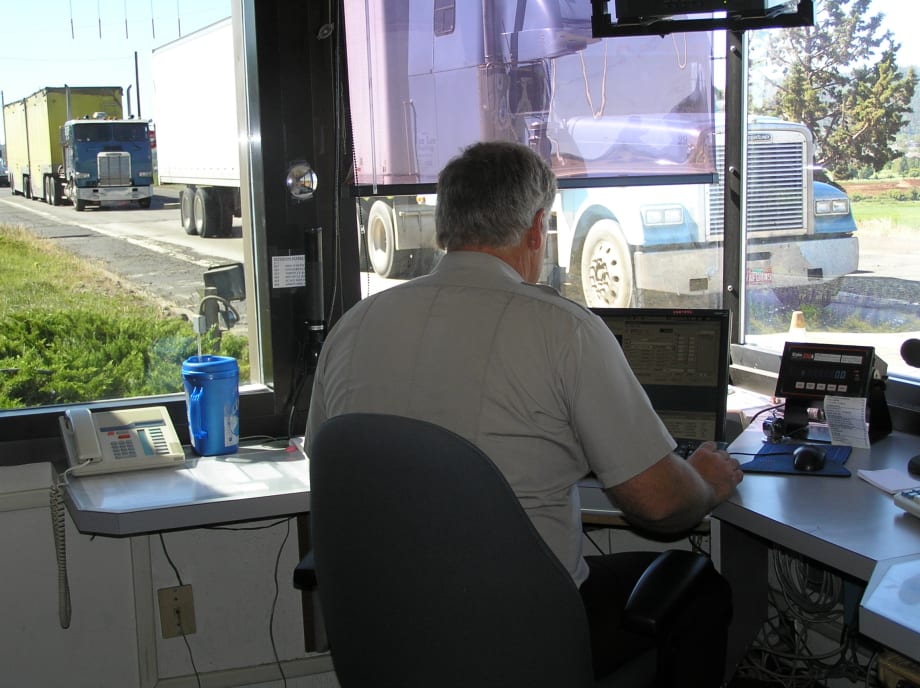
An Oregon DOT motor carrier enforcement officer weighs a truck as a it passes through a Port of Entry.
An Oregon DOT motor carrier enforcement officer weighs a truck as a it passes through a Port of Entry.
This summer the Oregon Department of Transportation began limiting the number of temporary passes/trip permits a motor carrier can purchase in a 12-month period – a move that one association representative calls “a money grab” that will affect small-business motor carriers located outside the state.
These rules state carriers are required to establish an account when any one vehicle exceeds five temporary passes or when an entire account exceeds 35 temporary passes within one 12-month period.
The Motor Carrier Transportation Division also requires a cash deposit or bond to Ensure the payment of fees, taxes, charges, penalties, and interest when a motor carrier operates on temporary passes.
Joe Rajkovacz, director of Governmental Affairs and Communications for the California Construction Trucking Association and The Western Trucking Alliance, says in the past many carriers based outside of Oregon had found it easier to comply with the state’s weight-mile tax by purchasing a temporary pass for $9 plus the cost of miles traveled in Oregon. (Establishing an account has always required the posting of a $2,000 cash deposit or surety bond in that amount.)
“This new policy will primarily affect small-business motor carriers who have either not wanted to post the $2,000 cash required or are simply not bondable,” he says. “As with all surety bonds, a risk assessment is made (primarily credit history), and even though the cost of posting an actual bond can be very cheap, less than $200 annually, it is not inconceivable that many smaller carriers are simply not bondable.”
Rajkovacz says the new policy in Oregon will force all out-of-state motor carriers to begin paying an additional fee for each temporary pass issued, whether they have established a permanent account or not.
A motor carrier with an established account may qualify for a cash deposit/bond waiver after a 12-month period of reporting and paying weight mile tax reports on vehicles with permanent credentials, according to the Oregon DOT. The account will be reviewed for late filings, suspensions and insufficient funds checks. If the account meets the criteria, the bond requirement may be waived. A cash deposit will be returned and a letter indicating the bond requirement is waived will be sent when there is a surety bond on file and the department has waived the bond or cash deposit.
It says operations solely under temporary passes will not qualify for a cash deposit/bond waiver. A cash deposit/bond may be waived when a carrier ceases operations and the operations have been reviewed by Motor Carrier Audit or after the carrier establishes and operates under a permanent account (with permanent credentials) and becomes eligible for a waiver.
A motor carrier with an established account that has met the total cash deposit requirement can still operate on temporary passes, but it will not qualify for a cash deposit/bond waiver. A motor carrier operating under a temporary account also will be required to apply and be approved for an established account.
“I suspect many owner-operators with their own authority, and owner-operators and drivers working for smaller carriers who have always purchased the trip permits are going to find out about this the hard way when purchasing a permit and the thresholds have been exceeded,” says Rajkovacz.
He calls the new policy by Oregon “nothing more than a money grab” and warns this new policy should also serve as a wake-up call to those thinking about new ways to fund highways.
“Oregon is the darling of the vehicle miles traveled tax crowd as an alternative to fuel taxes at the pump,” he says. “This is ultimately a tax, and if other states emulated Oregon this could conceivably make it impossible for small-business motor carriers to exist. Imagine a world where even a quarter of states required a $2,000 cash bond to be posted. Most small businesses would never have the liquidity to comply."
More Drivers

Truck Drivers Need More Than Another Alert
Fleets have more visibility into truck health, safety events, and driver activity than ever. The next challenge is turning all that information into useful guidance for the person who has to decide what to do next.
Read More →
FMCSA Removes 110 Truck Driver Training Schools from Certified ELDT List
Federal regulators also are targeting more than 160 additional training providers and launching a nationwide audit of third-party CDL skills testers as part of a broader crackdown on trucking fraud.
Read More →
Hours of Service Pilot Programs: FMCSA Readies for 2027 Rollout
Two pilot programs could eventually reshape hours-of-service rules, giving truck drivers options to pause their 14-hour clock or use longer split sleeper rest periods.
Read More →
Medical Cards, English Proficiency Reshape Roadcheck Violations
Medical-card violations jumped to the top of the driver out-of-service list during CVSA’s 2026 International Roadcheck, while English-language proficiency violations appeared among the leading violations for the first time.
Read More →
Driver Trust Can Make or Break the Success of Fleet Safety Technology
New Teletrac Navman research suggests that onboarding, transparency about driver data, and positive feedback can play a significant role in how commercial drivers respond to safety and coaching technology.
Read More →
EEOC Sues KLLM Over Alleged Sex Discrimination in Driver Training
KLLM is facing a federal sex-discrimination lawsuit over policies the EEOC alleges put female truck driver trainees at a disadvantage.
Read More →
FMCSA Moves to Codify English Language Requirements for Commercial Drivers
By changing regulations on English-language proficiency requirements for commercial drivers, rather than relying on a guidance memo, the FMCSA said future administrations won't be able to walk back the Trump administration's stricter enforcement with just a memo.
Read More →
Drivers Put Western Star Trucks to the Test at Star Nation Experience
Watch to get an inside look at the Western Star trucks, technology, and community behind the Star Nation Experience 2026!
Read More →
Trump Administration Looks to Put More Veterans Behind the Wheel
The Freedom Haulers program pulls together existing and expanded programs at several federal agencies to recruit veterans to drive commercial heavy-duty trucks and cut the red tape for them to get a CDL, training, and employment.
Read More →
Putting Mack’s Command Steer to the Test
A test drive of Mack’s Command Steer active steering system evaluates how it can make truck driving easier and less tiring.
Read More →