




New Connectivity Features from DTNA Boost Access to Truck Data
Two new connectivity-related services from Daimler Trucks North America will allow fleets to create their own electronic logging systems, develop driver scoring apps, and directly access to data on a truck for their backend systems.

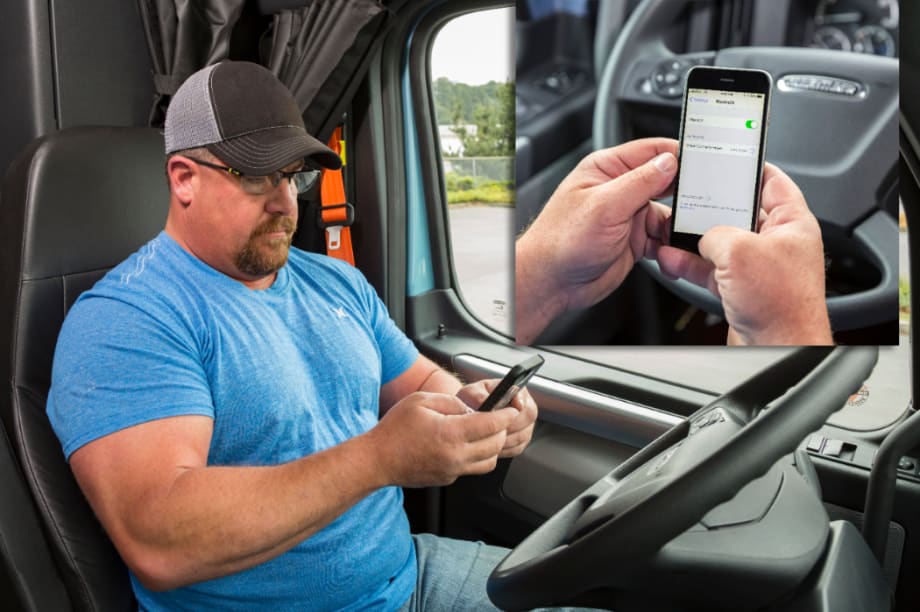
A driver can link to the Detroit Connect platform from an in-cab mobile device.
Photo courtesy Daimler Trucks
Arriving in the fourth quarter of this year, two new connectivity-related services from Daimler Trucks North America are designed to give fleets new power to create their own electronic logging systems, develop driver scoring apps that use data from the truck, and get direct access to truck data for their backend systems.
“Connected vehicles are commonplace, but not all connected vehicles are business machines as trucks are,” said Jason Krajewski, director of connectivity for Daimler Trucks North America, during Daimler Trucks’ Capital Market and Technology Day in Portland, Oregon, on June 6.
“Every feature of a truck is scrutinized for its value,” he explained, emphasizing that the value of a connected truck is directly tied to the people who interact with it, whether hands-on like the driver or technician, or in a remote way managing efficiency or safety, for instance.
The two new connectivity services in the Detroit Connect portfolio are Detroit Connect Direct and a wireless in-cab device connection, exclusive to the new Freightliner Cascadia spec’d with Detroit engines.
Detroit Connect Direct, Krajewski said, is for “people who love data,” such as fleet executives, fleet managers, and fuel and safety managers. It will give them direct access to critical information including vehicle location, fault codes and diagnostics, fuel performance, safety data, and driver behavior. Customers will be able to select which data sets they want, how much, and how frequently they would like that data made available so it can be imported into their backend systems, using a very simple menu-driven process.
“This really opens up a whole new dimension of data-centric thinking for our customers,” Krajewski said. “They’ve repeatedly asked for it.” There will be a tiered subscription offering to accommodate different data appetites.
“In addition to the vehicle-centric services we provide today, we understand that our customers have different business requirements as well as a variety of roles in their business that need accurate and timely information to help them perform their daily functions effectively,” he continued. The proprietary Detroit Connect platform will also link wirelessly with an in-cab device via Bluetooth, which will allow hours of service data to be delivered to Detroit Connect-authorized ELD apps. This will provide the necessary information required from the vehicle to meet the federal ELD rules without the need for any additional pieces of hardware. “Getting rid of that extra device down by the driver’s foot, or of a cable snaking through the cab, provides real value to the customer.”
When asked about the reliability of the Bluetooth connection, Krajewski said it had been tested to work as far as 30 feet from the cab. And he pointed out that even ELD systems that use cables and tablet systems, for instance, have been known to have the cable wiggle enough from truck vibration to become disconnected.
Daimler is looking at other potential applications for these technologies, and Krajewski suggested that a telematics provider and customer could run an application on mobile devices that use truck data such as a driver scoring application that tracks things like fuel economy and hard braking incidents.
Krajewski also highlighted and demonstrated other existing features of the Detroit Connect platform:
Remote diagnostics services with Detroit Connect Virtual Technician. This is available on all Detroit engines, including the Detroit DD5 and DD8, across all DTNA truck models.
Detroit Connect Remote Updates, exclusive to the new Freightliner Cascadia, enables customers to securely make over-the-air engine parameter changes and download Detroit Diesel Engine Control (DDEC) performance reports. Fleet managers no longer have to wait for their vehicles to be brought in to the shop to change key parameters on their vehicles, such as top speed or idle shutdown time. They now can be changed with a few clicks of the mouse, for one truck up to the entire fleet.
With Detroit Connect Analytics, fuel managers no longer need to pull data from various sources to determine how their vehicles are performing. It automatically translates critical fuel consumption and/or safety data into interactive and easy-to-understand reports.
For more information go to www.DemandDetroit.com/Connect.
Related: Daimler Aims for Level 4 Automated Trucks
More Fleet Management

Color Match Smarter: Tools That Restore & Perform
For fleet managers and collision repair professionals keeping heavy-duty trucks on the road, getting the color right the first time isn't just about appearance — it's about efficiency, turnaround time, and bottom-line results. Discover how today's digital color tools are transforming the repair process from guesswork to precision.
Read More →
FMCSA Pauses Biennial-Update Enforcement Amid Motus Transition
Carriers whose updates were due on or after June 1 have more time, while FMCSA works to stabilize its new registration system and warns of phishing sites impersonating its new carrier registration system, Motus.
Read More →
2026 Blueprint for Countering Smarter Supply Chain Theft
Cargo theft is no longer just the cost of doing business. It's a multi-billion-dollar criminal enterprise exploiting vulnerabilities across your fleet, drivers, and supply chain.
Read More →


How Telematics Improves Visibility, Control, and Performance in Refrigerated Fleets
Explore how telematics help refrigerated fleets improve visibility, uptime, efficiency, compliance, and cargo protection across connected cold chain operations.
Read More →
What the U.S.-Canada Trade War Means for Trucking
Escalating U.S.-Canada tariffs could disrupt cross-border freight, reduce truck volumes, raise costs, and create new uncertainty for carriers on both sides of the border.
Read More →
What Are Trucking’s Top Concerns for 2026?
The American Transportation Research Institute wants to know what's worrying trucking fleet managers, drivers, and other stakeholders in its annual Industry Issues survey.
Read More →
American Trucking Associations Looks for a New Leader
ATA President and CEO Chris Spear abruptly left his job at the association on August 21, at a pivotal time for the trucking industry.
Read More →
Public Wi-Fi Cybersecurity Risks: How Truck Drivers and Fleets Can Protect Their Data
Public Wi-Fi can expose truck drivers and fleets to credential theft, malware, and other cyber threats. Here’s how to reduce the risk on the road.
Read More →
For Nicky Cupp, Fleet Innovation Starts With Frustration
HDT Truck Fleet Innovator Nicky Cupp turns everyday pain points at Fraley & Schilling into opportunities for better technology and smarter processes.
Read More →
Adam Buttgenbach’s Approach to Electric Trucks: Start With Where They Fit
HDT Truck Fleet Innovator Adam Buttgenbach helped PepsiCo build one of North America’s largest EV fleets by focusing on where electric trucks make operational sense.
Read More →