




Read more about how the pandemic has affected trucking: HDT’s Innovators Reflect on Pandemic Year
New CDC Guidelines Could Accelerate Economic Normalization
What does new COVID-19 masking guidance for fully vaccinated Americans mean for the economy and truck freight, as spending on services that involve being around other people continues to improve?
by Avery Vise, FTR
May 27, 2021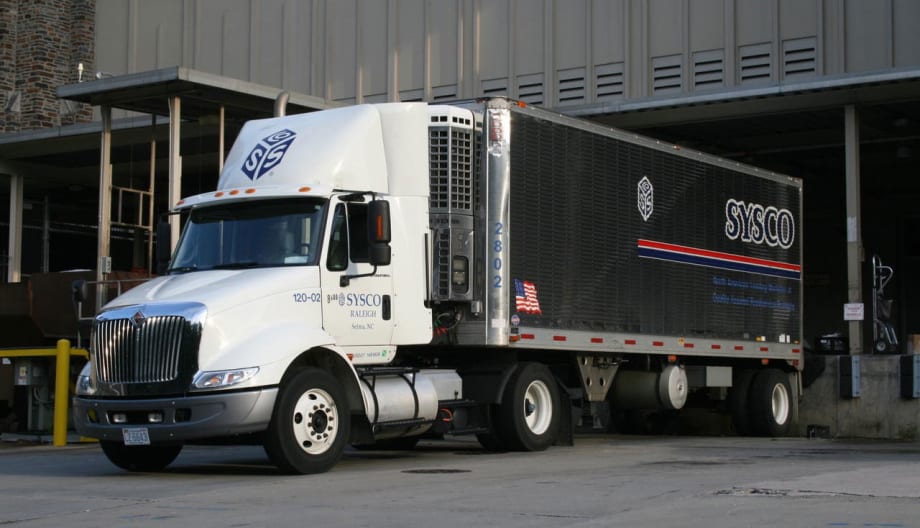
Food-service fleets were hit hard last year by the pandemic when restaurants and entertainment venues closed down.
Photo: Deborah Lockridge
4 min to read
The Centers for Disease Control’s May guidance that fully vaccinated people no longer need to wear masks indoors might prove to be the catalyst for returning the U.S. economy to something close to what we would have recognized in February 2020. Spending on services that involve being around other people has improved steadily this year as the pandemic has faded rapidly and vaccinations have ramped up sharply, but the latest data shows services spending still lagging pre-pandemic levels significantly.
As of March, total consumer spending had finally exceeded spending during the pre-pandemic month of February 2020, specifically by 3.3%. Of course, it took three rounds of stimulus from Washington totaling several trillions of dollars to get there. However, spending on services in April was still 3% below February 2020 while spending on goods was 18.2% higher. Aside from the tight driver market, this surge in spending on goods is the most important factor in why trucking is so strong today.
The industry hit hardest by the pandemic has been the one formally known as “food services and drinking places” – what normal people would call “restaurants and bars.” The industry has strongly recovered this year. Restaurants and bars accounted for 36% of all new U.S. payroll jobs this year through April. Restaurant sales in April were about 27% higher than in December, outpacing total retail and food service sales, which were about 16% higher.
That’s the good news. The bad news starts with the fact that despite this recovery restaurant and bar sales in April had yet to match February 2020, although they were down by only 0.6%. However, the worse news is that the lag in restaurant and bar employment is far larger – 13.5% – despite the recent gains. Carryout, drive-through, and delivery have kept restaurants afloat during the pandemic.
Although restaurants already were gradually reopening in-person dining, the CDC guidance surely will turbocharge that trend. And while restaurants might be the largest single beneficiary of the new guidance, we likely will see more travel and tourism, more conference and business travel, more concerts and movie theater patrons, and more visits to doctors and dentists than we would have otherwise in the near term. All of this means more spending and more jobs.
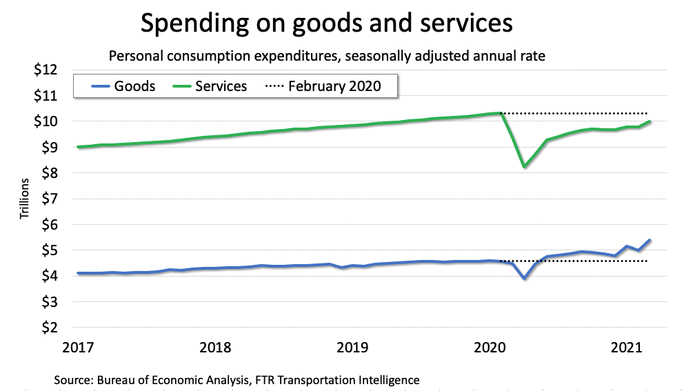
Goods spending has been a boon for most of trucking, as homebound Americans spend money on e-commerce and home renovations.
Graph: FTR
For the “glass half empty” crowd, sharply stronger spending on services sounds like a threat to freight volume. After all, if the substitution of goods for services helped spur freight volume, wouldn’t a reversal of that trend lead to weaker freight volume?
In theory, the shift could hurt freight volume, but we have solid reasons to doubt that will happen. For starters, further recovery in services will fuel a further recovery in employment, which should result in more goods spending by the newly reemployed. Also, trillions in stimulus produced what undoubtedly is the strongest level of consumer savings ever – and by a large margin. That money is available to maintain goods purchasing even if spending on restaurants, travel, etc., soars. Moreover, growth in some services – especially restaurants and bars – should result in a net gain in consumption. For example, we would not expect consumers to reduce their spending on groceries as much as they add spending at restaurants.
However, even if a shift toward services doesn’t hurt goods spending and transportation, freight volume faces a related risk due to another imbalance related to goods. Just as goods spending has greatly outpaced spending on services, spending on durable goods – items like cars, appliances, furniture, and so on – has greatly outpaced spending on nondurable goods, items like food, clothing, gasoline, etc.
Spending on nondurable goods in March was up more than 12% compared to February of last year, but spending on durable goods was up nearly 30%. Although that is great news for 2021, it does raise some red flags about spending on durable goods in 2022 and beyond, given that durable goods are, by definition, long-lasting. The ongoing supply chain challenges might prove to have some upside by postponing consumption to a degree.
Avery Vise is vice president, trucking, at transportation intelligence firm FTR. He contributes an exclusive monthly analysis to HDT. For more information on FTR, visit https://freight.ftrintel.com/heavydutytrucking
More Fleet Management

Sponsored•September 16, 2026
Color Match Smarter: Tools That Restore & Perform
For fleet managers and collision repair professionals keeping heavy-duty trucks on the road, getting the color right the first time isn't just about appearance — it's about efficiency, turnaround time, and bottom-line results. Discover how today's digital color tools are transforming the repair process from guesswork to precision.
Read More →
FMCSA Pauses Biennial-Update Enforcement Amid Motus Transition
Carriers whose updates were due on or after June 1 have more time, while FMCSA works to stabilize its new registration system and warns of phishing sites impersonating its new carrier registration system, Motus.
Read More →
Sponsored•September 14, 2026
2026 Blueprint for Countering Smarter Supply Chain Theft
Cargo theft is no longer just the cost of doing business. It's a multi-billion-dollar criminal enterprise exploiting vulnerabilities across your fleet, drivers, and supply chain.
Read More →


Sponsored•September 1, 2026
How Telematics Improves Visibility, Control, and Performance in Refrigerated Fleets
Explore how telematics help refrigerated fleets improve visibility, uptime, efficiency, compliance, and cargo protection across connected cold chain operations.
Read More →
What the U.S.-Canada Trade War Means for Trucking
Escalating U.S.-Canada tariffs could disrupt cross-border freight, reduce truck volumes, raise costs, and create new uncertainty for carriers on both sides of the border.
Read More →
What Are Trucking’s Top Concerns for 2026?
The American Transportation Research Institute wants to know what's worrying trucking fleet managers, drivers, and other stakeholders in its annual Industry Issues survey.
Read More →
American Trucking Associations Looks for a New Leader
ATA President and CEO Chris Spear abruptly left his job at the association on August 21, at a pivotal time for the trucking industry.
Read More →
Public Wi-Fi Cybersecurity Risks: How Truck Drivers and Fleets Can Protect Their Data
Public Wi-Fi can expose truck drivers and fleets to credential theft, malware, and other cyber threats. Here’s how to reduce the risk on the road.
Read More →
For Nicky Cupp, Fleet Innovation Starts With Frustration
HDT Truck Fleet Innovator Nicky Cupp turns everyday pain points at Fraley & Schilling into opportunities for better technology and smarter processes.
Read More →
Adam Buttgenbach’s Approach to Electric Trucks: Start With Where They Fit
HDT Truck Fleet Innovator Adam Buttgenbach helped PepsiCo build one of North America’s largest EV fleets by focusing on where electric trucks make operational sense.
Read More →