




New Bill Would Set National Freight Transportation Policy
A trio of Democratic Senators introduced legislation that would give freight a seat at the national transportation policy table
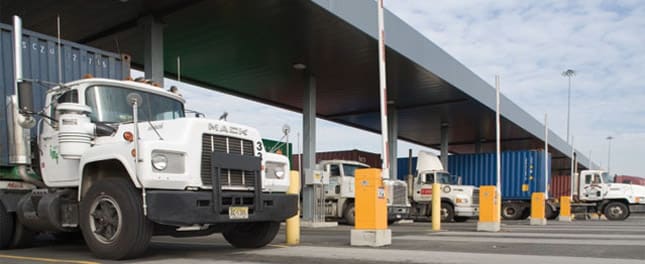
The new bill would aim to reduce delays at international points of entry, make transit times along freight corridors more reliable, improve safety and reducing air pollution. (Photo courtesy of the Port of New York/New Jersey)
A trio of Democratic Senators introduced legislation that would give freight a seat at the national transportation policy table.
The FREIGHT Act of 2010 would for the first time give the country an official freight policy - "to improve the efficiency, operation, and security of the national transportation system to move freight" - and create within the Department of Transportation an Office of Freight Planning and Development, to be run by an assistant DOT secretary.
The bill takes Washington's penchant for acronyms to dizzying new heights - FREIGHT stands Focusing Resources, Economic Investment and Guidance to Help Transportation - but it includes an array of policy initiatives that the freight community has been wanting for a long time.
It would provide a conceptual framework for freight investment and planning, and set goals such as reducing delays at international points of entry, making transit times along freight corridors more reliable, improving safety and reducing air pollution. It also would give DOT two years to develop a National Freight Transportation Strategic Plan that would guide planning and investment.
Another provision would create a merit-based grant program for projects such as port or intermodal facility improvement, rail capacity additions or use of Intelligent Transportation Systems to reduce congestion.
The bill was introduced yesterday by Sen. Frank Lautenberg of New Jersey, who chairs the Surface Transportation Subcommittee of the Senate Commerce Committee. He was joined by co-sponsors Patty Murray and Maria Cantwell of Washington.
"We are long overdue in establishing a national freight transportation policy that will meet the economic and mobility demands of the 21st Century," said Lautenberg in a statement.
"Poor planning and underinvestment in our transportation infrastructure has led to increased congestion at our ports, highways, airports, and increases the cost of doing business," he said. "We need a freight transportation system that works better. This bill would put us on that path."
The legislative path at this point is not clearly marked. Leslie Blakey, executive director of the Coalition for America's Gateways and Trade Corridors, which is supporting the measure, said that the bill could advance as part of pending legislation to reauthorize the federal highway program, or it could move as a stand-alone measure.
"I'm probably not surprising anyone in saying that it seems as though the cards are stacked against (the reauthorization bill moving) any time soon," Blakey said, referencing the difficult political problem of raising the funds that are needed to sustain and grow the national transportation system.
She said this measure was deliberately crafted without references to funding - either how much money is required or how to raise it. That way, Blakey said, the bill can be handled by the Senate Commerce Committee, which has jurisdiction over transportation policy matters. The money question would have to be handled by the Senate Finance Committee, and it might be easier to do that for this bill as a stand-alone measure rather than as a piece of the larger reauthorization bill, she said.
Mortimer Downey, chairman of the Coalition for America's Gateways and former deputy transportation secretary, described the measure as "the most broad-based response" he has seen to the long-standing need to give freight its due place in transportation planning.
"They understand that moving goods is critical to moving the economy," he said.
More Drivers

Truck Drivers Need More Than Another Alert
Fleets have more visibility into truck health, safety events, and driver activity than ever. The next challenge is turning all that information into useful guidance for the person who has to decide what to do next.
Read More →
FMCSA Removes 110 Truck Driver Training Schools from Certified ELDT List
Federal regulators also are targeting more than 160 additional training providers and launching a nationwide audit of third-party CDL skills testers as part of a broader crackdown on trucking fraud.
Read More →
Hours of Service Pilot Programs: FMCSA Readies for 2027 Rollout
Two pilot programs could eventually reshape hours-of-service rules, giving truck drivers options to pause their 14-hour clock or use longer split sleeper rest periods.
Read More →
Medical Cards, English Proficiency Reshape Roadcheck Violations
Medical-card violations jumped to the top of the driver out-of-service list during CVSA’s 2026 International Roadcheck, while English-language proficiency violations appeared among the leading violations for the first time.
Read More →
Driver Trust Can Make or Break the Success of Fleet Safety Technology
New Teletrac Navman research suggests that onboarding, transparency about driver data, and positive feedback can play a significant role in how commercial drivers respond to safety and coaching technology.
Read More →
EEOC Sues KLLM Over Alleged Sex Discrimination in Driver Training
KLLM is facing a federal sex-discrimination lawsuit over policies the EEOC alleges put female truck driver trainees at a disadvantage.
Read More →
FMCSA Moves to Codify English Language Requirements for Commercial Drivers
By changing regulations on English-language proficiency requirements for commercial drivers, rather than relying on a guidance memo, the FMCSA said future administrations won't be able to walk back the Trump administration's stricter enforcement with just a memo.
Read More →
Drivers Put Western Star Trucks to the Test at Star Nation Experience
Watch to get an inside look at the Western Star trucks, technology, and community behind the Star Nation Experience 2026!
Read More →
Trump Administration Looks to Put More Veterans Behind the Wheel
The Freedom Haulers program pulls together existing and expanded programs at several federal agencies to recruit veterans to drive commercial heavy-duty trucks and cut the red tape for them to get a CDL, training, and employment.
Read More →
Putting Mack’s Command Steer to the Test
A test drive of Mack’s Command Steer active steering system evaluates how it can make truck driving easier and less tiring.
Read More →