




New Advisory Panel Broadens Access to CSA Planning
The trucking industry and other interest groups are getting more say in how the Federal Motor Carrier Safety Administration shapes its signature CSA safety enforcement program. At the first meeting of a new CSA advisory panel yesterday, the agency spelled out the help it needs, calling for ideas and suggestions on how to solve such long-standing issues as public access to data, improvements in the data correction system and whether or not carriers should get credit for safety technology
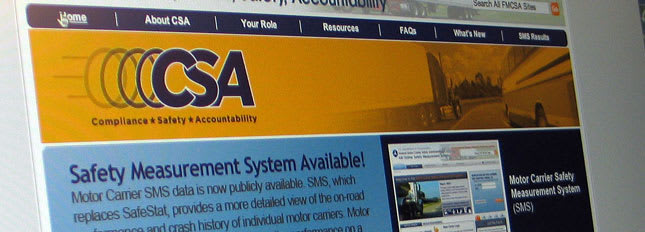
The trucking industry and other interest groups are getting more say in how the Federal Motor Carrier Safety Administration shapes its signature CSA safety enforcement program.
At the first meeting of a new CSA advisory panel yesterday, the agency spelled out the help it needs, calling for ideas and suggestions on how to solve such long-standing issues as public access to data, improvements in the data correction system and whether or not carriers should get credit for safety technology.
The panel is a subcommittee of the Motor Carrier Safety Advisory Committee, a group of 19 officials from industry, the enforcement community and labor and safety advocacy groups that provides counsel to FMCSA on a variety of issues.
David Parker, senior counsel at Great West Casualty, is chairman of the committee and also will chair the CSA Subcommittee.
The shape and size of the subcommittee is not yet clear. At yesterday's meeting in Alexandria, Va., Parker said he believes shippers, brokers, equipment suppliers and others should be involved in the CSA discussions, in addition to interested members of the Advisory Committee. He expects these issues to be resolved by the time of the subcommittee's first meeting in October.
The subcommittee will have a daunting agenda. Keying off on a list presented by the agency, the MCSAC members discussed a broad range of issues they hope to cover, many of which have been in play ever since CSA got under way two years ago.
What FMCSA Wants
Bill Quade, associate administrator for enforcement at FMCSA, outlined the agency's wish list.
It wants advice on how to handle public display of CSA data and messaging, on the thresholds it has established to trigger intervention by enforcement officials, and on whether or not the safety data should take a carrier's area of operation into account.
Also on the agency's agenda: what to do about shortcomings in the DataQs system for correcting errors, particularly with respect to handling violations that have been dismissed by a court.
In addition, the agency asked how it accounts for roadside screening versus a full inspection in the database, and should carriers get credit for using safety technologies such as lane departure warning.
And, should Safety Measurement System data be segmented by the type of operation, such as truckload, less-than-truckload, private carriage, flatbed, rural or urban?
What MCSAC Wants
To this the MCSAC members added a considerable list of their own.
They want to determine if CSA is working as it is supposed to, perhaps by engaging a third party to do an analysis.
They question whether the CSA system should focus on reducing the number of crashes, or on the severity of crashes.
Committee members applauded the agency's effort to roll out CSA to the entire community, but indicated that they would look for ways to improve communications with small carriers.
Other issues: how to lessen disparities in enforcement by the states, and find data that ties specific safety violations to crash risk.
Committee member Danny Schnautz of Clark Freight Lines put on the agenda the issue of shippers using CSA data as a carrier selection tool.
"Among shippers and brokers the (SMS) score is viewed as the Holy Grail," he said. Despite the warnings on the CSA web site about the uses of the data, "the message is not getting through to them."
CSA Improvements
The committee members took time to enumerate the ways CSA has benefited truck safety. They noted that the system is dispensing more data and giving the agency the ability to reach more carriers without a dramatic increase in resources.
It is better than the earlier system, SafeStat, in getting at the worst offenders, and it has led to the start of a cultural change in the industry by forcing carriers to focus on the details of safety management.
The agency already is planning another round of improvements to follow on those it posted last Friday.
It will consider modifying roadside violation severity weights, and changing the way it uses vehicle miles in determining scores for the Crash and Unsafe Driving categories of CSA. In addition, it will consider adjusting safety event groupings in all of the categories.
More Drivers

EEOC Sues Texas Trucking Company Over Driver Age Limits
The agency says Trancasa USA rejected applicants over 65 and applied tougher driving-record standards to those over 60.
Read More →
Nussbaum, Roehl Announce Second Driver Pay Increase This Year
This year has seen a swath of major truck driver pay increases as freight capacity has tightened.
Read More →
From One Generation to the Next: How Mentorship Builds Safer Truck Drivers
After three decades in trucking, Harold Perry shares what he's learned about driver safety, mentorship, and helping the next generation build confidence behind the wheel.
Read More →
Truck Drivers Need More Than Another Alert
Fleets have more visibility into truck health, safety events, and driver activity than ever. The next challenge is turning all that information into useful guidance for the person who has to decide what to do next.
Read More →
FMCSA Removes 110 Truck Driver Training Schools from Certified ELDT List
Federal regulators also are targeting more than 160 additional training providers and launching a nationwide audit of third-party CDL skills testers as part of a broader crackdown on trucking fraud.
Read More →
Hours of Service Pilot Programs: FMCSA Readies for 2027 Rollout
Two pilot programs could eventually reshape hours-of-service rules, giving truck drivers options to pause their 14-hour clock or use longer split sleeper rest periods.
Read More →
Medical Cards, English Proficiency Reshape Roadcheck Violations
Medical-card violations jumped to the top of the driver out-of-service list during CVSA’s 2026 International Roadcheck, while English-language proficiency violations appeared among the leading violations for the first time.
Read More →
Driver Trust Can Make or Break the Success of Fleet Safety Technology
New Teletrac Navman research suggests that onboarding, transparency about driver data, and positive feedback can play a significant role in how commercial drivers respond to safety and coaching technology.
Read More →
EEOC Sues KLLM Over Alleged Sex Discrimination in Driver Training
KLLM is facing a federal sex-discrimination lawsuit over policies the EEOC alleges put female truck driver trainees at a disadvantage.
Read More →
FMCSA Moves to Codify English Language Requirements for Commercial Drivers
By changing regulations on English-language proficiency requirements for commercial drivers, rather than relying on a guidance memo, the FMCSA said future administrations won't be able to walk back the Trump administration's stricter enforcement with just a memo.
Read More →