





Watch: Driving International’s LT Linehaul Tractor [Video]
Navistar Bullish on Truck Market as it Reports Strong Third-Quarter Results
Navistar is bullish on the trucking industry and its own growth, as truck orders appear to show no signs of slowing and the company reports its Class 8 market share is up 2.7 points over a year ago while its 13L heavy engine share more than doubled.
September 6, 2018

Navistar officials said the new International LT is driving an increase in Class 8 market share.
Photo: Navistar
5 min to read
Navistar is bullish on the trucking industry and its own growth, as truck orders appear to show no signs of slowing and the company reports its Class 8 market share is up 2.7 points over a year ago while its 13L heavy engine share more than doubled.
In its third-quarter 2018 earnings call on Sept. 6, Navistar reported higher revenues, led by a 25% increase in its truck segment for its fiscal quarter ending July 31. Net income rose to $170 million, up from $37 million a year ago. Profit in the truck segment alone rose to $165 million, from $7 million a year ago.
Navistar is predicting that Class 8 truck sales industry-wide will end 2018 between 260,000 and 280,000, and projects 2019 to be about the same, in the 255,000-285,000 range. That compares to 207,000 in 2017.
For Class 6/7 medium, Navistar is projecting sales of 95,000 for this year and next, up from 86,000 in 2017.
Troy Clarke, Navistar chairman, president and CEO, pointed out that economic conditions are ripe for industry growth, with GDP expansion of 4.1% the strongest since 2014, July consumer confidence the highest since 2000, and the purchase manager’s index on manufacturing the highest since 2004.
“These conditions support fleet utilization, higher freight rates, and improved carrier profits,” he told investor analysts and reporters in the call. “It’s just a great time to be in the truck business.”
For the quarter ending July 31, Navistar officials said, its retail market share in the U.S. and Canada for Class 8 heavy trucks was 13%, up from 10% a year ago. Number for medium-duty Class 6/7 were down from 25% to 22%, but officials pointed out that the new MV model for that market, announced in the spring, only started taking orders in July, so it expects that metric to improve.
Clarke also pointed to record industry-wide July Class 8 truck orders of more than 52,000, and said there are industry backlogs into the second quarter of 2019. Some skeptics, he said, are questioning whether these all will actually be built, or if some are placeholders for fleets wanting to make sure they will have build slots, or stock unit orders for dealers. “These are all good questions,” he said. “At Navistar we attempt to manage reporting of orders as accurately as possible, and we don’t expect a lot of cancellations.”
With the increasing popularity of the new International LT on-highway tractor, and July being the first month of orders for the new medium-duty MV, Clarke said, “we took in a lot of orders in Q3, July in particular, but cancellations have remained very stable for the last 18 months. We expect to build the units in our backlog.”
Most of the orders continue to be for replacement trucks, Clarke said, as new models get much better fuel economy than the four- or five-year-old trucks they are replacing. But he’s also seeing an increasing number for fleet expansion, even in the face of a driver shortage.
“There is a piece of that reflecting fleet expansion, reflecting GDP growth and a shift in mode toward more dedicated transport, which at the end of the day requires more trucks and fleet growth.”
He expects to see more of that starting this fall. “I think as we roll in to our fiscal 2019, we will see fleet expansion for a handful of reasons. To me that’s the best environment had in the eight years I’ve worked here.”
Production during the third quarter was hampered by supplier constraints, but company officials said they have worked through many of those issues and now face a delivery backlog. These supplier disruptions resulted in units not produced, or trucks that were built but not shipped because they were still awaiting a part, Clarke explained. As it increased build rates, the company had to work with a handful of suppliers to bring more capacity online, resource some work to other suppliers, and improve its productivity.
“The issues related to these suppliers are behind us,” he said, but officials are continuing to closely monitor the overall supply chain for components and parts, which remains tight for the industry.
“The industry is basically running without buffers, so things like power outages or breakdowns can cause problems,” he said. “But they remain minor in scale and we believe we have realistic view of supplier capacity.”
Rising raw materials costs, especially for steel, are so far being offset by hedging, long-term contracts, and cost reductions, especially through Navistar’s joint procurement deal with Traton Group (formerly Volkswagen Truck & Bus.) Nevertheless, the company announced a 1% to 3% price increase in July across its brands. Those increases won’t take effect until sometime in 2019 because of the large backlog. Clarke explained that while part of the increase is due to increased material and other costs, it also reflects the improved quality of the product line, which is now entirely new or updated.
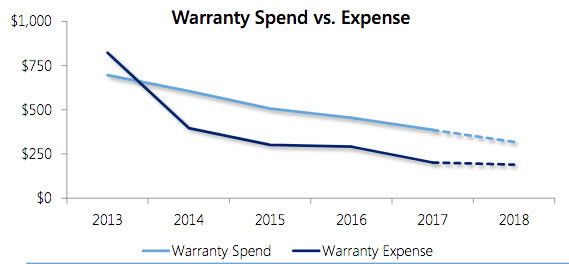
Navistar continues to make progress on the legacy issues that have dogged it. Warranty expense for the quarter (excluding pre-existing claims) as a percentage of revenue was 1.7%, down from 2.4% a year earlier. It still has some 1,100 of the MaxxForce 13 engines in inventory, but that’s down from last year.
Revenues were up in Navistar’s parts business compared to a year earlier, although net profit was down. The company saw double-digit growth in its Fleetrite branded all-makes components, as it shifts its revenue mix in the parts business to more private-label brand sales.
Navistar’s global operations saw a slight increase in revenue and profit, as economic conditions have improved in Brazil, while the financial services business profits were about the same on slightly higher revenue.
More Equipment

How Volvo Updated Its D13 for EPA 2027 [Watch]
Volvo’s updated D13 promises lower emissions without sacrificing performance or fuel economy. Take a closer look at what changed inside the engine in this HDT Spotlight video.
Read More →
Michelin Tire Improves Efficiency and Durability for Regional Fleets
The Michelin X Multi Energy D2 is a regional haul drive tire engineered to help fleets improve fuel efficiency, durability and traction in demanding stop-and-go operations.
Read More →
ZF Expands Commercial Vehicle Push in North America
ZF is expanding its North American commercial-vehicle presence with new transmission applications, electrification, trailer technology and autonomous-driving systems.
Read More →
Tesla Wants a Self-Driving Semi. Are Cameras Enough?
Could Tesla’s camera-only autonomous driving technology work on an 80,000-pound Semi? In this commentary, HDT's Deborah Lockridge takes a look at Tesla, Cybercab, and how autonomous trucks see the road.
Read More →
Kodiak: Driverless Long-Haul Truck Launch on Track for 2026
Kodiak AI says its driverless long-haul safety case is 93% complete and it remains on track to begin commercial operations by year-end 2026.
Read More →
What DOT’s Automated Vehicle Strategy Means for Trucking
The U.S. Department of Transportation issued a new automated-vehicle strategy that outlines plans for driverless-truck regulations, cross-state freight corridors, and federal safety standards.
Read More →
East Coast Port Launches $45M Electric Truck Push
The Port Authority of New York and New Jersey announced millions in incentives for zero-emission drayage trucks, yard tractors, and new charging hubs near the port.
Read More →
PlusAI Going Public to Fund Autonomous Truck Launch
A SPAC deal could provide PlusAI with up to $300 million as it works toward a 2027 commercial launch of factory-built autonomous trucks.
Read More →
NHTSA Moves to Rewrite Truck Fuel-Economy Rules
The National Highway Traffic Safety Administration says it lacks authority to regulate medium- and heavy-duty truck engines separately from complete vehicles, but the existing standards have not yet been eliminated.
Read More →
Detroit Opens Orders for EPA 2027 Engines
Detroit isn’t starting from scratch to meet EPA 2027 diesel emissions standards. Its Gen 6 DD13 and DD15 engines keep much of today’s platform while updating the fuel and aftertreatment systems.
Read More →