




Natural Gas Expected To Grow Despite Diesel Price Drop
Looking at the most likely adoption curve, ACT believes Class 8 penetration is expected to total 23% of the units sold in 2025.
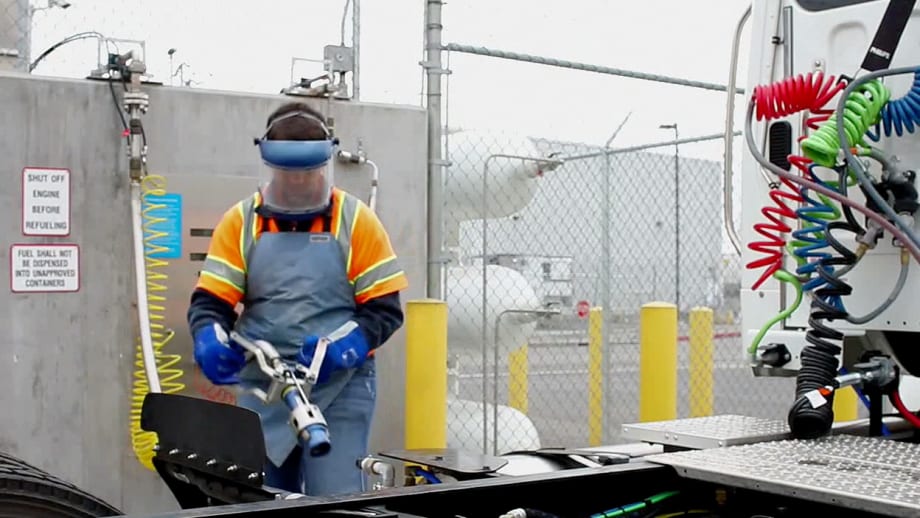
Fueling a natural gas powered heavy truck.

With the natural gas powered vehicle market seemingly stalled as diesel fuel prices have fallen much of the year the trucking industry research firm ACT Research has released the results of its updated findings on U.S. natural gas transportation fuel trends in the heavy duty truck market.
The report entitled, “NG Reality Check: Moving from Infancy to Adolescence,” is a comprehensive, forward-looking long-term analysis on the use of natural gas as fuel in the U.S. heavy Class 8 truck transportation sector, according to the firm.
ACT published its first comprehensive natural gas study in 2012. It was more bullish than this latest report, said ACT, reflecting the enthusiasm of the moment that included planned market and product development that has been slow to materialize with a narrowing fuel price spread and improving diesel engine fuel economy gains.
“The previous long-term penetration over-statement does not mean natural gas has not grown. It has and will continue to grow, but at a slower rate the next few years.” said Ken Vieth, ACT Research senior partner and general manager. “Natural gas Class 8 truck/transit bus penetration was 3% in 2013 and should reach 4% in 2014, or about 11,000 units.”
Looking at the most likely adoption curve, ACT believes Class 8 penetration is expected to total 23% of the units sold in 2025. If the total new U.S. Class 8 truck/transit bus market is 200,000 units that year, then the natural gas market would be 46,000 units.
“That’s a large quantity that will be shared by those with an understanding of tomorrow’s truck transportation needs and plans to get there,” said Veith, “Depending upon the emissions and greenhouse gas needs of the nation and the regulations put in place in coming years to achieve those needs, Natural gas penetration could even be higher since natural gas is equally available and is a cleaner, cheaper fuel than diesel.”
The report provides forecasts, insights and supporting analysis on major trends already taking place such as:
Natural gas engine technologies,
Natural gas fuel preference,
Infrastructure design, from fuel only to full service and fuels,
Emerging infrastructure investors and early natural gas adopters,
Return-on-investment adjustments as fuel cost spreads and up-charges change,
Miles per gallon versus cost per mile and
Shipper-trucker relationships from contracts to diesel fuel surcharges to going green and more.
More information about the report, including details on obtaining a copy, is on the ACT Research website.
More Fuel Smarts

Cummins Adjusts 2027 Engine Rollout After EPA Proposal
The engine maker will gradually introduce its new Model Year 2027 diesel engines while continuing to offer current models during the transition, citing the EPA's proposed emissions rule changes.
Read More →
EPA Proposal Could Ease 2027 Truck Costs and Buying Uncertainty
The proposal doesn't change the tougher NOx standard, but it would revise key implementation requirements that manufacturers say have driven up costs and complicated fleet purchasing decisions.
Read More →
Cummins, Paccar Ease DEF Derates After EPA Guidance
Updated diesel engine software gives truck operators more time to address emissions-system issues while staying compliant with EPA emissions standards.
Read More →
Maintenance in the Messy Middle Part 3: Biodiesel
Biodiesel can reduce emissions, improve fuel-system lubricity and use existing diesel infrastructure. But NACFE’s Messy Middle maintenance report says fleets must actively manage storage, cold-weather operation, filters and oil drain intervals to avoid problems.
Read More →
Enhance Fleet Performance with High-Efficiency Auxiliary Power Units
Drive sustainable cost savings while increasing driver comfort during short- and long-haul logistics operations.
Read More →
Maintenance in the ‘Messy Middle’ Part 2: Renewable Diesel Fuel
NACFE's latest Messy Middle Powertrain Service & Maintenance report says renewable diesel gives fleets an opportunity to reduce carbon emissions without changing trucks, fueling infrastructure or maintenance practices. But technicians still need to understand several important operational differences.
Read More →
The Diesel Engine Enters NACFE’s ‘Messy Middle’
NACFE’s new Messy Middle Powertrain Service & Maintenance report says keeping modern diesel engines running now depends as much on software, diagnostics and data as traditional mechanical service.
Read More →
DTNA Software Update Gives Truckers More Time Before DEF Derates Take Effect
The changes reflect EPA guidance aimed at reducing downtime caused by emissions-system faults while maintaining compliance requirements.
Read More →
New Agentic Predictive Maintenance Report Demonstrates How Degraded Aftertreatment Systems Waste Fuel
Questar analyzed a large mixed-class fleet and discovered it was wasting as much as $30 in fuel per vehicle, per day, because of mechanically degraded aftertreatment systems.
Read More →
New York City's Microhub Project is Delivering Results
Trucking, last-mile delivery companies, and environmental advocates like what they are seeing so far with New York's microhub program.
Read More →