





“Driver availability no longer is the key issue to watch in trucking conditions.”
Mixed Numbers on Trucking Conditions
FTR's Trucking Conditions Index from April and the Cass Transportation Indexes for May identify trends such as job growth and economic conditions that could point to a weakening after a nearly two-year cycle of surging freight volumes.
June 20, 2022
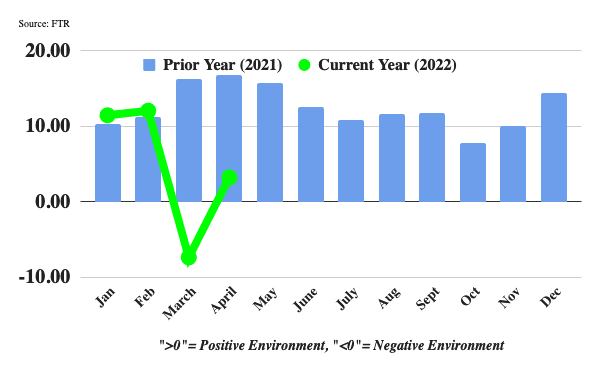
April's trucking conditions bounced back from a dismal March, but are still well below last year.
Source: FTR
4 min to read
FTR's Trucking Conditions Index from April and the Cass Transportation Indexes for May both identify trends such as job growth and economic conditions that could point to a weakening after a nearly two-year cycle of surging freight volumes.
The Trucking Conditions Index rebounded to a reading of 3.21 from March when the index fell to -7.38. However, the April reading otherwise was weak — the lowest since July 2020, not counting March’s negative reading.
The TCI tracks the changes representing five major conditions in the U.S. truck market: freight volumes, freight rates, fleet capacity, fuel prices, and financing costs. The individual metrics are combined into a single index indicating the industry’s overall health.
Diesel prices in April were relatively stable, FTR pointed out, "but softer capacity utilization and freight rates made for positive but lackluster market conditions for trucking companies," it said in a news release.
The outlook is mildly positive in the near term, but ongoing fuel price increases and other factors could result in further negative readings, according to the transportation research firm.
“Recent strong gains in trucking’s payroll employment support our analysis that freight demand has remained solid and that weaker spot market metrics this year indicate a shift of activity back to more normal route guides,” said Avery Vise, FTR’s vice president of trucking. “Driver availability no longer is the key issue to watch in trucking conditions; increasingly, the principal question will be the resilience of freight demand. Downside risks are high and growing due to inflation and related stresses, but our forecasting model so far is not identifying a downturn.”
ACT Research: Turbulent Environment
ACT Research still believes a soft landing is the U.S. economy’s most likely path, but "the potential for a mild recession is becoming an increasingly compelling alternative," according to its latest North American Commercial Vehicle Outlook.
“We find ourselves in a turbulent environment, where still significant positive and increasingly negative economic forces are crashing into one another," said Kenny Vieth, ACT’s president and senior analyst. "With inflationary shocks emanating from Ukraine, the Fed’s task of engineering a soft landing has become increasingly challenging.”
ACT believes downward pressures are building and the probability of recession continues to grow.
“With the current head of steam that includes healthy consumer and business balance sheets, strong employment demand, and pent-up manufacturing sector activity, this inflation-driven economic slowdown is on one hand somewhat unique," Vieth explained. "On the other, traditional recession predictors are in play: Fed rate hikes, high energy prices, negative exogenous events, and falling equity valuations come to mind.”
Cass Freight Index
Looking at its May data, Cass Information Systems says after a nearly two-year cycle of surging freight volumes, two key drivers of growth for the freight cycle — goods consumption and inventory restocking — are faltering.
Combined with a major improvement in driver availability (27,300 new jobs added in the past two months), all signs continue to point to a change in the trajectory of rates in the coming months.
The Cass Transportation Indexes measure changes in North American freight activity and costs based on $37 billion in paid freight expenses for the Cass customer base of hundreds of large shippers.
The shipments component of the Cass Freight Index rose 5.4% m/m in May (up 4% seasonally adjusted), more than recovering the 2.6% decline in April. Normal seasonality would see that rise 2% year over year in June and flat to up 1% for 2022. "The news from the retail sector and in the oil markets suggest that’s probably optimistic, but at this point, it’s a pretty stable environment," Cass said, with no sign of a major downturn.

A simple calculation of the Cass Freight Index data (expenditures divided by shipments) produces a data set of inferred freight rates that explains the overall movement in rates (specifically, the cost of a shipment).
Source: Cass Information Systems
Cass Inferred Freight Rates fell 9.5% m/m on a seasonally adjusted basis in May.
“It’s tempting to see this as a sign that freight costs have peaked, and on a year-over-year basis that is true, as inferred rates will slow all the way to 13% year-over-year in June on normal seasonality," Cass said. "Supply/demand fundamentals have certainly turned looser this year, so it wouldn’t be an unreasonable conclusion. However... the drop was largely due to mix [less-than-truckload vs. truckload], and with fuel prices still adding upward pressure, the descent is not straightforward.”
The 15% year-over-year decline in rates (excluding fuel surcharges) in the more real-time spot markets in early June portends a downcycle on the horizon, according to Cass.
This year has seen a big improvement in driver availability and a flattening of freight demand, which means freight rates will drop, Cass predicted — though it will take several months to filter from the spot market into contract rates.
However, equipment capacity remains limited and could tighten further if the Russia/Ukraine war or China lockdowns worsen the chip shortage.
More Fleet Management

Why Private Fleets Are Taking More Freight
Private fleets are putting their own trucks on demanding customers and high-cost lanes as companies seek greater control over service, costs, and capacity.
Read More →
Sponsored•September 16, 2026
Color Match Smarter: Tools That Restore & Perform
For fleet managers and collision repair professionals keeping heavy-duty trucks on the road, getting the color right the first time isn't just about appearance — it's about efficiency, turnaround time, and bottom-line results. Discover how today's digital color tools are transforming the repair process from guesswork to precision.
Read More →
FMCSA Pauses Biennial-Update Enforcement Amid Motus Transition
Carriers whose updates were due on or after June 1 have more time, while FMCSA works to stabilize its new registration system and warns of phishing sites impersonating its new carrier registration system, Motus.
Read More →


Sponsored•September 14, 2026
2026 Blueprint for Countering Smarter Supply Chain Theft
Cargo theft is no longer just the cost of doing business. It's a multi-billion-dollar criminal enterprise exploiting vulnerabilities across your fleet, drivers, and supply chain.
Read More →
Sponsored•September 1, 2026
How Telematics Improves Visibility, Control, and Performance in Refrigerated Fleets
Explore how telematics help refrigerated fleets improve visibility, uptime, efficiency, compliance, and cargo protection across connected cold chain operations.
Read More →
What the U.S.-Canada Trade War Means for Trucking
Escalating U.S.-Canada tariffs could disrupt cross-border freight, reduce truck volumes, raise costs, and create new uncertainty for carriers on both sides of the border.
Read More →
What Are Trucking’s Top Concerns for 2026?
The American Transportation Research Institute wants to know what's worrying trucking fleet managers, drivers, and other stakeholders in its annual Industry Issues survey.
Read More →
American Trucking Associations Looks for a New Leader
ATA President and CEO Chris Spear abruptly left his job at the association on August 21, at a pivotal time for the trucking industry.
Read More →
Public Wi-Fi Cybersecurity Risks: How Truck Drivers and Fleets Can Protect Their Data
Public Wi-Fi can expose truck drivers and fleets to credential theft, malware, and other cyber threats. Here’s how to reduce the risk on the road.
Read More →
For Nicky Cupp, Fleet Innovation Starts With Frustration
HDT Truck Fleet Innovator Nicky Cupp turns everyday pain points at Fraley & Schilling into opportunities for better technology and smarter processes.
Read More →