




Minnesota Ups Biodiesel Mandate to 10%
Starting Tuesday, Minnesota, the first state to require biodiesel be blended with diesel sold in the state, will require all diesel fuel in the state to contain 10% biodiesel.
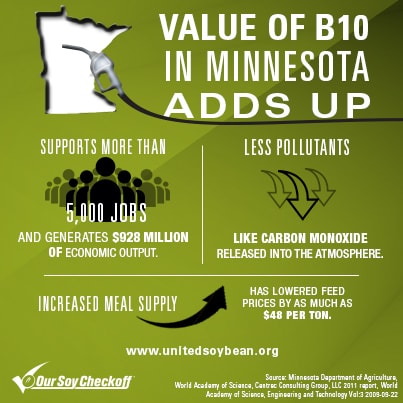
The state agriculture industry has been a big supporter of Minnesota's biodiesel mandate.
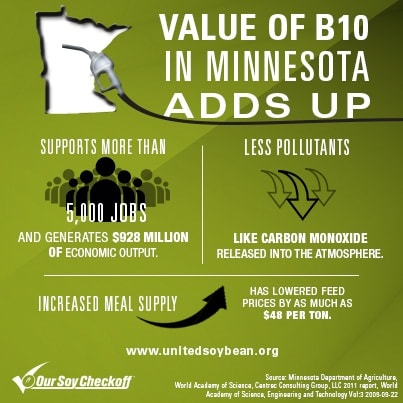
The state agriculture industry has been a big supporter of Minnesota's biodiesel mandate.
Starting Tuesday, Minnesota, the first state to require biodiesel be blended with diesel sold in the state, will require all diesel fuel in the state to contain 10% biodiesel. An exception will be made in the winter, when the requirement will be 5%.
The state trucking association criticized the move.
"We will be alone in the nation with a 10 percent mandate," John Hausladen, president of the Minnesota Trucking Association, told the Pioneeer Press. "We believe that the biodiesel industry is mature and can stand on its own. It does not need a mandate now, and it's time to phase out the mandate, not increase it."
Previously, the state required diesel fuel to contain at least 5% biodiesel -- 2% during the winter.
Biodiesel in this country is most often made from soybean oil, and Minnesota ranks third in soybean production in the nation.
When biodiesel made its debut in Minnesota nearly a decade ago, some poor-quality fuel led to clogged fuel filters, angry truckers, and emergency waivers of the new law. However, the biodiesel industry says the quality problem has long been solved.
The problems did result in delays for the higher blends. Originally, state lawmakers wanted all diesel fuel to contain 10% biodiesel by 2012 and 20% by 2015.
A B20 mandate is still on the books for 2018.
Hausladen noted that some industries are exempt from the mandate, including railroads, mining and logging.
Sixteen other states now have mandates or tax incentives to blend biodiesel with petroleum-based diesel, according to the National Biodiesel Board. Illinois offers a tax break to blend biodiesel at 10 percent or more, but only Minnesota mandates that high of a blend.
The move comes as nationally, biodiesel advocates are pushing the Obama Administration to continue growing biodiesel volumes under the Renewable Fuel Standard.
We asked engine makers whether the new mandate should be of any concern. Mack and Volvo said the use of biodiesel up to a maximum of 20% (B20) in and of itself, will not affect the manufacturer's mechanical warranty as to engine and emissions system related components, provided the biofuel used in the blend conforms to ASTM D6751, B1 to B5 blends conform to ASTM D975, and B6 to B20 blends conform to ASTM D7467.
More Fuel Smarts

How Volvo Updated Its D13 for EPA 2027 [Watch]
Volvo’s updated D13 promises lower emissions without sacrificing performance or fuel economy. Take a closer look at what changed inside the engine in this HDT Spotlight video.
Read More →
Diesel Price Spike Shortens Payback for Natural Gas Trucks, Report Says
Energy Vision estimates fleets could recover the higher purchase price of an RNG-fueled Class 8 tractor in 1.3 to 2.8 years under current fuel-price scenarios.
Read More →
Calstart Becomes Catalyst Mobility, Reflecting Broader Focus
Calstart is now Catalyst Mobility, reflecting the nonprofit’s growing national role in clean transportation, including zero-emission trucks, infrastructure and incentive programs.
Read More →

Record Diesel Prices Squeeze Trucking Fleets
Average U.S. diesel prices have climbed to nearly $6 a gallon, surpassing the 2022 record as tight refinery capacity and Middle East disruptions keep fuel costs elevated.
Read More →
How Fuel Delivery Shapes Engine Performance
Fuel delivery depends on more than what happens at the injector. For fleet, maintenance and technical professionals, looking at the full path from pump to injector can provide useful context for understanding engine performance.
Read More →
East Coast Port Launches $45M Electric Truck Push
The Port Authority of New York and New Jersey announced millions in incentives for zero-emission drayage trucks, yard tractors, and new charging hubs near the port.
Read More →
California Bill Could Shed Light on Electric Truck Prices
Why do battery-electric Class 8 trucks remain so expensive? A California bill headed to Gov. Gavin Newsom would give fleets and state agencies more visibility into what manufacturers charge.
Read More →
Detroit Opens Orders for EPA 2027 Engines
Detroit isn’t starting from scratch to meet EPA 2027 diesel emissions standards. Its Gen 6 DD13 and DD15 engines keep much of today’s platform while updating the fuel and aftertreatment systems.
Read More →
Zero-Emission Truck Corridor Planned for West Coast
California, Oregon, Washington, British Columbia and Baja California are coordinating plans for truck charging and hydrogen fueling from Canada to Mexico.
Read More →
A Closer Look at Kenworth’s Electric T880E Vocational Truck [Video]
Learn more about Kenworth's T880E battery-electric vocational truck at the Paccar Technical Center, including its range, applications, upfitting considerations, and PTO options, in this HDT Spotlight video.
Read More →