




Mercedes Fuel Cell Trucks Go to Work in Europe
Daimler Truck has begun initial customer trials with five Mercedes-Benz GenH2 Trucks in Europe with Air Products, Amazon, Holcim, INEOS and Wiedmann & Winz.

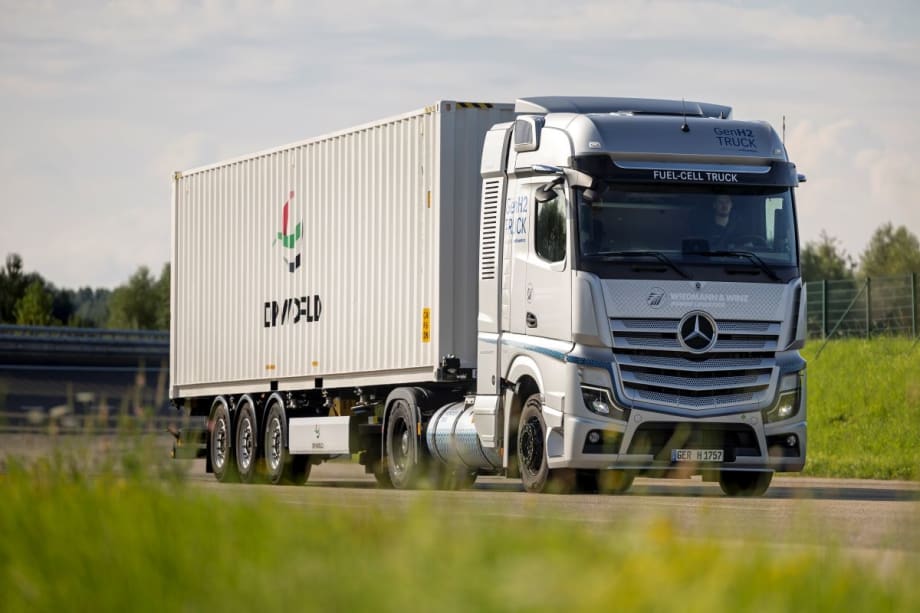
Mercedes-Benz has begun initial customer trials in Germany with its Actros GenH2 hydrogen fuel cell trucks.
Photo: Daimler Truck
At the Daimler Truck Test and Development Center in Woerth am Rhein, Gemany, Martin Daum, Chairman of the Board of Management of Daimler Truck, celebrated the start of the initial customer trials of five Mercedes-Benz GenH2 Truck fuel cell prototype trucks. With Daum were Hildegard Müller, President of the German Association of the Automotive Industry (VDA), with Air Products, Amazon, Holcim, INEOS and Wiedmann & Winz.
According to Daimler, these customers have the opportunity to gain practical experience in long-distance transport with fuel cell trucks at an early stage, during a trial phase of around one year.
The Daimler Truck development team will also acquire valuable insights into the real-life operations of trucks powered by liquid hydrogen, learns about specific customer requirements and can take them into account for series development.
Long-Haul Applications
The five GenH2 Trucks will be deployed in different long-haul applications on specific routes in Germany, such as the transport of building materials, sea containers or cylinder gases.
During these first customer trials the vehicles will remain under the direct supervision and responsibility of the manufacturer.
The trucks will be refueled at the designated liquid hydrogen filling stations (sLH2) in Woerth am Rhein (Rhineland-Palatinate) and in future also in the Duisburg area (North-Rhine Westphalia).
“When it comes to decarbonizing transport, we are focusing on battery-electric and hydrogen-based drives, Daum said. “The transformation can only succeed if green energy is sufficiently and comprehensively available – and for this we need both technologies. With regard to hydrogen drives, we are now taking another important step towards series readiness: we are starting the trials of our Mercedes-Benz GenH2 Trucks in real-life daily transport operations with our customers. However, it is important to note that high-performance CO2-neutral vehicles alone will not be enough to make sustainable transportation successful. This also requires a corresponding charging and refueling infrastructure, as well as cost parity with conventional vehicles. Although policymakers and energy companies are already active here, we urgently need even more momentum, across entire Europe!”
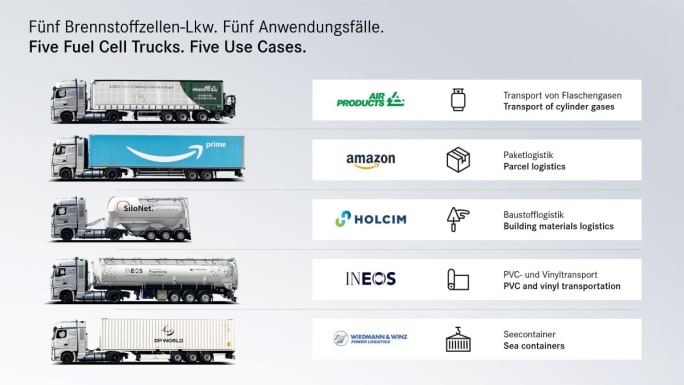
The Mercedes-Benz GenH2 trucks are deployed in five different applications -- all of which are long-haul operations.
Chart: Daimler Truck
The five semi-trailer tractors will be used by customers in various long-haul applications throughout the trial period.
Amazon will use the GenH2 Truck in its logistics operations in Germany. Air Products for the transport of cylinder gases. Wiedmann & Winz for sea containers. Holcim for building materials logistics, and VERVAEKE – the logistics company of INEOS – for PVC and vinyl transportation.
Actros Design Platform
GenH2 Truck performance is comparable with conventional long-haul trucks, Daimler said.
The development engineers of Daimler Truck have based the GenH2 Truck on the characteristics of the conventional Mercedes-Benz Actros long-haul truck in terms of payload, range and performance.
The Mercedes-Benz GenH2 Trucks, which are used in these first customer trials, offer a payload of approximately 25 tons at a gross combination weight (GCW) of 40 tons.
Two special liquid hydrogen tanks and a powerful fuel-cell system by Cellcentric, the Joint Venture of Daimler Truck and Volvo Group, enable the high payload and long range. They represent the centerpiece of the GenH2 Truck.
The fuel-cell system of the GenH2 Truck delivers 300 kilowatts (2 x150 kW) and the battery provides an additional 400 kW temporarily. At 70 kWh, the storage capacity of the battery is relatively low, as it is not intended to meet energy needs, but mainly to be switched on to provide situational power support for the fuel cell, for example during peak loads while accelerating or while driving uphill fully loaded.
At the same time, the relatively light battery allows a higher payload, Daimler said. It is recharged with braking energy and excess fuel-cell energy.
A core element of the sophisticated operating strategy of the fuel-cell and battery system is a cooling and heating system that keeps all components at a suitable operating temperature, thus ensuring maximum durability.
In a pre-series version, the two electric motors are designed for a total of 2 x 230 kW continuous power and 2 x 330 kW maximum power. The GenH2 Truck thereby delivers a torque of 2 x 1,577 Nm or 2 x 2,071 Nm.
The two stainless-steel liquid-hydrogen tanks of the GenH2 Truck have a particularly high storage capacity of 88 kilograms (44 kg each), perfectly suited for covering long distances. The stainless-steel tank system consists of two tubes, one within the other, that are vacuum isolated and connected to each other.
The liquid hydrogen enables a range of 1,000 kilometers or more Daimler said.
Liquid Hydrogen Focus
Daimler Truck prefers liquid hydrogen in the development of hydrogen-based drives. In this aggregate state the energy carrier has a significantly higher energy density, the OEM said.
As a result, more hydrogen can be carried, which significantly increases the range and enables comparable performance of the vehicle with that of a conventional diesel truck.
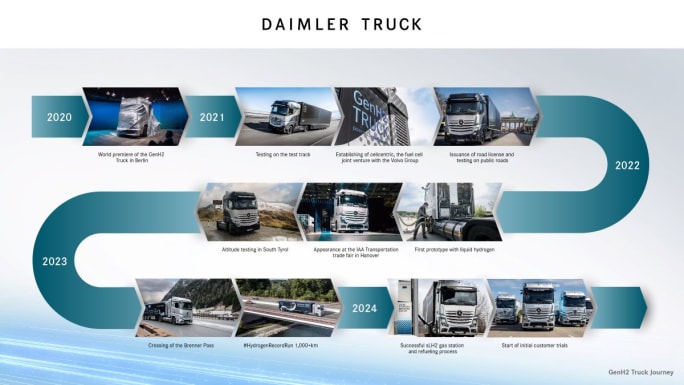
Mercedes-Benz fuel cell trucks are entering fleet trials after a four-year development cycle.
Chart: Daimler Truck
Also, according to Daimler, transportation efforts can be significantly reduced with liquid hydrogen, and liquid hydrogen tanks also offer advantages in terms of cost and weight compared to compressed gaseous hydrogen.
Thus, the use of liquid hydrogen enables a higher payload. This makes the Mercedes-Benz GenH2 Truck just as suitable for flexible and demanding long-haul road transportation as conventional diesel trucks, Daimler claimed.
In September 2023, Daimler Truck said it successfully demonstrated this when a public road approved prototype of the Mercedes-Benz GenH2 Truck completed the #HydrogenRecordRun, covering 1,047 km with one tank filling of liquid hydrogen on board.
More Fuel Smarts

How Volvo Updated Its D13 for EPA 2027 [Watch]
Volvo’s updated D13 promises lower emissions without sacrificing performance or fuel economy. Take a closer look at what changed inside the engine in this HDT Spotlight video.
Read More →
Diesel Price Spike Shortens Payback for Natural Gas Trucks, Report Says
Energy Vision estimates fleets could recover the higher purchase price of an RNG-fueled Class 8 tractor in 1.3 to 2.8 years under current fuel-price scenarios.
Read More →
Calstart Becomes Catalyst Mobility, Reflecting Broader Focus
Calstart is now Catalyst Mobility, reflecting the nonprofit’s growing national role in clean transportation, including zero-emission trucks, infrastructure and incentive programs.
Read More →

Record Diesel Prices Squeeze Trucking Fleets
Average U.S. diesel prices have climbed to nearly $6 a gallon, surpassing the 2022 record as tight refinery capacity and Middle East disruptions keep fuel costs elevated.
Read More →
How Fuel Delivery Shapes Engine Performance
Fuel delivery depends on more than what happens at the injector. For fleet, maintenance and technical professionals, looking at the full path from pump to injector can provide useful context for understanding engine performance.
Read More →
East Coast Port Launches $45M Electric Truck Push
The Port Authority of New York and New Jersey announced millions in incentives for zero-emission drayage trucks, yard tractors, and new charging hubs near the port.
Read More →
California Bill Could Shed Light on Electric Truck Prices
Why do battery-electric Class 8 trucks remain so expensive? A California bill headed to Gov. Gavin Newsom would give fleets and state agencies more visibility into what manufacturers charge.
Read More →
Detroit Opens Orders for EPA 2027 Engines
Detroit isn’t starting from scratch to meet EPA 2027 diesel emissions standards. Its Gen 6 DD13 and DD15 engines keep much of today’s platform while updating the fuel and aftertreatment systems.
Read More →
Zero-Emission Truck Corridor Planned for West Coast
California, Oregon, Washington, British Columbia and Baja California are coordinating plans for truck charging and hydrogen fueling from Canada to Mexico.
Read More →
A Closer Look at Kenworth’s Electric T880E Vocational Truck [Video]
Learn more about Kenworth's T880E battery-electric vocational truck at the Paccar Technical Center, including its range, applications, upfitting considerations, and PTO options, in this HDT Spotlight video.
Read More →