





Related: Do Your Trailers Have Legal RIGs with Labels That Say So?
Major Trailer Makers Score Top Underride Guard Rating
IIHS has awarded its top underride guard rating to Great Dane, Hyundai Translead, Manac, Stoughton Trailers, Strick Trailers, Utility Trailer Manufacturing, Vanguard National Trailer, and Wabash National, representing 80% of trailers on the road.
September 28, 2018
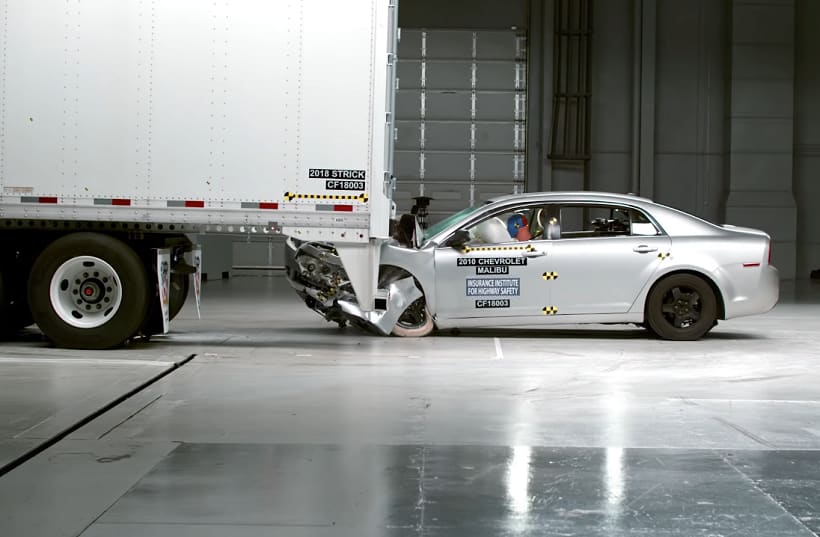
Eight major trailer manufacturers have all recieved the IIHS ToughGuard award for the highest rated underride guard safety rating.
Photo: Insurance Institute for Highway Safety
2 min to read
The Insurance Institute for Highway Safety has awarded its top underride guard rating to eight major trailer manufacturers, Great Dane, Hyundai Translead, Manac, Stoughton Trailers, Strick Trailers, Utility Trailer Manufacturing, Vanguard National Trailer, and Wabash National, representing 80% of trailers on the road.
To qualify for the IIHS ToughGuard award, trailers must have rear guards that prevent underride of a midsize car in three test modes: full-width, 50% overlap, and 30% overlap. In each test, a midsize car travels at 35 m.p.h. toward the back of a parked semitrailer.
In the full-width test, which all trailers were able to pass in the initial round of testing, the car strikes the center of the guard head-on. In the 50% overlap, which all but one trailer passed initially, half of the car's front end strikes the guard. In the 30% overlap, the toughest evaluation, 30% of the car's front strikes the corner of the trailer.
Trailers on U.S. roads are required to have underride guards that meet federal safety standards and also meet a more stringent Canadian regulation. Despite this, IIHS research showed that even guards that met these requirements could buckle or break off in a crash.
At first, only one trailer underride guard was able to pass the 30% overlap test in testing. However, all other companies made updates to their guards and requested retests. By the time IIHS announced the ToughGuard award last year, five of the eight guards met the criteria. Today, all eight designs meet the criteria. Some of the manufacturers have made the improved guards standard on all new trailers, while in other cases they are optional.
In the full-width test, which all trailers were able to pass in the initial round of testing, the car strikes the center of the guard head-on. In the 50% overlap, which all but one trailer passed initially, half of the car's front end strikes the guard. In the 30% overlap, the toughest evaluation, 30 percent of the car's front strikes the corner of the trailer.
"We're pleased that all the major manufacturers responded positively to our underride tests," says David Zuby, IIHS chief research officer. "By improving their guards, these companies have demonstrated a commitment to the safety of passenger vehicle occupants who share the road with their trailers."
More Safety & Compliance

FMCSA Pauses Biennial-Update Enforcement Amid Motus Transition
Carriers whose updates were due on or after June 1 have more time, while FMCSA works to stabilize its new registration system and warns of phishing sites impersonating its new carrier registration system, Motus.
Read More →
ZF Expands Commercial Vehicle Push in North America
ZF is expanding its North American commercial-vehicle presence with new transmission applications, electrification, trailer technology and autonomous-driving systems.
Read More →
Truck Drivers Need More Than Another Alert
Fleets have more visibility into truck health, safety events, and driver activity than ever. The next challenge is turning all that information into useful guidance for the person who has to decide what to do next.
Read More →
Tesla Wants a Self-Driving Semi. Are Cameras Enough?
Could Tesla’s camera-only autonomous driving technology work on an 80,000-pound Semi? In this commentary, HDT's Deborah Lockridge takes a look at Tesla, Cybercab, and how autonomous trucks see the road.
Read More →
What DOT’s Automated Vehicle Strategy Means for Trucking
The U.S. Department of Transportation issued a new automated-vehicle strategy that outlines plans for driverless-truck regulations, cross-state freight corridors, and federal safety standards.
Read More →
NYC Expands Speed, Pedestrian Safety Tech Across Fleet
New York City is expanding intelligent speed assistance and pedestrian-alert systems across its municipal fleet, moving the technologies from pilot programs into vehicle procurement and retrofit requirements.
Read More →
FMCSA Removes 110 Truck Driver Training Schools from Certified ELDT List
Federal regulators also are targeting more than 160 additional training providers and launching a nationwide audit of third-party CDL skills testers as part of a broader crackdown on trucking fraud.
Read More →
Beyond DOT Compliance: What Makes a Trucking Fleet Truly Safe?
A trucking fleet can follow every rule and still make unsafe decisions. The real test comes when safety conflicts with freight, productivity, or cost.
Read More →
Hours of Service Pilot Programs: FMCSA Readies for 2027 Rollout
Two pilot programs could eventually reshape hours-of-service rules, giving truck drivers options to pause their 14-hour clock or use longer split sleeper rest periods.
Read More →
New Guide Offers Pet Safety Tips for Truck Drivers
Hundreds of thousands of pets travel in truck cabs. A new safety guide from Volvo Trucks and the Center for Pet Safety offers practical advice for truck drivers who bring dogs and cats along for the ride.
Read More →