




Related: Mack Announces Over The Air Remote Powertrain Updates
Mack Adds More Configurations to the Granite MHD Truck Lineup
Mack Trucks has added new features to its Granite Medium Heavy Duty (MHD) truck, aimed at increasing its versatility and enabling more cost effective choices for customers that need a durable and light work truck.
by Staff
March 7, 2018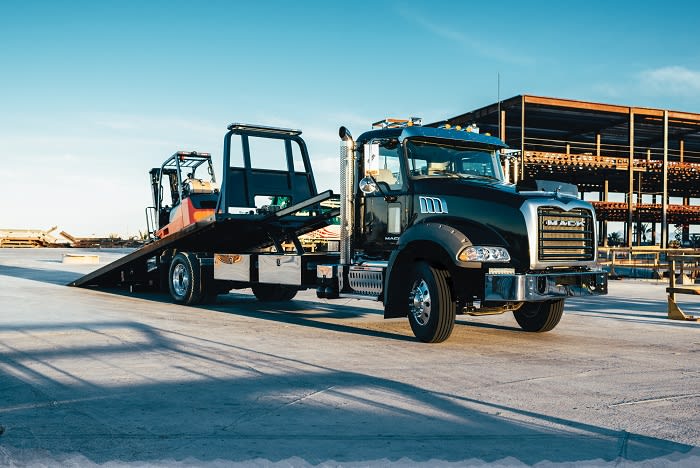
Mack Trucks today announced several new enhancements to its Mack Granite Medium Heavy Duty (MHD) model, increasing its versatility. Photo: Mack Trucks
2 min to read
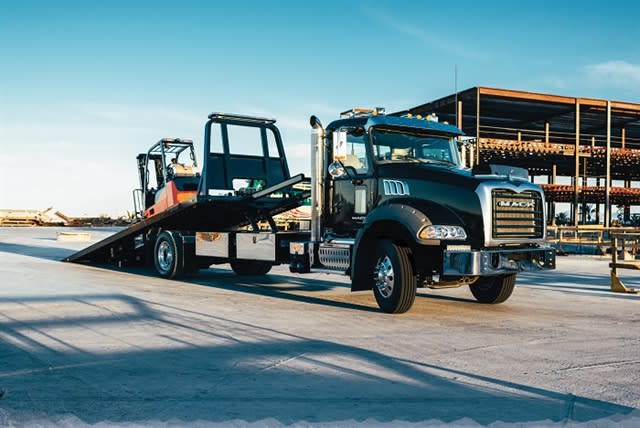
Mack Trucks today announced several new enhancements to its Mack Granite Medium Heavy Duty (MHD) model, increasing its versatility.Photo: Mack Trucks
Mack Trucks has added new features to its Granite Medium Heavy Duty (MHD) truck, aimed at increasing its versatility and enabling more cost effective choices for customers that need a durable and light work truck.
The enhancements include a new horsepower rating, under-frame exhaust system, a shorter wheelbase 4x2 configuration, and a tractor configuration to expand the applications coverage for the MHD.
“Vocational customers have a wide variety of needs,” said Tim Wrinkle, Mack Trucks construction product manager. “Some require lighter weight options but still need their trucks to meet the difficult demands of the application. The MHD model delivers both without compromise.”
The MHD, equipped with the Cummins L9 engine, now features a lower horsepower option, allowing customers to spec an engine with 330 horsepower and up to 1,000 ft.-lbs. of torque. The lower horsepower rating offers customers another option that may increase return on investment.
A new under-frame exhaust gives customers more options for body adaptation, further expanding application capabilities, such as tankers, flatbeds, box trucks, cranes, and certain municipal applications.
The MHD model can be spec’d as a Class 7 or Class 8 vehicle, is offered in either an axle back or axle forward configuration, and is available as a 4x2 or 6x4, offering customers the flexibility to choose between a heavy-duty and a lighter-weight medium-duty option. An axle back tractor option meets the needs of light tractor applications requiring maneuverability, flexibility, and durability without extra weight.
A shorter wheelbase is also now available for the MHD model in the 4x2 configuration, ideal for the 10-foot dump body commonly used in municipal applications, and providing a more maneuverable, cost-effective option.
More Equipment

Used-Truck Remarketing Math Is Changing
Used-truck value is no longer just a concern at trade-in. Decisions made throughout a truck’s first life can influence what it’s worth years later.
Read More →
How Volvo Updated Its D13 for EPA 2027 [Watch]
Volvo’s updated D13 promises lower emissions without sacrificing performance or fuel economy. Take a closer look at what changed inside the engine in this HDT Spotlight video.
Read More →
Michelin Tire Improves Efficiency and Durability for Regional Fleets
The Michelin X Multi Energy D2 is a regional haul drive tire engineered to help fleets improve fuel efficiency, durability and traction in demanding stop-and-go operations.
Read More →
ZF Expands Commercial Vehicle Push in North America
ZF is expanding its North American commercial-vehicle presence with new transmission applications, electrification, trailer technology and autonomous-driving systems.
Read More →
Tesla Wants a Self-Driving Semi. Are Cameras Enough?
Could Tesla’s camera-only autonomous driving technology work on an 80,000-pound Semi? In this commentary, HDT's Deborah Lockridge takes a look at Tesla, Cybercab, and how autonomous trucks see the road.
Read More →
Kodiak: Driverless Long-Haul Truck Launch on Track for 2026
Kodiak AI says its driverless long-haul safety case is 93% complete and it remains on track to begin commercial operations by year-end 2026.
Read More →
What DOT’s Automated Vehicle Strategy Means for Trucking
The U.S. Department of Transportation issued a new automated-vehicle strategy that outlines plans for driverless-truck regulations, cross-state freight corridors, and federal safety standards.
Read More →
East Coast Port Launches $45M Electric Truck Push
The Port Authority of New York and New Jersey announced millions in incentives for zero-emission drayage trucks, yard tractors, and new charging hubs near the port.
Read More →
PlusAI Going Public to Fund Autonomous Truck Launch
A SPAC deal could provide PlusAI with up to $300 million as it works toward a 2027 commercial launch of factory-built autonomous trucks.
Read More →
NHTSA Moves to Rewrite Truck Fuel-Economy Rules
The National Highway Traffic Safety Administration says it lacks authority to regulate medium- and heavy-duty truck engines separately from complete vehicles, but the existing standards have not yet been eliminated.
Read More →