




Related: Link Introduces Intelligent Semi-Active Cab Suspension
Link to Roll Out Intelligent Auxiliary Suspension Systems
Link Mfg. said it plans to bring to market next year a family of automated ROI self-steer and non-steer auxiliary suspension systems that will "increase asset utilization, reduce training time, improve safety, and will be compatible with OEM and aftermarket integration."
by Heavy Duty Trucking Staff
September 12, 2021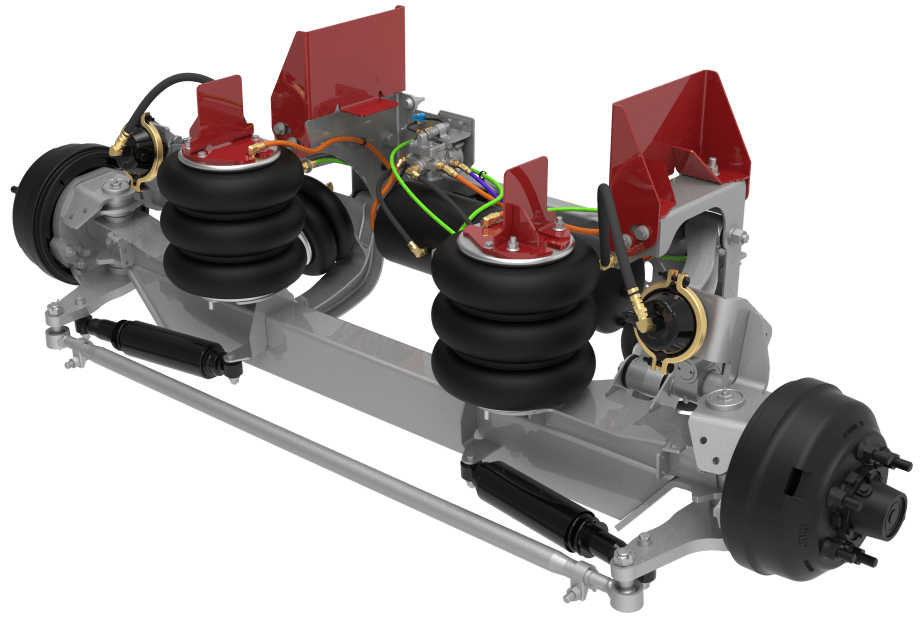
Link 8K SS auxiliary suspension is among a family of intelligent suspensions systems to be brought to market next year.
Credit:
Link Mfg.
3 min to read
Link Mfg. Ltd. announced what it said will become “the industry’s first family of intelligent auxiliary suspension systems” on Sept. 12 here at the Technology & Maintenance Council Fall Meeting in Cleveland. The automated ROI self-steer and non-steer auxiliary suspension systems will “increase asset utilization, reduce training time, improve safety, and will be compatible with OEM and aftermarket integration,” according to the company.
With field testing in progress, Link Mfg. said it expects to make the 8K, 10K, 13.5K and 20K ROI auxiliary suspensions commercially available in 2022.
The company said the point of being “intelligent” is that using a traditional auxiliary suspension system generally requires a significant amount of guesswork, even for experienced drivers. And in the face of driver shortages and diminished experience levels, human error is common. While most systems allow the deployment pressure to be manually set, those auxiliary suspensions are still binary; that is to say they are either up or down.
“If an auxiliary suspension system is engaged when not needed, it can cause the tires to drag, or ‘scrub,’ negatively affecting tire wear, gas mileage and maintenance intervals,” said Mike Leakey, Link’s vice president of sales and marketing. “Conversely, if auxiliary axles are not deployed when needed, the vehicle may not comply with local bridge laws, and the vehicle and its occupants may even be exposed to dangerous mechanical forces.”
Link developed its new, smart load-balancing suspensions using its proprietary Road Optimized Innovation (ROI) technology. First introduced in the company’s ROI Cabmate Cab Suspension in 2019, the ROI Auxiliary Suspension System will sense and maintain optimal tire-to-ground pressure, reducing tire wear and maximizing fuel mileage. The company added that with this intelligent load-balancing auxiliary suspension system, “the guesswork of when to lift or lower is removed so even inexperienced drivers can maintain maximum traction without overloading the axles.”
“Link’s ROI technology is able to sense when the vehicle’s load has changed and automatically deploys or retracts the auxiliary suspension system as needed,” Eli DeGroff, product manager, Road Optimized Innovations for Link said. “Unlike traditional all-on or all-off auxiliary axles, Link’s smart suspensions are able to determine the load they need to bear and automatically adjust to precisely accommodate that weight.”
Link now introducing an all-new smart suspension system at #TMC.
Uses advanced electronic sensors - gives optimal tire to-ground pressure for improved fuel economy. Real-time load monitoring automatically shifts loads & traction to drive axles. Big help in snow and mud. pic.twitter.com/JuBf24NO4t— Jack Roberts (@By_JackRoberts) September 12, 2021
Intelligent suspensions like Link’s new 8K, 10K, 13.5K and 20K auxiliary offerings will automatically respond to the vehicle’s wheel traction and don’t need to be manually retracted. In snow, mud and other challenging conditions, Link said its ROI technology, working in conjunction with the vehicle’s ABS, will sense the absence of surface friction and will reduce pressure as needed to shift the requisite tractive force to the drive axles.
“With Link’s ROI Auxiliary Suspension System, fleets will be able to get new drivers trained and working in less time,” said Leakey. “Exceeding axle ratings can be dangerous as well as costly due to unscheduled maintenance and fines. Now even novice drivers can avoid these issues, maintaining safety and efficiency.”
Link said its intelligent auxiliary suspensions will be suitable for trucks and tractors in the heavy-duty, on-highway and off-highway segments, including dump bodies, cement trucks, roll-off trucks and other vocational applications.
For its initial aftermarket product launch, Link is designing a Bodybuilder Package that has the control system integrated into the suspension. Link’s patented Swift Mount technology, coupled with its Bodybuilder Package, will give upfitters and bodybuilders the ability to install one of its intelligent auxiliary axles in less time than traditional auxiliary suspension installations, according to the company.
“Using Link suspensions with ROI technology, fleets and owner-operators can expect superior handling, better fuel mileage, reduced tire wear, more uptime, and a lower overall cost of ownership,” added Leakey.
More Equipment

How Volvo Updated Its D13 for EPA 2027 [Watch]
Volvo’s updated D13 promises lower emissions without sacrificing performance or fuel economy. Take a closer look at what changed inside the engine in this HDT Spotlight video.
Read More →
Michelin Tire Improves Efficiency and Durability for Regional Fleets
The Michelin X Multi Energy D2 is a regional haul drive tire engineered to help fleets improve fuel efficiency, durability and traction in demanding stop-and-go operations.
Read More →
ZF Expands Commercial Vehicle Push in North America
ZF is expanding its North American commercial-vehicle presence with new transmission applications, electrification, trailer technology and autonomous-driving systems.
Read More →
Tesla Wants a Self-Driving Semi. Are Cameras Enough?
Could Tesla’s camera-only autonomous driving technology work on an 80,000-pound Semi? In this commentary, HDT's Deborah Lockridge takes a look at Tesla, Cybercab, and how autonomous trucks see the road.
Read More →
Kodiak: Driverless Long-Haul Truck Launch on Track for 2026
Kodiak AI says its driverless long-haul safety case is 93% complete and it remains on track to begin commercial operations by year-end 2026.
Read More →
What DOT’s Automated Vehicle Strategy Means for Trucking
The U.S. Department of Transportation issued a new automated-vehicle strategy that outlines plans for driverless-truck regulations, cross-state freight corridors, and federal safety standards.
Read More →
East Coast Port Launches $45M Electric Truck Push
The Port Authority of New York and New Jersey announced millions in incentives for zero-emission drayage trucks, yard tractors, and new charging hubs near the port.
Read More →
PlusAI Going Public to Fund Autonomous Truck Launch
A SPAC deal could provide PlusAI with up to $300 million as it works toward a 2027 commercial launch of factory-built autonomous trucks.
Read More →
NHTSA Moves to Rewrite Truck Fuel-Economy Rules
The National Highway Traffic Safety Administration says it lacks authority to regulate medium- and heavy-duty truck engines separately from complete vehicles, but the existing standards have not yet been eliminated.
Read More →
Detroit Opens Orders for EPA 2027 Engines
Detroit isn’t starting from scratch to meet EPA 2027 diesel emissions standards. Its Gen 6 DD13 and DD15 engines keep much of today’s platform while updating the fuel and aftertreatment systems.
Read More →