




Link Introduces Intelligent Semi-Active Cab Suspension
Link has introduced the ROI Cabmate Semi-Active Cab Suspension, a more advanced version of its Cabmate cab suspension that features technology that actively improves ride quality and responds to road and weather conditions.

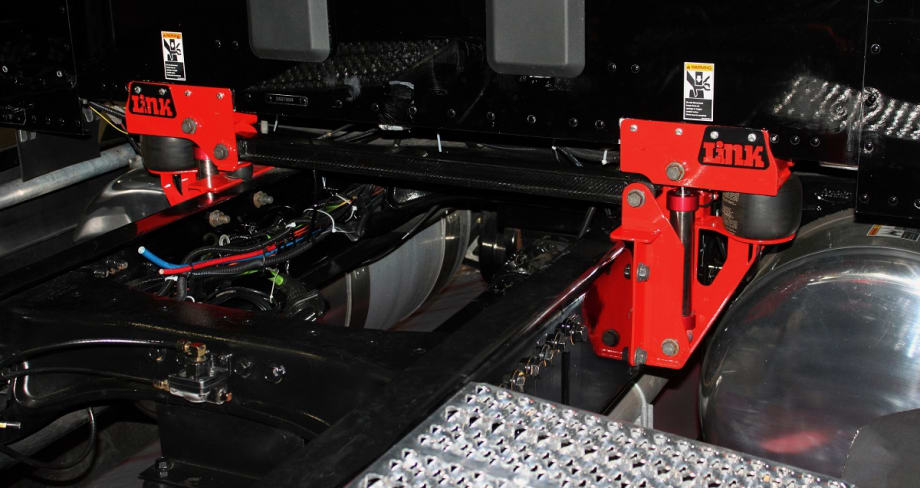
Link has introduced its ROI Cabmate Semi-Active Cab Suspension, a more advanced version of its Cabmate cab suspension that features technology that actively improves ride quality and responds to road and weather conditions.
Photos: Jim Park
Link Mfg., provider of specially-engineered suspensions, has introduced its ROI Cabmate Semi-Active Cab Suspension, a more advanced version of its Cabmate cab suspension that features Link’s Road-Optimized Innovations technology to improve ride quality and respond to road and weather conditions.
The ROI Cabmate Semi-Active Cab Suspension employs multiple sensors to constantly assess environmental circumstances and respond simultaneously. An accelerometer monitors the motion of the cab, while a position sensor measures the position and velocity of the cab relative to the frame.
Using Link’s proprietary algorithms, the system’s electronic control unit interprets the stream of information from all sensors in real time, and responds by continuously adjusting the stiffness of shock absorbers and by filling or exhausting air from the system’s air springs to optimize ride stability and comfort. The entire ROI system operates on less than 10 watts of power.
After transitioning from on- to off-highway conditions, cabs can sustain structural damage, vehicles can become harder to handle and drivers can be forced to decrease speed to avoid losing control, according to Link. The ROI Cabmate Semi-Active Cab Suspension can help prevent health risks, handling impediments and asset destruction that decrease worker satisfaction, productivity and revenue potential.
Bill Ott, Link’s vice president of engineering, said while the suspension is physically consistent no matter which OEM cab is used, each installation is tweaked for that application.
"Our testing has identified specific characteristics of various OE chassis suspensions," said Ott. "So we have optimized the damping characteristics to suit the application."
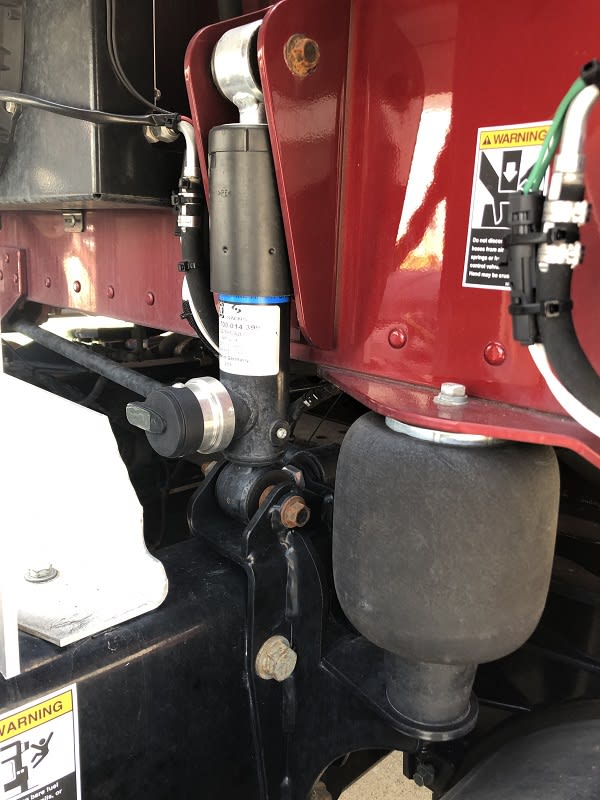
The ROI Cabmate Semi-Active Cab Suspension employs multiple sensors to constantly assess environmental circumstances and respond simultaneously.
Seating is often thought of as the primary interface between the driver and the chassis. And while seating can do much to improve the ride quality for the driver, it serves only the driver.
"Seating only helps maintain driver stability, it does nothing to stabilize what surrounds the driver," said Michael Hof, Link's vice president of business development. "What about vehicle electronics or the driver in the sleeper? Seating won't do much for them, but a better cab suspension can really help there."
The ROI Cabmate Semi-Active Cab Suspension System also features electronic height control. The system minimizes air consumption compared to traditional height control valves, because it does not fill or exhaust air in response to dynamic suspension motion. The system is designed to produce a better overall ride regardless of road surfaces and atmospheric forces, such as wind shear.
“Fleets will find numerous advantages associated with any vehicle fitted with Link’s ROI Cabmate Semi-Active Cab Suspension System, beginning with protection of the driver and the whole-cab asset,” said Hof. “Reducing driver and vehicle fatigue and enhancing ergonomics may enable operators to traverse an uneven route more quickly and safely, enabling productivity to rise and additional runs to be made in a single shift.”
More Equipment

How Volvo Updated Its D13 for EPA 2027 [Watch]
Volvo’s updated D13 promises lower emissions without sacrificing performance or fuel economy. Take a closer look at what changed inside the engine in this HDT Spotlight video.
Read More →
Michelin Tire Improves Efficiency and Durability for Regional Fleets
The Michelin X Multi Energy D2 is a regional haul drive tire engineered to help fleets improve fuel efficiency, durability and traction in demanding stop-and-go operations.
Read More →
ZF Expands Commercial Vehicle Push in North America
ZF is expanding its North American commercial-vehicle presence with new transmission applications, electrification, trailer technology and autonomous-driving systems.
Read More →
Tesla Wants a Self-Driving Semi. Are Cameras Enough?
Could Tesla’s camera-only autonomous driving technology work on an 80,000-pound Semi? In this commentary, HDT's Deborah Lockridge takes a look at Tesla, Cybercab, and how autonomous trucks see the road.
Read More →
Kodiak: Driverless Long-Haul Truck Launch on Track for 2026
Kodiak AI says its driverless long-haul safety case is 93% complete and it remains on track to begin commercial operations by year-end 2026.
Read More →
What DOT’s Automated Vehicle Strategy Means for Trucking
The U.S. Department of Transportation issued a new automated-vehicle strategy that outlines plans for driverless-truck regulations, cross-state freight corridors, and federal safety standards.
Read More →
East Coast Port Launches $45M Electric Truck Push
The Port Authority of New York and New Jersey announced millions in incentives for zero-emission drayage trucks, yard tractors, and new charging hubs near the port.
Read More →
PlusAI Going Public to Fund Autonomous Truck Launch
A SPAC deal could provide PlusAI with up to $300 million as it works toward a 2027 commercial launch of factory-built autonomous trucks.
Read More →
NHTSA Moves to Rewrite Truck Fuel-Economy Rules
The National Highway Traffic Safety Administration says it lacks authority to regulate medium- and heavy-duty truck engines separately from complete vehicles, but the existing standards have not yet been eliminated.
Read More →
Detroit Opens Orders for EPA 2027 Engines
Detroit isn’t starting from scratch to meet EPA 2027 diesel emissions standards. Its Gen 6 DD13 and DD15 engines keep much of today’s platform while updating the fuel and aftertreatment systems.
Read More →