





Kodiak Robotics Demonstrates Tire Blowout on Self-Driving Truck
Kodiak is Taking its Autonomous Truck Tech Public
Autonomous trucking technology company Kodiak Robotics announced it is going public via a special purpose acquisition company, or SPAC.
April 15, 2025
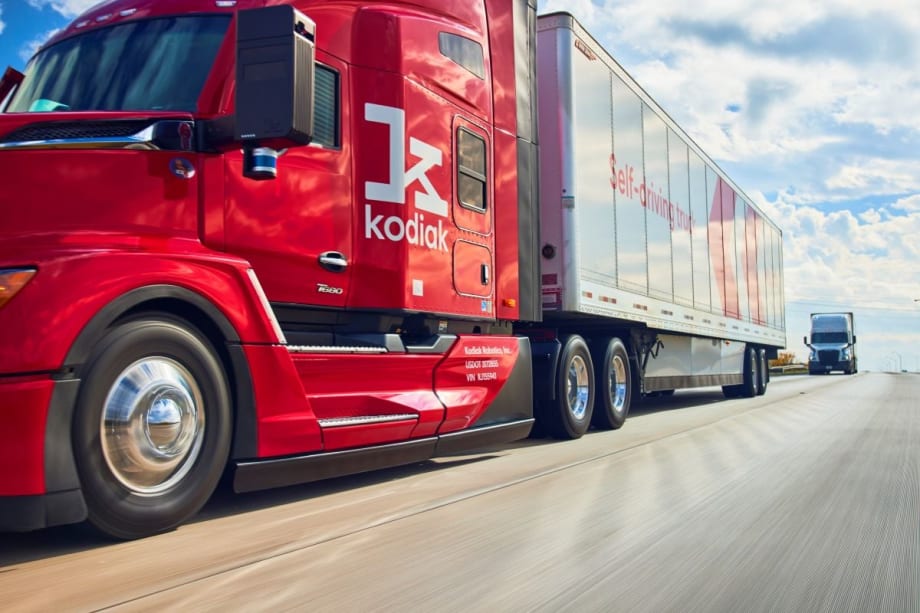
Kodiak Robotics, founded in 2018, is becoming a publicly traded company.
Photo: Kodiak
3 min to read
Autonomous trucking technology company Kodiak Robotics announced it is going public via a special purpose acquisition company, or SPAC.
Kodiak Inc. and Ares Acquisition Corporation II announced they have entered into a definitive business combination agreement through which Kodiak will become a publicly listed company.
Kodiak was founded in 2018 by industry veteran Don Burnette. He called this “a remarkable milestone [that] reinforces our confidence in the significant value proposition we see in our differentiated driverless technology.
“We believe entering the public markets will accelerate our strategy to expand our existing partner relationships, provide our technology to a broader customer base, and deliver enhanced solutions across the commercial trucking and public sector industries.”
Kodiak's Automated Driving System
Kodiak’s single-platform automated driving system, the Kodiak Driver, combines advanced AI-driven software with modular hardware.
The Kodiak Driver integrates learnings from real-world experience across commercial trucking and public sector applications to continuously improve its AI models. It has logged over 2.6 million autonomous miles in real-world conditions.
Kodiak’s platform is designed to enable technology integration with customers’ existing operations, providing a flexible, scalable, Driver-as-a-Service solution.
Kodiak’s Driver-as-a-Service business model charges customers either a per truck or per mile recurring license fee. Today, Kodiak earns recurring revenue through its partnership with Atlas and owns and operates autonomous trucks that generate a fee paid per delivery.
Kodiak's Autonomous Tech in Action
In 2024, Kodiak said it believed it was the first company to announce delivery of a driverless trucking product to a customer.
Through its partnership with Atlas Energy Solutions, Kodiak-powered driverless trucks have achieved more than 750 hours of commercial driverless operations across West Texas's Permian Basin without a human driver on board.
Kodiak expects to support Atlas in further expanding its fleet this year. Last month, Atlas committed to order an initial 100 trucks.
In addition to Atlas, Kodiak has collaborated with major industry players such as Bridgestone, C.R. England, J.B. Hunt, Martin Brower, and Werner Enterprises.
In addition, Kodiak was awarded a contract by the U.S. Department of Defense and has received approximately $30 million to adapt its autonomous technology for U.S. Army vehicles.
More About the Deal Taking Kodiak Public
Today, Kodiak’s lane network operates primarily in the Sunbelt region, serving some of the most freight-dense lanes in the U.S.
Kodiak estimates a roughly $1 trillion market opportunity in the U.S. alone, with the potential for a total global addressable market of over $4 trillion.
New and existing Kodiak institutional investors including Soros Fund Management, ARK Investments and Ares have funded or committed over $110 million in financing to support the transaction alongside approximately $551 million of cash held in trust
Additionally, existing Kodiak investor ARK Investments has expressed its continued support of Kodiak. Kodiak was featured in ARK's Big Ideas 2025 report.
The boards of directors of both Kodiak and AACT have unanimously approved the proposed business combination, which is expected to close in the second half of 2025, subject to approval by AACT and Kodiak stockholders and customary closing conditions.
Upon closing, the combined company will be named Kodiak AI Inc.
More Equipment

How Volvo Updated Its D13 for EPA 2027 [Watch]
Volvo’s updated D13 promises lower emissions without sacrificing performance or fuel economy. Take a closer look at what changed inside the engine in this HDT Spotlight video.
Read More →
Michelin Tire Improves Efficiency and Durability for Regional Fleets
The Michelin X Multi Energy D2 is a regional haul drive tire engineered to help fleets improve fuel efficiency, durability and traction in demanding stop-and-go operations.
Read More →
ZF Expands Commercial Vehicle Push in North America
ZF is expanding its North American commercial-vehicle presence with new transmission applications, electrification, trailer technology and autonomous-driving systems.
Read More →
Tesla Wants a Self-Driving Semi. Are Cameras Enough?
Could Tesla’s camera-only autonomous driving technology work on an 80,000-pound Semi? In this commentary, HDT's Deborah Lockridge takes a look at Tesla, Cybercab, and how autonomous trucks see the road.
Read More →
Kodiak: Driverless Long-Haul Truck Launch on Track for 2026
Kodiak AI says its driverless long-haul safety case is 93% complete and it remains on track to begin commercial operations by year-end 2026.
Read More →
What DOT’s Automated Vehicle Strategy Means for Trucking
The U.S. Department of Transportation issued a new automated-vehicle strategy that outlines plans for driverless-truck regulations, cross-state freight corridors, and federal safety standards.
Read More →
East Coast Port Launches $45M Electric Truck Push
The Port Authority of New York and New Jersey announced millions in incentives for zero-emission drayage trucks, yard tractors, and new charging hubs near the port.
Read More →
PlusAI Going Public to Fund Autonomous Truck Launch
A SPAC deal could provide PlusAI with up to $300 million as it works toward a 2027 commercial launch of factory-built autonomous trucks.
Read More →
NHTSA Moves to Rewrite Truck Fuel-Economy Rules
The National Highway Traffic Safety Administration says it lacks authority to regulate medium- and heavy-duty truck engines separately from complete vehicles, but the existing standards have not yet been eliminated.
Read More →
Detroit Opens Orders for EPA 2027 Engines
Detroit isn’t starting from scratch to meet EPA 2027 diesel emissions standards. Its Gen 6 DD13 and DD15 engines keep much of today’s platform while updating the fuel and aftertreatment systems.
Read More →