





Related: Q&A: Kenworth’s Baney on Innovating Amidst Rapid Change
Kenworth Highlights Fuel-Cell Electric Truck at NACV Show
This year's slowdown in truck sales, the rapid pace of technological change, and Kenworth's fuel-cell electric truck project were the highlights of Kenworth's remarks to reporters at the North American Commercial Vehicle Show.
October 28, 2019
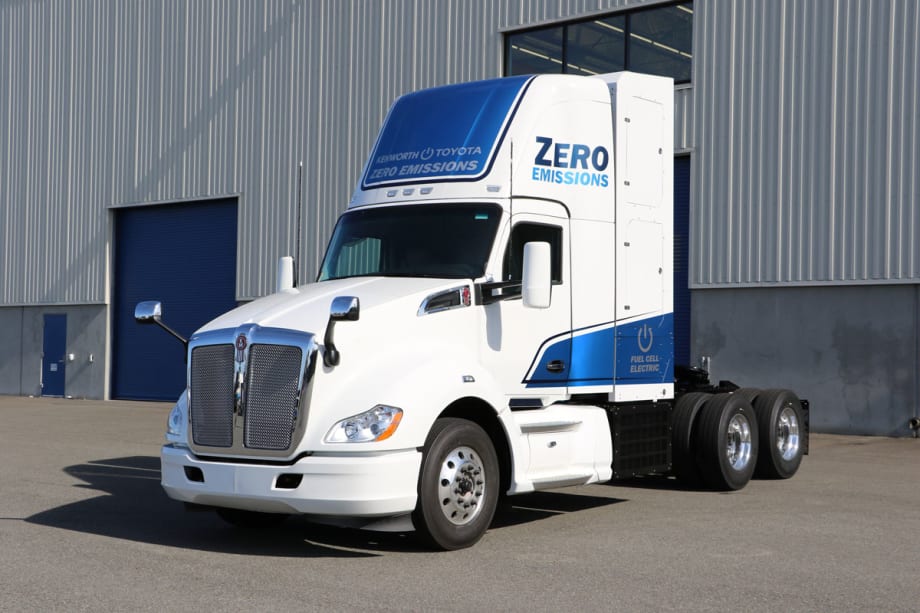
Kenworth is showcasing a zero-emissions hydrogen fuel cell truck at NACV.
Photo courtesy Kenworth
4 min to read
Although heavy-duty trucks sales have slowed to more normal levels, Kenworth says it’s looking forward to 2020 being another good year, even as it continues to develop new products and technology at an unprecedented rate.
“The level of investment required today, whether it’s greenhouse gas reduction or emerging powertrain technology or the march toward autonomous, the rate of product development is the fastest I’ve ever seen I grew up as an engineer in Paccar,” said Kevin Baney, who recently took on the general manager job at Kenworth after a 25-year career with Paccar, talking to reporters at the North American Commercial Vehicle Show in Atlanta on Oct. 27.
He said he has never seen the amount of investment that’s being poured into the industry today to meet current customer demands and develop future technology such as advanced driver assistance systems and alternative powertrains.
Baney noted that many economic indicators, including consumer confidence, truck tonnage, and construction spending, continue to remain at high levels, reflecting an overall strong economy. The one indicator that bears watching, however, is the PMI, which for the first time since 2016 has contradicted for two months in a row.
Looking at the truck sales market, Baney said Kenworth expects Class 8 sales for combined U.S. and Canada to come in between 310,000 and 320,000 for the year, the second highest in history.
However, the company expects 2020 Class 8 sales to drop down to a more average level of 230,000 to 260,000 Class 8 trucks.
In preparation for this, the company lowered its build rates and has dropped its workforce by about 100 people, much of that handled through natural attrition rather than sudden layoffs.

Kenworth GM Kevin Baney speaks to reporters at the North American Commercial Vehicle Show.
Photo: Deborah Lockridge
While the last few months of Class 8 orders have been lower than normal, Baney said that after meeting with some 40 fleets during th American Trucking Associations’ annual Management Conference and Exhibition earlier this month, “I think they are starting to make their decisions for next year. The last few weeks we’ve seen more activity, so I think we’ll see order intakes swing up.”
One bright spot is that vocational sales are still strong he said, with housing markets still strong in many areas of the country and anticipation of an infrastructure spending bill.
On the medium-duty side, Class 6-7 for U.S. and Canada is projected to end the year at 105,000 and be about 90,000 to 110,000 for 2020. “Medium-duty is a very strong market; we anticipate that to continue next year as well.”
When asked what other economic indicators bore watching, Baney said the used truck market.
Working on Zero Emissions
Zero-emission powertrains are a key part of what Kenworth and sister Paccar company Paccar are exhibiting in Atlanta, with Kenworth showing off one of the hydrogen fuel cell electric day cabs it’s been working with Toyota on.
Kenworth and Toyota are collaborating to develop 10 zero-emission Kenworth T680s powered by Toyota hydrogen fuel cell electric powertrains.
The effort is part of a $41 million Zero and Near-Zero Emissions Freight Facilities (ZANZEFF) grant awarded by the California Air Resources Board, with the Port of Los Angeles as the prime applicant.
So far, the Kenworth assembly plant in Renton, Washington, has produced four hydrogen fuel cell electric vehicles (FCEVs) – with a fifth truck now in production.
Kenworth provides the T680 chassis and cab, motors, transmission, and cooling systems, and delivers overall FCEV integration. Toyota provides fuel cell stacks, hydrogen tanks, load balancing batteries, and other components necessary to deliver the high voltage to the motors, in addition to the controls for that power.
The program’s first FCEV to enter real-world service will go to Toyota Logistics Services by year-end for operation at the Los Angeles ports. The full contingent of 10 FCEVs is expected to enter operation in the ports and Los Angeles basin 2020, and will be placed into service by UPS, Toyota Logistics, TTSI and Southern Counties Express.
Baney explained that the fuel-cell trucks built so far are in high demand, making appearances at trucking industry events such as the NACV Show and as part of Toyota promotional efforts, but at the same time they are working to put testing miles on them.
Already, he said, as later iterations of the 10 are being built, engineers are already tweaking th design. “We’re already getting to second and third generation technology, whether it’s motors or hydrogen tanks, they’re being developed as it goes,” Baney said. “The intent is to develop and prove the technology and develop the business case.”
Asked how the hydrogen fuel cell project positions Kenworth to meet California Air Resources Board proposed regulations that would require a certain percentage of a manufacturer’s trucks to be zero emissions, Baney said, those proposals “continue to change.” However, noting the high cost of battery technology, “Our position is there will still have to be subsidies in order for customers to run battery-powered trucks.”
On the hydrogen fuel cell side, he noted, fueling infrastructure is a challenge, just as it was for natural gas trucks.
Baney also said Kenworth continues to offer natural gas powertrains. “Our philosophy is we will build what our customers need until they don’t ned it. We still see customer demand; UPS is an example, they are still buying high volumes of natural gas trucks.”
More Equipment

How Volvo Updated Its D13 for EPA 2027 [Watch]
Volvo’s updated D13 promises lower emissions without sacrificing performance or fuel economy. Take a closer look at what changed inside the engine in this HDT Spotlight video.
Read More →
Michelin Tire Improves Efficiency and Durability for Regional Fleets
The Michelin X Multi Energy D2 is a regional haul drive tire engineered to help fleets improve fuel efficiency, durability and traction in demanding stop-and-go operations.
Read More →
ZF Expands Commercial Vehicle Push in North America
ZF is expanding its North American commercial-vehicle presence with new transmission applications, electrification, trailer technology and autonomous-driving systems.
Read More →
Tesla Wants a Self-Driving Semi. Are Cameras Enough?
Could Tesla’s camera-only autonomous driving technology work on an 80,000-pound Semi? In this commentary, HDT's Deborah Lockridge takes a look at Tesla, Cybercab, and how autonomous trucks see the road.
Read More →
Kodiak: Driverless Long-Haul Truck Launch on Track for 2026
Kodiak AI says its driverless long-haul safety case is 93% complete and it remains on track to begin commercial operations by year-end 2026.
Read More →
What DOT’s Automated Vehicle Strategy Means for Trucking
The U.S. Department of Transportation issued a new automated-vehicle strategy that outlines plans for driverless-truck regulations, cross-state freight corridors, and federal safety standards.
Read More →
East Coast Port Launches $45M Electric Truck Push
The Port Authority of New York and New Jersey announced millions in incentives for zero-emission drayage trucks, yard tractors, and new charging hubs near the port.
Read More →
PlusAI Going Public to Fund Autonomous Truck Launch
A SPAC deal could provide PlusAI with up to $300 million as it works toward a 2027 commercial launch of factory-built autonomous trucks.
Read More →
NHTSA Moves to Rewrite Truck Fuel-Economy Rules
The National Highway Traffic Safety Administration says it lacks authority to regulate medium- and heavy-duty truck engines separately from complete vehicles, but the existing standards have not yet been eliminated.
Read More →
Detroit Opens Orders for EPA 2027 Engines
Detroit isn’t starting from scratch to meet EPA 2027 diesel emissions standards. Its Gen 6 DD13 and DD15 engines keep much of today’s platform while updating the fuel and aftertreatment systems.
Read More →