





Related: Jacobs Partners with Tula on Cylinder Deactivation Technology
Jacobs Vehicle Systems Launches Nationwide Tech Tour
A Jacobs Vehicle Systems truck, loaded with technological enhancements to promote better fuel consumption, reduce harmful emissions and improve engine braking capabilities, is now touring North America.
November 11, 2019
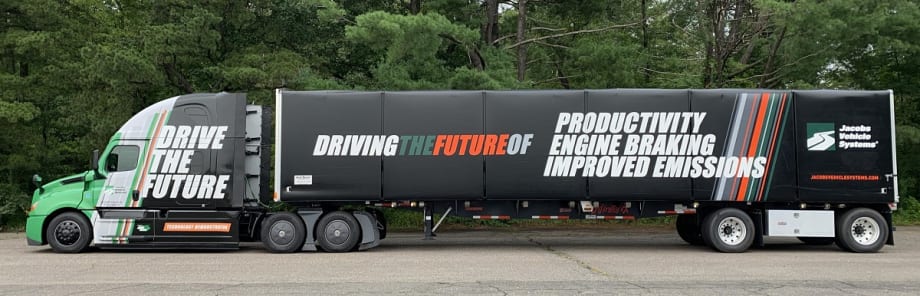
Enhancements on the Jacob's Freightliner Cascadia show truck include patented High Power Density (HPD) technology and Active Decompression Technology (ADT) that the company will be showcasing to trucking industry OEM executives, fleets, dealers and service providers throughout the U.S. and Canada.
Photo: Jacobs Vehicle Systems
2 min to read
Jacobs Vehicle Systems, has launched its North American Technology Tour, which will feature a new demonstrator truck equipped with technological enhancements to promote better fuel consumption, reduce harmful emissions and improve engine braking capabilities.
The enhancements on the Freightliner Cascadia show truck include Jacobs’ patented High Power Density (HPD) technology and Active Decompression Technology (ADT) that Jacobs will be showcasing in 2020 to trucking industry OEM executives, fleets, dealers and service providers throughout the U.S. and Canada.
“The tour will essentially provide representatives from all stakeholders in trucking an opportunity to experience firsthand Jacobs’ newest transportation solutions,” said Steve Ernest, vice president, engineering and business development for Jacobs. “With these new technologies, we want to show as many people as possible how far Jacobs has come to support the ever-changing demands of contemporary trucking.”
HPD provides a host of upgrades over traditional engine brakes, Jacob s engineers say, primarily centered on the modern-day need for increased retarding demands to compensate for lower engine operating speeds, smaller displacement engines, and decreased aerodynamic drag and decreased rolling resistance common with most of today’s trucks. Additional HPD highlights include:
Double the braking power at cruise speeds.
Quicker up-shifting for better acceleration and hill climbing.
Promotes faster trip times and increased productivity.
Increased driver confidence and comfort.
Improved service brake life.
Reduces the need for downshifting by providing power at the normal operating engine speed.
According to Jacob’s engineers, ADT operates to offset complications associated with anti-idling regulations by improving engine operation during startup and shutdown. This creates a more comfortable driver experience and helps reduce emissions and fuel consumption associated with idling. Additional ADT highlights include:
Eliminates engine-shutdown-induced cabin vibration.
Improves cold starting.
Reduces starter system wear.
Increases engine cranking speed for easier start-ups.
Cost-effective design that easily integrates onto multiple engine platforms.
Complements start-stop fuel savings strategies.
More Fuel Smarts

How Volvo Updated Its D13 for EPA 2027 [Watch]
Volvo’s updated D13 promises lower emissions without sacrificing performance or fuel economy. Take a closer look at what changed inside the engine in this HDT Spotlight video.
Read More →
Diesel Price Spike Shortens Payback for Natural Gas Trucks, Report Says
Energy Vision estimates fleets could recover the higher purchase price of an RNG-fueled Class 8 tractor in 1.3 to 2.8 years under current fuel-price scenarios.
Read More →
Calstart Becomes Catalyst Mobility, Reflecting Broader Focus
Calstart is now Catalyst Mobility, reflecting the nonprofit’s growing national role in clean transportation, including zero-emission trucks, infrastructure and incentive programs.
Read More →

Record Diesel Prices Squeeze Trucking Fleets
Average U.S. diesel prices have climbed to nearly $6 a gallon, surpassing the 2022 record as tight refinery capacity and Middle East disruptions keep fuel costs elevated.
Read More →
Sponsored•September 9, 2026
How Fuel Delivery Shapes Engine Performance
Fuel delivery depends on more than what happens at the injector. For fleet, maintenance and technical professionals, looking at the full path from pump to injector can provide useful context for understanding engine performance.
Read More →
East Coast Port Launches $45M Electric Truck Push
The Port Authority of New York and New Jersey announced millions in incentives for zero-emission drayage trucks, yard tractors, and new charging hubs near the port.
Read More →
California Bill Could Shed Light on Electric Truck Prices
Why do battery-electric Class 8 trucks remain so expensive? A California bill headed to Gov. Gavin Newsom would give fleets and state agencies more visibility into what manufacturers charge.
Read More →
Detroit Opens Orders for EPA 2027 Engines
Detroit isn’t starting from scratch to meet EPA 2027 diesel emissions standards. Its Gen 6 DD13 and DD15 engines keep much of today’s platform while updating the fuel and aftertreatment systems.
Read More →
Zero-Emission Truck Corridor Planned for West Coast
California, Oregon, Washington, British Columbia and Baja California are coordinating plans for truck charging and hydrogen fueling from Canada to Mexico.
Read More →
A Closer Look at Kenworth’s Electric T880E Vocational Truck [Video]
Learn more about Kenworth's T880E battery-electric vocational truck at the Paccar Technical Center, including its range, applications, upfitting considerations, and PTO options, in this HDT Spotlight video.
Read More →