




Related: FMCSA Seeks Comment on Preempting California Rest Break Rules
J.B. Hunt Settles Truck Driver Wage Lawsuit for $15 Million
J.B. Hunt has reportedly settled a class-action driver wage lawsuit for $15 million after fighting the claims for more than a decade, a suit that has been cited in recent debates over when federal rules regarding driver work should pre-empt state regulations.

Steven Martinez・Web Editor
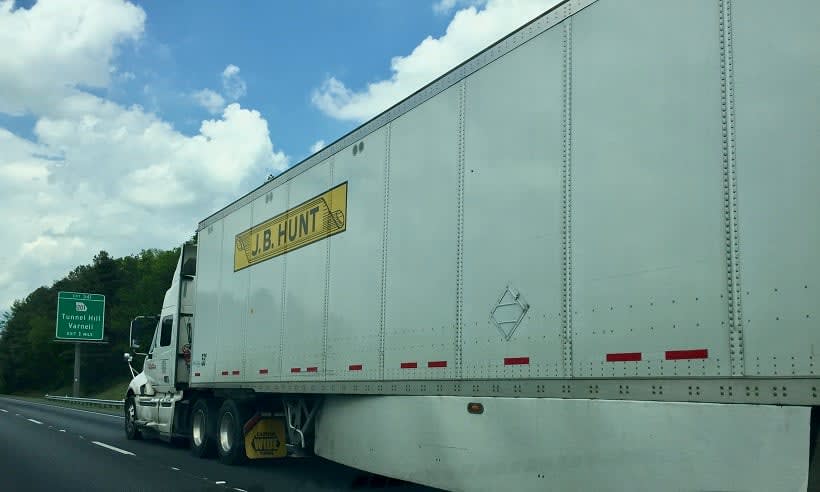
After failing to get the Supreme Court to hear its appeal, J.B. Hunt has settled a class-action lawsuit from drivers that claimed the company violated California's wages, rest break and meal rules.
Photo: Deborah Lockridge
3 min to read
J.B. Hunt has reportedly settled a class-action driver wage lawsuit for $15 million after fighting the claims for more than a decade, a suit that has been cited in recent debates over when federal rules regarding driver work should pre-empt state regulations.
The lawsuit was filed in 2007 over allegations that J.B. Hunt improperly skirted California’s meal and rest break rules and minimum wage laws for employees working in the state. The class-action represented as many as 11,000 J.B. Hunt employees.
J.B. Hunt has not commented to HDT, or anyone else it seems, on the settlement. But David Heller, vice president of government affairs for the Truckload Carriers Association, told HDT that the recent development highlights the need for a single regulation for transportation companies working in interstate commerce that supersedes individual state rules.
“This is a case that has cost J.B. hunt $15 million just to settle, to say nothing of what it cost in litigation getting to this point,” said Heller. “It shows you that this is becoming an even greater problem than originally anticipated, and right now it seems to start affecting the larger carriers and is somewhat trickling down to the mid-size carriers.”
California’s rules would be hard for the average driver paid by the mile to follow. They require employers to provide employees with a 30-minute meal break after five hours if the employee is on duty for more than six hours in a day. They also include provisions for a second 30-minute break during a work day longer than 12 hours and on-the-clock 10 minute breaks accrued every four hours. Also at stake were claims that employees were not paid for required activities, such as paperwork, potentially violating minimum wage laws in the state.
A district court initially ruled in favor of J.B. Hunt, saying that the lawsuit’s claims were preempted by the Federal Aviation Administration Authorization Act, which was enacted in 1994 to prevent state and municipal governments from undermining federal deregulation of interstate trucking, according to J.B. Hunt’s petition to the Supreme Court. That initial judgement was later overruled by the Ninth Circuit Court of Appeals. At the urging of trucking interest groups like California Trucking Association and American Trucking Associations, J.B. Hunt later petitioned the Supreme Court to overturn the Ninth Circuit judgement but was denied.
“J.B. Hunt was following the federal hours-of-service regulations. There is a difference between those state breaks and what is basically a federal rule in which the majority of carriers on our roadways operate,” said Heller.
Groups such as TCA have tried to get legislation passed that would clarify that federal rules take precedent over state rules in the transportation industry, most recently through the Dehnam Amendment attatched to the latest FAA reauthorization Act, but it has been unsuccessful so far.
“We advocate for that one federal rule and have done so on the Hill,” said Heller. “There is a petition at FMCSA right now that would hopefully federally pre-empt some of these state meal and rest breaks because, quite frankly, there’s not a need for it. Interstate trucking is a different beast altogether.”
"Trying to keep track of 20 separate meal breaks and seven different rest breaks that are different from the federal HOS regulations is quite unproductive to say the least, which is why we have one federal standard, and it should be that one federal standard that is enforced for truckers across the country."
More Fleet Management

Sponsored•September 16, 2026
Color Match Smarter: Tools That Restore & Perform
For fleet managers and collision repair professionals keeping heavy-duty trucks on the road, getting the color right the first time isn't just about appearance — it's about efficiency, turnaround time, and bottom-line results. Discover how today's digital color tools are transforming the repair process from guesswork to precision.
Read More →
FMCSA Pauses Biennial-Update Enforcement Amid Motus Transition
Carriers whose updates were due on or after June 1 have more time, while FMCSA works to stabilize its new registration system and warns of phishing sites impersonating its new carrier registration system, Motus.
Read More →
Sponsored•September 14, 2026
2026 Blueprint for Countering Smarter Supply Chain Theft
Cargo theft is no longer just the cost of doing business. It's a multi-billion-dollar criminal enterprise exploiting vulnerabilities across your fleet, drivers, and supply chain.
Read More →


Sponsored•September 1, 2026
How Telematics Improves Visibility, Control, and Performance in Refrigerated Fleets
Explore how telematics help refrigerated fleets improve visibility, uptime, efficiency, compliance, and cargo protection across connected cold chain operations.
Read More →
What the U.S.-Canada Trade War Means for Trucking
Escalating U.S.-Canada tariffs could disrupt cross-border freight, reduce truck volumes, raise costs, and create new uncertainty for carriers on both sides of the border.
Read More →
What Are Trucking’s Top Concerns for 2026?
The American Transportation Research Institute wants to know what's worrying trucking fleet managers, drivers, and other stakeholders in its annual Industry Issues survey.
Read More →
American Trucking Associations Looks for a New Leader
ATA President and CEO Chris Spear abruptly left his job at the association on August 21, at a pivotal time for the trucking industry.
Read More →
Public Wi-Fi Cybersecurity Risks: How Truck Drivers and Fleets Can Protect Their Data
Public Wi-Fi can expose truck drivers and fleets to credential theft, malware, and other cyber threats. Here’s how to reduce the risk on the road.
Read More →
For Nicky Cupp, Fleet Innovation Starts With Frustration
HDT Truck Fleet Innovator Nicky Cupp turns everyday pain points at Fraley & Schilling into opportunities for better technology and smarter processes.
Read More →
Adam Buttgenbach’s Approach to Electric Trucks: Start With Where They Fit
HDT Truck Fleet Innovator Adam Buttgenbach helped PepsiCo build one of North America’s largest EV fleets by focusing on where electric trucks make operational sense.
Read More →