





Related: Spot Rates Recede from Record Highs
Is the Capacity Crunch Slowing?
Market numbers point to a turning point in the capacity crisis, says Noel Perry.
August 6, 2018
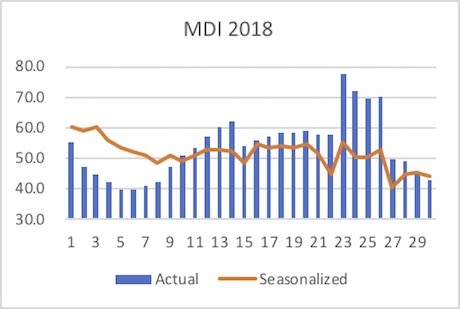
Graph courtesy Transport Futures
3 min to read
Market numbers point to a turning point in the capacity crisis, says Noel Perry.
In two recent entries in his Transport Navigator blog, he tells subscribers that changes in the spot and contract market tracked by Truckstop.com is a leading indicator of changing market conditions.
Perry has been consulting on the freight market since 2008 and has provided insight and forecasts in the past for firms such as FTR and Schneider.
A few weeks ago, on July 10, Perry wrote about the four consecutive weeks of elevated numbers for dry vans in Truckstop.com’s Market Demand Index.
“The change has been coincident with the normal spring safety enforcement period, suggesting a strong enforcement effect. While there is likely some fire to go with that smoke, we need to look more carefully before concluding that the market has moved to a new and more dramatic level of tightness.”
Consulting rate statistics, he explained, did not show the same type of dramatic movement. While “one must conclude that prices are quite high, almost fifty cents per mile above a year ago…They are not, however, moving farther upward in a convincing fashion.” In fact, he said, “one can justifiably suggest that most of the 2018 movement in rates has been seasonal.”
And in fact, he said, if you “seasonalize” the dry van spot rates, the “capacity crisis” actually peaked in January.
Looking at contract rates, which lag behind spot rates, Perry noted that after rising only modestly for much of 2017, contract rates have taken off in 2018 and apparently have not peaked yet. Such double-digit increases have occurred only one other time since 2000: in 2004, the other great capacity event.
By last week, on August 3, Perry said looking at the seasonalized Market Demand Index, he could see three distinct periods for the year. The first featured falling readings as the market settled down, after peaking at the time of the beginning of the electronic logging device (ELD) mandate. The market established a new, roughly flat trend through the middle spring as participants were testing the effects of ELD enforcement.
However, since Week 20, roughly Memorial Day, there has been a new and declining trend. (The bump-ups in weeks 23 and 26 have to do with the timing of holidays, not sustained market dynamics.) Since the current trend started 10 weeks ago, the Index has lost almost 20% of its value, he said.
“I conclude that we have reached a turning point in the current capacity crisis," he wrote. "Ten weeks and the 20% drop are more than enough to substantiate that conclusion. This development is entirely consistent with the cessation of new regulation. Only the very strong economics in the second quarter have kept the decline from being more dramatic.”
Of course, spot market data is a leading indicator.
“History tells us that spot prices lag capacity measures by three to six months. We should also conclude that same downward pressure will eventually impinge on contract pricing, perhaps with a further lag of six months,” he wrote. “Things will happen in contract pricing, caused by the same market forces, but not until later.”
The upshot? Perry predicts that “pricing will remain strong even though the capacity fundamentals are softening. This means that short-term operating plans, still dealing with robust pricing, will be at odds with planning, which must account for weaker pricing (and volumes).”
Perry's Transport Navigator blog is written under the banner of his Transport Futures consultancy firm and is available by subscription only.
More Fleet Management

Sponsored•September 16, 2026
Color Match Smarter: Tools That Restore & Perform
For fleet managers and collision repair professionals keeping heavy-duty trucks on the road, getting the color right the first time isn't just about appearance — it's about efficiency, turnaround time, and bottom-line results. Discover how today's digital color tools are transforming the repair process from guesswork to precision.
Read More →
FMCSA Pauses Biennial-Update Enforcement Amid Motus Transition
Carriers whose updates were due on or after June 1 have more time, while FMCSA works to stabilize its new registration system and warns of phishing sites impersonating its new carrier registration system, Motus.
Read More →
Sponsored•September 14, 2026
2026 Blueprint for Countering Smarter Supply Chain Theft
Cargo theft is no longer just the cost of doing business. It's a multi-billion-dollar criminal enterprise exploiting vulnerabilities across your fleet, drivers, and supply chain.
Read More →


Sponsored•September 1, 2026
How Telematics Improves Visibility, Control, and Performance in Refrigerated Fleets
Explore how telematics help refrigerated fleets improve visibility, uptime, efficiency, compliance, and cargo protection across connected cold chain operations.
Read More →
What the U.S.-Canada Trade War Means for Trucking
Escalating U.S.-Canada tariffs could disrupt cross-border freight, reduce truck volumes, raise costs, and create new uncertainty for carriers on both sides of the border.
Read More →
What Are Trucking’s Top Concerns for 2026?
The American Transportation Research Institute wants to know what's worrying trucking fleet managers, drivers, and other stakeholders in its annual Industry Issues survey.
Read More →
American Trucking Associations Looks for a New Leader
ATA President and CEO Chris Spear abruptly left his job at the association on August 21, at a pivotal time for the trucking industry.
Read More →
Public Wi-Fi Cybersecurity Risks: How Truck Drivers and Fleets Can Protect Their Data
Public Wi-Fi can expose truck drivers and fleets to credential theft, malware, and other cyber threats. Here’s how to reduce the risk on the road.
Read More →
For Nicky Cupp, Fleet Innovation Starts With Frustration
HDT Truck Fleet Innovator Nicky Cupp turns everyday pain points at Fraley & Schilling into opportunities for better technology and smarter processes.
Read More →
Adam Buttgenbach’s Approach to Electric Trucks: Start With Where They Fit
HDT Truck Fleet Innovator Adam Buttgenbach helped PepsiCo build one of North America’s largest EV fleets by focusing on where electric trucks make operational sense.
Read More →