




Industry Applauds Fuel Economy Policy
Trucking company and truck maker leaders are on board with the policy President Obama signed last week calling on two federal agencies to develop national standards for fuel economy and greenhouse gas emissions for medium and heavy trucks. "This will bring down costs for transporting goods, serving businesses and consumers alike," Obama said. "We estimate that we can increase fuel economy by as much as 25 percent in tractor-trailers using technologies that already exist.
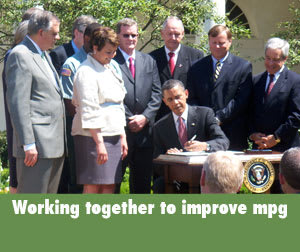
Trucking company and truck maker leaders are on board with the policy President Obama signed last week calling on two federal agencies to develop national standards for fuel economy and greenhouse gas emissions for medium and heavy trucks.
"This will bring down costs for transporting goods, serving businesses and consumers alike," Obama said. "We estimate that we can increase fuel economy by as much as 25 percent in tractor-trailers using technologies that already exist."
On the stage with the president at the May 21 Rose Garden ceremony were chief executives from major manufacturers, as well as the trucking industry, signaling broad industry support for the new policy.
On hand were Martin Daum, president and CEO of Daimler Trucks North America, Dennis Slagle, president and CEO of Volvo North American Trucks, Tim Solso, CEO of Cummins, Daniel Ustian, president and CEO of Navistar, G. Tommy Hodges, chairman of the American Trucking Associations, and Anthony Dunkley, a driver for Waste Management.
2014 Target Date
Under the agreement, the Environmental Protection Agency and the National Highway Traffic Safety Administration will work together to produce rules covering emissions and fuel standards, respectively, that will start to take effect in the 2014 model year.
Both the fuel economy standard and the emissions standard will come in the form of proposed rules that are open to comments from the public. The Presidential Memorandum Obama signed calls for the rule to be ready by July 30, 2011.
Truck and engine manufacturers have been working with EPA for a year and a half to craft a workable plan. Details of what the agencies will propose are yet to be revealed but the principles of the program were outlined in a May 18 letter to Transportation Secretary Ray LaHood and EPA Administrator Lisa Jackson from Martin Daum of Daimler Trucks.
The new standards will start in 2014 and be fully implemented by 2018, and the program will be designed to increase the use of existing technologies to reduce greenhouse gas emissions and improve fuel economy.
Low-Hanging Fruit
On this point, the industry's expectation is that the technologies that are familiar to participants in EPA's SmartWay program will be used in this program - improved aerodynamics and low rolling resistance tires, for instance, according to Allen Schaeffer, executive director of the Diesel Technology Forum.
Depending on the measurement metrics and baselines used in the standards, emissions could be cut by as much as 20 percent and fuel economy improved by as much as 25 percent. Daum noted that the agencies' preliminary analysis indicates the program could save up to 500 million barrels of oil over the lifetime of the vehicles built between 2014 and 2018, and achieve about $70 billion in fuel savings.
The program will establish standards that recognize trucking's needs and the demands of heavy-duty applications. This includes recognition of technology improvement opportunities for the entire vehicle and its operations, the need to be compatible with the complexities of the market and the need to avoid unintended consequences, Daum wrote.
Another principle calls for incentives for early introduction of advanced technologies, such as the tax incentives now used to promote the purchase of hybrid and electric trucks.
Working With Industry
"Our company is committed to working with EPA and NHTSA, the states, and other interested parties to help address three of the most pressing issues facing the U.S. today and into the future: greenhouse gas reductions, fuel efficiency improvements, and increased energy security," Daum wrote.
American Trucking Associations President and CEO Bill Graves said the association has been supporting development of fuel economy standards. "Reducing fuel consumption and CO2 production is good for the trucking industry and great for the environment," he said. ATA Chairman Tommy Hodges, who was chairman of the ATA Sustainability Committee that in 2008 offered truck fuel economy standards and other recommendations to reduce fuel consumption by 86 billion gallons over a 10-year period, said he's excited to see the administration moving forward.
A sampling of manufacturer statements issued following the announcement:
Denny Slagle of Volvo and Mack Trucks: "We fully support the provisions that any such standards applicable to medium- and heavy-duty vehicles must be established in a way that recognizes the commercial needs of the trucking industry."
Solso of Cummins: "Cummins recognizes the need for a consistent and responsible set of standards to address the threat of greenhouse gas emissions and to reduce our nation's dependence on fossil fuels. We are committed to working with regulators, our customers and others in the industry to achieve these important environmental improvements."
Jed Mandel, President of the Engine Manufacturers Association: "The program and principles announced today clearly will advance the nation's efforts to reduce GHG emissions and improve fuel efficiency. We are delighted to be part of the solution."
Alan Schaeffer of the Diesel Technology Forum: "Today's announcement highlights the prominent role of clean diesel technology to improve fuel efficiency and reduce greenhouse gas emissions in commercial trucks. Diesel engines offer an unmatched combination of energy-efficiency, work capability, reliability and now near-zero emissions environmental performance making them the technology of choice for commercial trucks today and into the foreseeable future."
More Drivers

Truck Drivers Need More Than Another Alert
Fleets have more visibility into truck health, safety events, and driver activity than ever. The next challenge is turning all that information into useful guidance for the person who has to decide what to do next.
Read More →
FMCSA Removes 110 Truck Driver Training Schools from Certified ELDT List
Federal regulators also are targeting more than 160 additional training providers and launching a nationwide audit of third-party CDL skills testers as part of a broader crackdown on trucking fraud.
Read More →
Hours of Service Pilot Programs: FMCSA Readies for 2027 Rollout
Two pilot programs could eventually reshape hours-of-service rules, giving truck drivers options to pause their 14-hour clock or use longer split sleeper rest periods.
Read More →
Medical Cards, English Proficiency Reshape Roadcheck Violations
Medical-card violations jumped to the top of the driver out-of-service list during CVSA’s 2026 International Roadcheck, while English-language proficiency violations appeared among the leading violations for the first time.
Read More →
Driver Trust Can Make or Break the Success of Fleet Safety Technology
New Teletrac Navman research suggests that onboarding, transparency about driver data, and positive feedback can play a significant role in how commercial drivers respond to safety and coaching technology.
Read More →
EEOC Sues KLLM Over Alleged Sex Discrimination in Driver Training
KLLM is facing a federal sex-discrimination lawsuit over policies the EEOC alleges put female truck driver trainees at a disadvantage.
Read More →
FMCSA Moves to Codify English Language Requirements for Commercial Drivers
By changing regulations on English-language proficiency requirements for commercial drivers, rather than relying on a guidance memo, the FMCSA said future administrations won't be able to walk back the Trump administration's stricter enforcement with just a memo.
Read More →
Drivers Put Western Star Trucks to the Test at Star Nation Experience
Watch to get an inside look at the Western Star trucks, technology, and community behind the Star Nation Experience 2026!
Read More →
Trump Administration Looks to Put More Veterans Behind the Wheel
The Freedom Haulers program pulls together existing and expanded programs at several federal agencies to recruit veterans to drive commercial heavy-duty trucks and cut the red tape for them to get a CDL, training, and employment.
Read More →
Putting Mack’s Command Steer to the Test
A test drive of Mack’s Command Steer active steering system evaluates how it can make truck driving easier and less tiring.
Read More →